The 2026 SaaS HR Software Buyer's Guide: 20 Top Platforms Ranked
Need HR SaaS software that actually fits? Our 2026 buyer's guide ranks 20 top HR software companies with real pricing, implementation insights, and unbiased recommendations.

Choosing the right HR software can make or break your team's productivity—and your employees' experience. With dozens of HR SaaS platforms competing for your attention (and budget), finding the right fit requires more than a quick Google search.
This guide cuts through the marketing noise. We've evaluated 20 of the best SaaS HR software platforms on the market, breaking down who each one is built for, what they do well, and where they fall short. Whether you're a 50-person startup or a 5,000-employee enterprise, you'll find options worth considering.
What Is HR SaaS?
HR SaaS (Software as a Service) refers to cloud-based human resources platforms delivered over the internet on a subscription basis. Unlike legacy on-premises systems that require servers and IT maintenance, SaaS HR software runs in the cloud—offering automatic updates, accessibility from anywhere, and typically lower upfront costs.
Modern HR SaaS platforms typically bundle several functions together:
- Core HR & Employee Records – Centralized employee data, org charts, and document management
- Payroll & Tax Administration – Automated pay runs, tax filings, and compliance
- Benefits Administration – Health insurance enrollment, 401(k) management, and open enrollment workflows
- Time & Attendance – Clock-in/out tracking, PTO management, and scheduling
- Talent Management – Performance reviews, goal setting, learning, and succession planning
- Recruiting & Onboarding – Applicant tracking, offer letters, and new hire workflows
The best platforms integrate these modules into a unified experience. The worst make you jump between disconnected systems that don't talk to each other.
How We Evaluated These Platforms
At OutSail, we advise hundreds of companies each year on HR technology decisions. Our assessments are based on:
- Product demos and hands-on evaluations of each platform
- Implementation feedback from companies we've helped through selection and deployment
- Ongoing client relationships that reveal how platforms perform after the honeymoon phase
- Vendor briefings where we get updates on roadmaps and new features
- Pricing data from actual customer contracts (not just list prices)
We don't accept pay-for-placement or affiliate fees that could bias our recommendations.
Enterprise HR SaaS Platforms
These platforms are built for organizations with 1,000+ employees, sophisticated HR needs, and the budget to match. Expect longer implementations, higher costs, and more configurability.
Workday
Best for: Large enterprises (2,500+ employees) wanting a modern, unified HCM platform
Pricing: $28–42 per employee per month (PEPM)
Workday has become synonymous with enterprise HR for good reason. The platform offers an intuitive interface that executives actually enjoy using, paired with robust talent management, workforce planning, and analytics. Their Fortune 500 client roster speaks to the platform's scalability and security.
Strengths:
- Market-leading user experience among enterprise HCM platforms
- Strong talent management including performance, succession, and learning
- Powerful reporting and people analytics with Workday Illuminate AI features
- Excellent financial planning integration for those also using Workday Financials
Limitations:
- Recruiting module (Workday Recruiting) doesn't compete with best-in-class ATS platforms
- Premium pricing puts it out of reach for many mid-market companies
- 80%+ of implementations go through partners, adding complexity and cost
What's new in 2026: Workday has introduced more aggressive mid-market pricing with streamlined 3-4 month deployment options, making them competitive below their traditional enterprise sweet spot.
Dayforce
Best for: Companies needing real-time payroll data and strong global capabilities
Pricing: $24–38 PEPM
Dayforce (formerly Ceridian Dayforce) delivers what might be the most powerful core HR and payroll engine on the market. Their single-database architecture means changes made anywhere in the system reflect everywhere instantly—no batch processing or overnight syncs.
Strengths:
- Real-time, continuous payroll calculations let employees see accurate pay data anytime
- Industry-leading earned wage access through Dayforce Wallet (Daily Pay)
- Native global payroll processing in 20+ countries
- Strong workforce management for shift-based and hourly workforces
Limitations:
- Recent transition to private equity ownership creates some uncertainty about long-term direction
- Benefits administration requires more manual configuration than some competitors
- The depth of functionality means a steeper learning curve for administrators
What's new in 2026: Private equity firm took Dayforce private in late 2025, signaling potential changes ahead. Their continued investment in global capabilities and AI-powered workforce planning shows ambition beyond North America.
UKG Ready

Best for: Organizations with hourly workforces needing industry-leading time and attendance
Pricing: $20–31 PEPM
UKG Ready represents the evolution of UKG's product strategy, superseding UKG Pro as their flagship offering. Built on modern architecture with Kronos-heritage workforce management at its core, UKG Ready excels at managing shift-based, hourly workforces across multiple locations.
Strengths:
- Best-in-class time and attendance (Kronos legacy shines here)
- Single-database architecture avoids the integration headaches of older UKG Pro
- Recent front-end refresh improves daily user experience
- Strong compliance tools for complex labor law requirements
Limitations:
- Talent management modules still catching up to the workforce management strength
- The Kronos-UKG merger created service challenges that are still being worked through
- July 2024 layoffs (14% of workforce) created concerns about support capacity
What's new in 2026: UKG has been pushing hard to position Ready as their go-forward platform. Recent acquisitions (including Immedis for global payroll) expand capabilities beyond their traditional North American focus.
Read our full UKG Ready review
ADP Lyric
Best for: Global enterprises needing payroll across 140+ countries
Pricing: $30–45 PEPM
ADP Lyric represents ADP's answer to Workday and Dayforce in the enterprise space. Purpose-built for multinational organizations, Lyric handles global payroll complexity that few competitors can match.
Strengths:
- Unmatched global payroll coverage (140+ countries with native processing)
- ADP's decades of payroll expertise and compliance knowledge
- Modern user interface that breaks from ADP's legacy reputation
- Strong integration with existing ADP services for transitioning customers
Limitations:
- Relatively new platform still building out non-payroll functionality
- Premium pricing positions it firmly in enterprise-only territory
- ADP's multiple platform strategy (Lyric, Workforce Now, RUN) can create confusion
What's new in 2026: ADP continues investing heavily in Lyric's AI capabilities and expanding the talent management suite to compete more directly with Workday.
Read our full ADP Lyric review
Mid-Market HR SaaS Leaders
These platforms serve companies with 100–2,500 employees, balancing functionality and cost. Implementations typically take 2–4 months.
ADP Workforce Now
Best for: Mid-market companies prioritizing payroll reliability over cutting-edge features
Pricing: $22–35 PEPM
ADP Workforce Now is the default choice for mid-market companies who want payroll done right. With 1M+ employers on ADP payroll products, you're buying proven infrastructure and tax expertise.
Strengths:
- Rock-solid payroll processing backed by decades of experience
- Compensation benchmarking data from ADP's massive employer base
- Enhanced service tiers available for companies wanting more hands-on support
- Integration marketplace connects to hundreds of third-party tools
Limitations:
- User experience feels dated compared to modern competitors
- ADP's three different US platforms (RUN, Workforce Now, Lyric) slow down innovation
- Support quality varies significantly by service tier
- Platform rigidity limits customization for unique workflows
What's new in 2026: ADP revamped their mobile app and introduced new AI-powered insights features, though the core platform architecture remains largely unchanged.
Read our full ADP Workforce Now review
Paylocity

Best for: Mid-market companies wanting solid all-around HR tech with strong integrations
Pricing: $22–32 PEPM
Paylocity has emerged as a well-rounded mid-market leader, offering good-enough capabilities across HR, payroll, talent management, and workforce management. They're rarely the absolute best at any single thing, but they're competitive everywhere.
Strengths:
- Strong integration marketplace (one of the best in mid-market)
- Recently acquired Trace for position management and workforce planning
- Blue Marble partnership extends global payroll capabilities
- Workflow automation tools reduce administrative burden
Limitations:
- Smaller customers (under 100 employees) report service challenges
- Talent management is solid but doesn't differentiate against specialists
- Some advanced features require premium pricing tiers
What's new in 2026: Paylocity's acquisition of Trace strengthens their workforce planning story. Continued investment in their Community portal and mobile experience shows commitment to employee engagement.
Read our full Paylocity review
Rippling

Best for: Tech-forward companies wanting HR and IT unified in one platform
Pricing: $24–36 PEPM
Rippling has disrupted the HR tech market by recognizing that HR and IT onboarding are fundamentally connected. When you hire someone, they need both an employment record and a laptop with the right apps—Rippling handles both.
Strengths:
- Highest-rated user experience in the category (the product is genuinely beautiful)
- Unified HR and IT management (device management, app provisioning, SSO)
- 100+ pre-built integrations that actually work
- Global HR, payroll, and EOR capabilities for international teams
Limitations:
- Still a startup, which means occasional bugs and rapid changes
- Support is primarily chat-based; phone support requires higher spending tiers
- Payroll and benefits are now optional modules, changing the pricing equation
- Aggressive growth strategy has created some service growing pains
What's new in 2026: Rippling's modular approach now lets companies pick only the HR components they need. Their IT management capabilities continue to differentiate, especially for tech companies already invested in the Rippling ecosystem.
Paycom

Best for: Companies wanting a single vendor with everything built in-house
Pricing: $26–38 PEPM (20-30% premium vs. peers)
Paycom takes the opposite approach from Rippling's integration-heavy strategy. Everything is built in-house on a single database, which means tight integration between modules—but limited flexibility to swap in best-in-class point solutions.
Strengths:
- Single database means data flows seamlessly between all modules
- "Beti" self-service payroll reduces admin time by having employees verify their own pay
- Dedicated single point of contact for support (not round-robin)
- Modern user interface with "I Want" AI-powered search
Limitations:
- Premium pricing (typically 20-30% higher than mid-market peers)
- Poor integration with third-party tools by design
- All-or-nothing approach doesn't work for companies with existing tech investments
- Limited global capabilities (recently added Mexico and Canada)
What's new in 2026: Paycom continues pushing their single-vendor message. New AI features focus on automating administrative tasks that previously required HR intervention.
Paychex

Best for: Companies wanting the stability of a large provider with service options
Pricing: $20–32 PEPM
Paychex serves over 700,000 businesses, making them one of the largest HR SaaS providers by customer count. Their recent acquisition of Paycor brings additional mid-market talent management capabilities into the fold.
Strengths:
- Financial stability and scale (publicly traded, $5B+ revenue)
- Multiple service tiers from self-service to fully outsourced
- Retirement services integration (one of the largest 401(k) administrators)
- Broad geographic presence with local support options
Limitations:
- Product experience varies significantly across their multiple platforms
- Innovation pace has historically lagged more nimble competitors
- Paycor acquisition integration is still in progress
What's new in 2026: The Paycor acquisition adds best-in-class talent management (Paycor had acquired leading ATS and performance tools) and industry-specific capabilities for healthcare, manufacturing, and restaurants.
isolved
Best for: Companies wanting dedicated support without enterprise pricing
Pricing: $19–26 PEPM
isolved occupies an interesting middle ground—large enough to have financial stability and broad capabilities, but still operating with a more boutique, service-oriented approach than the mega-vendors.
Strengths:
- Dedicated point of contact (not round-robin support)
- Project managers assigned for implementations
- Strong benefits administration heritage (COBRA, HSA, FSA, retirement)
- Open integration approach with dedicated team for custom connectors
- Modular implementation lets you add capabilities over time
Limitations:
- Less revenue means less product investment than larger competitors
- User interface gets mixed reviews (described as click-heavy)
- Smaller customers sometimes report support frustrations
- Sweet spot is 50-350 employees; may struggle with high complexity
What's new in 2026: isolved continues investing in their network of regional partners who provide white-glove implementation and support. Their HCM Intelligence analytics platform has improved significantly.
Global HR SaaS Platforms
These platforms are built for companies with international workforces, whether through direct employment or contractor relationships.
Deel

Best for: Companies managing international contractors and global payroll
Pricing: $29–49 per contractor; $599+ per employee for EOR
Deel exploded onto the scene as the fastest-growing HR tech startup in history, built on a simple promise: hire anyone, anywhere, compliantly. They've since expanded from contractor management into full HRIS territory.
Strengths:
- Industry-leading contractor management across 160+ countries
- Global payroll and Employer of Record (EOR) services
- Recently added full HRIS capabilities through acquisitions
- Embedded payroll (via Check) and benefits admin (via Employee Navigator)
Limitations:
- CEO legal disputes in 2024-2025 created uncertainty about leadership
- Aggregator model for some countries raises compliance questions
- HRIS features are still maturing compared to native-built competitors
- Premium pricing for EOR services
What's new in 2026: Deel's acquisition spree continues building out their full-platform vision. The question is whether a contractor management company can successfully transform into a comprehensive HCM provider.
Remote

Best for: Companies building globally distributed teams with full compliance
Pricing: $29–49 per contractor; $599+ per employee for EOR
Remote competes directly with Deel in the global employment space, with a focus on owning their own entities rather than partnering with local providers. This gives them more control over the employment experience.
Strengths:
- Owned entities in 80+ countries (rather than partner network)
- IP protection and equipment management for distributed teams
- Competitive pricing for high-volume users
- Strong focus on compliance and employment law expertise
Limitations:
- HRIS capabilities are less developed than pure-play HCM vendors
- Smaller company than Deel with less market presence
- Limited integrations compared to established HR platforms
What's new in 2026: Remote continues expanding their entity coverage and recently launched enhanced benefits administration for international teams.
Personio
Best for: European companies wanting a modern, action-oriented HR platform
Pricing: $14–24 PEPM
Personio has become the leading HR platform for European companies, with offices in Madrid, Munich, London, and Dublin. Their design philosophy centers on helping HR teams take action, not just store data.
Strengths:
- Modern, action-oriented interface that guides users toward next steps
- Robust document management with templates and e-signatures
- 100+ integration marketplace
- HR helpdesk with built-in whistleblowing capabilities
Limitations:
- Payroll processing only in UK, Ireland, and Germany (integration-based elsewhere)
- All support teams are based in Europe (timing challenges for global teams)
- Best suited for European HQ companies
What's new in 2026: Personio continues expanding payroll coverage and recently enhanced their compensation management and people analytics features.
Darwinbox

Best for: Companies in Asia-Pacific wanting cutting-edge AI and mobile-first design
Pricing: $16–28 PEPM
Darwinbox emerged from India to become a leading HCM platform across Asia-Pacific, with recent expansion into the US and Europe. They're pushing boundaries on AI integration and mobile experience.
Strengths:
- Cutting-edge AI roadmap (one of the most aggressive in HCM)
- Mobile-first design that works beautifully on any device
- No-code automation builder for custom workflows
- 40+ languages supported
Limitations:
- Requires third-party integration for US payroll and benefits
- Support primarily based in India (time zone challenges)
- Less brand recognition in North America and Europe
- Average customer size (~2,000 employees) may not fit smaller organizations
What's new in 2026: Darwinbox continues their geographic expansion with new US partnerships and enhanced integrations with North American payroll providers.
Read our full Darwinbox review
Keka
Best for: Companies in India/APAC wanting affordable, modern HR tech
Pricing: $8–13 PEPM
Keka has built a strong following in India and is expanding into other markets with an affordable, feature-rich platform that punches above its price point.
Strengths:
- Excellent value for comprehensive HR capabilities
- Embedded Professional Services Automation (PSA) for project-based firms
- Strong localization for India and key APAC markets
- US payroll available via Check integration
Limitations:
- US payroll integration is still maturing
- EMEA localization catching up to APAC strength
- Smaller company with less global brand recognition
What's new in 2026: Keka continues expanding their US payroll capabilities and adding localization for European markets.
OmniHR
Best for: Distributed global companies (500–2,000 employees) in Southeast Asia
Pricing: $3–7 PEPM
OmniHR offers remarkable value for globally distributed companies, with particular strength in Southeast Asian markets. Their pricing makes them accessible to growing companies that can't afford enterprise platforms.
Strengths:
- Incredibly affordable all-in-one HR platform
- Strong Southeast Asia localization (Singapore, Malaysia, Indonesia, etc.)
- Free implementation included
- Dedicated support via Slack, WhatsApp, or Telegram
Limitations:
- Newer vendor with startup-scale operations
- Less mature than established global competitors
- BPO and FinTech industry focus may not translate to all sectors
What's new in 2026: OmniHR continues adding localization for new markets and recently enhanced their performance management module.
Small Business HR SaaS Platforms
These platforms serve companies with under 100 employees, prioritizing simplicity and affordability over configurability.
BambooHR

Best for: Growing companies (50–500 employees) wanting delightful HR software
Pricing: $12–20 PEPM
BambooHR built their reputation on user experience, and it shows. The platform is genuinely enjoyable to use—a rarity in HR software. They've expanded from core HR into payroll and benefits administration while maintaining that signature ease of use.
Strengths:
- Best-in-class user experience (the product people actually like using)
- Excellent customer support with helpful, knowledgeable team
- Recently added benefits administration and compensation management
- Strong core HR for employee records, time-off, and reporting
Limitations:
- Off-the-shelf approach limits customization for unique workflows
- Talent management features are lean compared to specialists
- Not built for complex payroll scenarios (multi-state, union, etc.)
- Outgrowing BambooHR often happens around 500 employees
What's new in 2026: BambooHR continues refining their payroll product and recently launched enhanced compensation management features.
Gusto
Best for: Small businesses (under 50 employees) wanting modern, simple HR
Pricing: $12–22 PEPM
Gusto brought consumer-grade design to small business HR and payroll. For companies without dedicated HR staff, Gusto makes it possible to handle payroll, benefits, and compliance without becoming an expert.
Strengths:
- Modern, intuitive interface that non-HR people can actually use
- Automated state tax registration and compliance
- Global contractor payments
- HR support services available as add-ons
- Strong app marketplace for specialized needs
Limitations:
- Can't support dedicated account representatives (support is queue-based)
- Basic timekeeping features (may need third-party tool for complex scheduling)
- Newer recruiting and performance tools are limited compared to specialists
- Not designed to scale beyond small business complexity
What's new in 2026: Gusto continues expanding their embedded payroll partnerships and recently enhanced their people advisory services for companies wanting HR guidance.
HiBob
Best for: Employee-centric companies prioritizing engagement and culture
Pricing: $18–28 PEPM
HiBob (the platform is called "Bob") is a modern HR platform (HRIS) that combines core HR, payroll, hiring, and talent management into a single system, while maintaining a strong focus on employee experience.
The result is an HR platform that employees actually want to interact with. The platform also includes AI embedded across everyday HR workflows to help reduce manual work and surface insights for HR teams and managers.
Strengths:
- Market-leading employee engagement, recognition, and social features
- Modern, visually appealing interface
- Strong global capabilities with offices in US, UK, Australia, and Tel Aviv
- Built-in applicant tracking system (Bob Hiring)
- Now offers native payroll in the US and UK, with additional support for other regions via integrations
Limitations:
- Recent price increases have pushed them toward premium positioning
- Payroll and benefits features are newer (integrated, not native-built)
- May be more than needed for companies not prioritizing culture features
What's new in 2026: HiBob's embedded payroll and benefits administration bring them closer to a full-platform offering, though they're still best known for engagement and core HR.
Specialized HR SaaS Platform
Miter

Best for: Construction, utilities, and field-service companies with prevailing wage complexity
Pricing: $16–24 PEPM
Miter built their platform specifically for field-heavy, project-based industries where standard HR software falls short. If you deal with prevailing wage, union requirements, certified payroll, or multi-state construction crews, Miter understands your world.
Strengths:
- Automated prevailing wage, union, and certified payroll compliance
- Native integrations with construction ERPs (Sage, Procore, Acumatica, Vista, Foundation)
- Modern interface designed for both field teams and back-office
- Fast implementations (1-2 months vs. 3-6 for general HCM)
Limitations:
- No talent management features (performance, goals, succession)
- Not designed for office-based/white-collar workforces
- Limited brand recognition outside construction industry
What's new in 2026: Miter continues expanding their integration ecosystem and recently added enhanced reporting for Davis-Bacon compliance.
How to Choose the Right HR SaaS Platform
With 20 solid options, the challenge isn't finding a good platform—it's finding the right one for your specific situation. Here's how to narrow it down:
Start with Your Non-Negotiables
Make a list of capabilities you absolutely must have. Common deal-breakers include:
- Global payroll – If you have employees in multiple countries, eliminate platforms that can't handle it
- Industry-specific compliance – Construction, healthcare, and manufacturing have requirements generic platforms miss
- Integration requirements – If you're keeping your existing ATS or benefits broker, the new platform must connect
- Budget constraints – Enterprise platforms aren't going to negotiate down to small business pricing
Consider Your Growth Trajectory
The platform that fits today might not fit in three years. Think about:
- Headcount growth – Will you cross thresholds that change your needs (100 employees, 500, 1,000)?
- Geographic expansion – Moving from domestic-only to international changes everything
- Complexity growth – Adding acquisitions, multiple EINs, or union workforces adds requirements
Evaluate the Vendor, Not Just the Product
Software demos show best-case scenarios. Ask about:
- Implementation approach – Who leads it? What's the timeline? What resources do you need to provide?
- Support model – Dedicated rep or ticket queue? Phone or chat only? Response time guarantees?
- Customer retention – What's their renewal rate? Why do customers leave?
- Financial stability – Private equity-backed vendors may prioritize different things than public companies
Get References from Similar Companies
A platform that works brilliantly for a 5,000-person tech company might struggle with a 200-person manufacturer. Ask vendors for references that match:
- Your industry
- Your company size
- Your complexity level
- Your geographic footprint
Pricing Comparison: What to Actually Expect
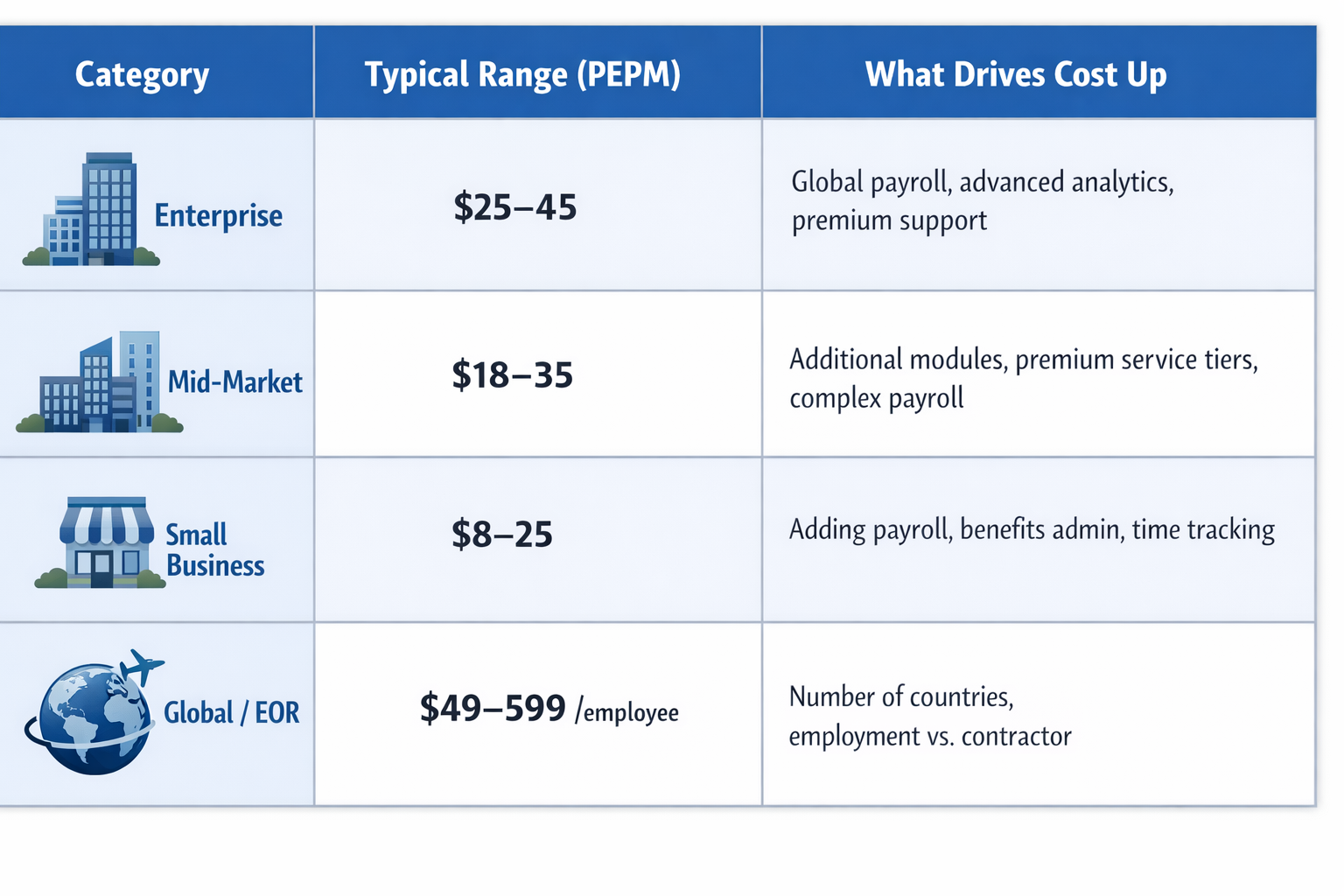
Published pricing rarely reflects what companies actually pay. Here's what we see in the market:
Watch out for:
- Implementation fees (can be 50-100% of first-year subscription)
- Per-module pricing that adds up quickly
- Minimum employee counts that inflate costs for smaller teams
- Annual escalators buried in contracts (3-5% annual increases are common)
See our detailed HRIS Landscape Report
Why Trust OutSail's HR Software Recommendations?
Choosing HR software based on vendor marketing or generic review sites is risky. Here's why OutSail's perspective is different:
Our Experience
OutSail has guided 500+ companies through HR technology selection and implementation since 2017. We've seen what happens after the sales demo ends—the implementation challenges, the support frustrations, and the features that don't work as advertised. Our recommendations come from watching platforms perform in the real world, not from vendor briefings alone.
Our Expertise
Our advisory team includes former HR technology practitioners, implementation consultants, and industry analysts. We evaluate platforms across:
- Product capability – Does it actually do what the sales team promises?
- Implementation success – How often do deployments go smoothly vs. off the rails?
- Long-term satisfaction – Are customers still happy two years post-implementation?
- Total cost of ownership – What do companies actually pay, including hidden costs?
Our Independence
Unlike review sites that accept advertising or affiliate fees, OutSail's recommendations are independent. We're compensated by vendors only after successful implementations—meaning we have zero incentive to recommend a platform that won't work for you. If a vendor's product doesn't fit, we say so.
Our Process
Every platform in this guide has been evaluated through:
- Hands-on product demos with our advisory team
- Implementation feedback from companies we've supported
- Ongoing client relationships that reveal long-term platform performance
- Vendor briefings on roadmaps, pricing changes, and strategic direction
- Market research tracking industry trends, acquisitions, and competitive positioning
We update this guide quarterly as platforms evolve and market conditions change.
Ready to Evaluate HR Software?
Choosing HR software is one of the most impactful decisions your team will make. The right platform saves time, reduces errors, and improves the employee experience. The wrong one creates years of frustration.
At OutSail, we help companies evaluate and select HR technology without the guesswork. Our advisors have seen hundreds of implementations and know which platforms deliver—and which ones don't live up to the sales pitch.
Want help with your evaluation? Schedule a consultation
OutSail is an HR technology advisory firm. We help companies select and implement the right HR, payroll, and benefits technology. Our services are free to buyers—we're compensated by vendors only after successful implementations.
.png)
