ADP Workforce Now Review 2026: Pricing, Pros, Cons & Honest User Feedback
ADP Workforce Now review for 2026: updated pricing from $23–30 PEPM, honest pros and cons, real user feedback from 7,000+ reviews, and head-to-head comparisons with Paycom, Paylocity, UKG & Rippling.

ADP Workforce Now is one of the most trusted mid-market payroll and HR platforms, typically priced at $23–30 PEPM, offering industry-leading tax compliance, flexible outsourcing options, and powerful benchmark reporting backed by data from 42 million+ employee records.
For well over a decade, this platform has been a fixture in the HR technology space, and in 2026 it remains one of the most widely used HRIS solutions among mid-market employers in the United States. With more than one million employers running payroll on ADP's infrastructure, few vendors can match its scale, compliance track record, or depth of payroll expertise.
But scale alone doesn't make a platform the right fit.
In this updated 2026 review, we break down what ADP Workforce Now does well, where it falls short, how much it actually costs, and what real users are saying — so you can decide whether it belongs on your shortlist.
What Is ADP Workforce Now?
ADP Workforce Now is a cloud-based, all-in-one HCM (Human Capital Management) platform designed primarily for mid-sized businesses with 50 to 1,000+ employees. It bundles payroll processing, benefits administration, time and attendance, talent management, and HR recordkeeping into a single database.
Originally launched in 2009, Workforce Now represents ADP's evolution from a legacy payroll processor into a full-suite HR technology provider. The platform is built on a single-database architecture, meaning payroll, time, benefits, and HR data all sync automatically — reducing manual entry and minimizing errors across departments.
ADP Workforce Now is organized into three core plan tiers:
- Select — Payroll, tax filing, onboarding, and basic HR management
- Plus — Everything in Select, plus benefits administration
- Premium — Everything in Plus, plus time and attendance tracking
Beyond those tiers, ADP offers add-on modules for recruiting, performance management, compensation management, learning management, and advanced analytics (ADP DataCloud). There's also ADP's outsourced service model — Comprehensive Services — which we'll cover below.
For companies with fewer than 50 employees, ADP offers ADP Run, a separate small-business payroll product. For enterprises needing global reach, ADP provides international capabilities through Celergo, its global payroll aggregator covering 140+ countries.
ADP Workforce Now Pricing in 2026
ADP does not publish pricing on its website, and every quote is customized based on company size, modules selected, and contract length. That said, here's what most mid-market buyers should expect based on OutSail's advisory data:
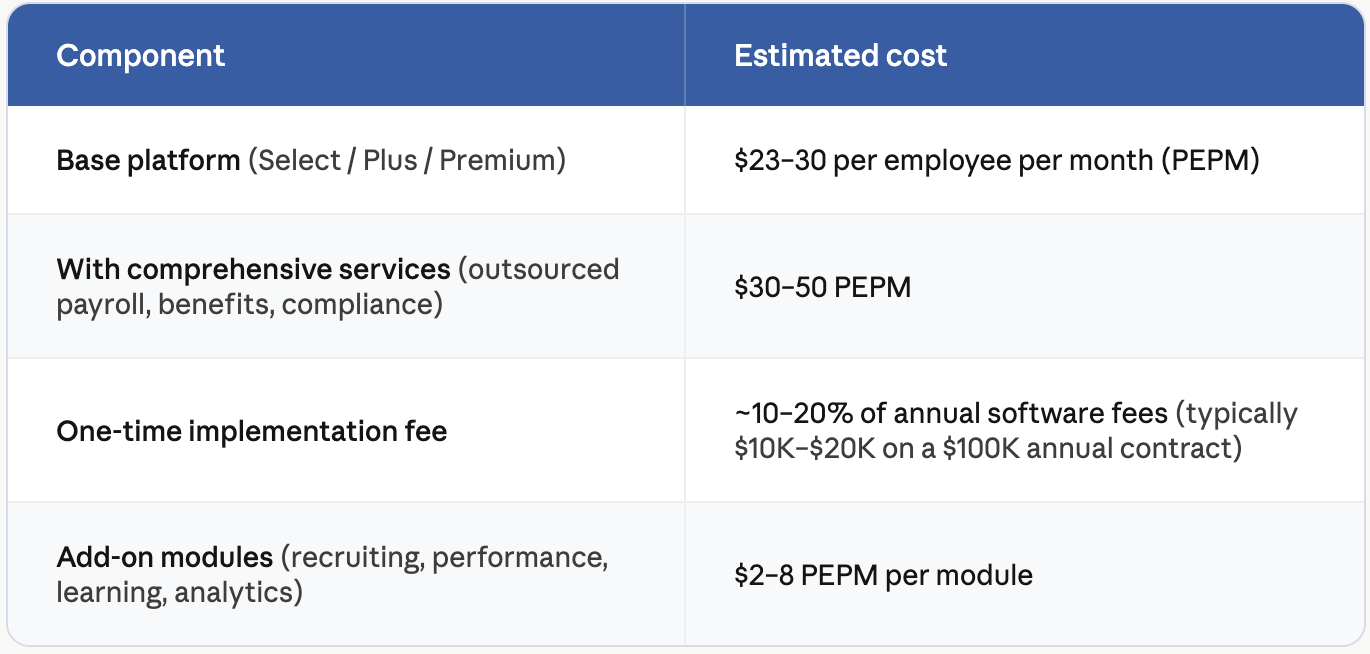
A 200-employee company on the Plus plan should budget roughly $55,000–$72,000 per year for base software, plus implementation in year one. Companies adding Comprehensive Services or multiple talent modules will see that number climb.
One thing to watch: ADP's invoicing can be opaque. Garnishment processing fees, W-2 printing charges, and per-payroll-run costs can appear as separate line items that weren't prominently discussed during the sales process. We always recommend getting a fully itemized breakdown before signing.
Unlock Full HRIS Insights: Get comprehensive insights on ADP and others — unlock detailed reviews, pricing, pros, and cons by signing up for our HRIS Marketplace.
What ADP Workforce Now Does Well
1. Industry-Leading Payroll and Tax Compliance
This is the centerpiece of ADP's value proposition — and it's earned. ADP processes payroll for roughly 1 in 6 American workers, and the U.S. government uses ADP employment data to help calculate the unemployment rate. That kind of scale produces an unrivaled tax and compliance engine.
Workforce Now supports automated tax filing and reporting across federal, state, and local jurisdictions. It earned a top score of 100 for payroll and tax management in SelectHub's 2026 analysis, ahead of UKG Pro, Oracle HCM, Dayforce, and Paycor. For companies with multi-state payroll obligations or frequent regulatory changes, this reliability is hard to overstate.
The platform also features AI-powered anomaly detection that flags potential payroll errors before you process a pay run — a feature that's been well received by payroll administrators in recent reviews.
2. Outsourced Service Models (Comprehensive Services)
One of ADP's most distinctive advantages is its ability to function as more than just software. Through Comprehensive Services, companies can outsource their payroll processing, benefits administration, and compliance management to ADP's team of specialists.
This is particularly valuable for distributed organizations, companies transitioning out of a PEO, or lean HR teams that don't have the bandwidth to handle day-to-day administration. Rather than simply providing a tool and leaving you to figure it out, ADP can take on the operational workload — which sets it apart from most mid-market HRIS competitors.
3. Compensation Benchmarking with ADP DataCloud
ADP's massive customer base isn't just a sales talking point — it translates into real analytical power. ADP DataCloud taps into anonymized data from over 42 million employee records, allowing Workforce Now users to benchmark their compensation, turnover, and overtime against similar companies in their industry and geography.
For HR leaders who need to justify pay decisions to executives or board members, this kind of peer-level benchmarking data is extremely useful — and it's baked into the platform rather than requiring a separate subscription.
4. Revamped Mobile App and Employee Experience
ADP recently overhauled its mobile app, and the results have been noticeable. The updated ADP Mobile Solutions app allows employees to view pay stubs, manage direct deposits, clock in and out, enroll in benefits, and access tax documents — all from their phone.
User reviews consistently highlight the mobile experience as a strong point. Employees can handle routine self-service tasks without contacting HR, which reduces administrative burden and drives higher platform utilization across the workforce.
5. Extensive Integration Ecosystem (ADP Marketplace)
ADP has invested heavily in its APIs and partner marketplace. Because of ADP's market weight, nearly every leading third-party HR solution — from applicant tracking systems to learning management platforms to performance management tools — has some level of integration with ADP.
The ADP Marketplace offers pre-built connectors, and ADP API Central supports custom integrations for companies with more specialized needs. If your HR tech strategy involves best-in-class point solutions alongside a core HRIS, ADP's integration infrastructure is one of the best in the mid-market.
6. Global Payroll Capabilities
For companies with international employees, ADP can serve as a global system of record. Through Celergo, its global payroll aggregator, ADP can process payroll in 140+ countries. The platform supports multiple languages, and ADP has localized support teams around the world.
The caveat: Workforce Now and Celergo are still separate systems, so the integration isn't seamless. But for companies that want a single vendor relationship across domestic and international payroll, ADP offers a viable path. For a broader look at global options, check out our comparison of ADP vs. UKG vs. Dayforce for global payroll.
Where ADP Workforce Now Falls Short
1. Customer Support Can Be Inconsistent
This is the most common complaint in ADP user reviews — and it has been for years. On G2, "Poor Customer Support" is mentioned 111 times in recent reviews, making it the most frequently cited negative theme.
Users report long hold times, transfers between departments, and difficulty getting issues resolved quickly. The experience tends to be better for companies on ADP's outsourced service tiers (Comprehensive Services), where you get a more dedicated support structure. But for standard Workforce Now customers on Select, Plus, or Premium plans, support can feel like a maze.
ADP has made efforts to improve, including expanding chat-based support and enhancing their help documentation. But if responsive, personalized customer service is a top priority for your team, this is a factor worth weighing carefully.
See how ADP stacks up in our service model comparison: Comparing Paycom, Paylocity, and Paycor Customer Service Models.
2. Platform Rigidity and Customization Limitations
While ADP Workforce Now offers a broad feature set, multiple users describe the platform as "rigid" when it comes to configuring workflows, reports, and processes to match how their organization operates. The phrase that comes up repeatedly is that companies need to "adjust their processes to fit ADP's way of doing things."
The custom report builder, in particular, is a frequent pain point. Users report that building or locating specific reports often requires support assistance, and the tool itself feels dated compared to more modern analytics interfaces.
ADP has begun addressing this with their NextGen payroll engine, which promises greater flexibility and configurability than the legacy back-end. As more Workforce Now customers migrate to this newer engine, this criticism may soften — but as of mid-2026, it's still a valid concern for many buyers.
3. Multiple Product Lines Can Slow Innovation
ADP operates at least three distinct HRIS platforms in the U.S. alone: ADP Run (small business), ADP Workforce Now (mid-market), and ADP Next Gen HCM (enterprise/next-generation). This means development resources are spread across multiple product lines rather than concentrated on a single platform.
For Workforce Now customers, this can translate into slower feature rollouts compared to competitors like Paylocity or Rippling that focus their engineering efforts on a single platform. It's a structural trade-off that comes with being the largest HR technology company in the world.
4. Pricing Transparency
ADP's pricing model is quote-based and not published publicly, which makes it harder for buyers to benchmark before engaging with sales. Add-on modules, per-payroll-run charges, garnishment fees, and annual renewal increases can all catch buyers off guard if they haven't negotiated carefully upfront.
We recommend reading our HRIS pricing negotiation playbook and requesting a fully itemized cost breakdown before signing any ADP agreement.
ADP Workforce Now vs. Key Competitors
Choosing the right HRIS depends on what matters most to your organization. Here's how ADP Workforce Now compares to other popular mid-market options:
- ADP vs. Paycom: Paycom offers a single-application approach with strong employee self-service (Beti), while ADP excels in payroll depth and outsourcing options. Paycom is often preferred by companies that want to drive employee usage; ADP fits better when tax compliance and service layers are the priority.
- ADP vs. Paylocity: Paylocity is often seen as more modern and user-friendly, with stronger community and engagement features. ADP wins on payroll scale, global capabilities, and outsourcing. For a mid-market company that values innovation speed and UX, Paylocity is a strong alternative.
- ADP vs. UKG: UKG Pro targets larger mid-market and enterprise organizations with more advanced workforce management needs. ADP's advantage is pricing flexibility and outsourcing; UKG's advantage is in scheduling, labor management, and configurable workflows.
- ADP vs. Rippling: Rippling is a newer, fast-growing platform that appeals to tech-forward companies wanting tight IT and HR integration. ADP offers more established service infrastructure and global reach. The choice often comes down to company culture and IT priorities.
For a full side-by-side breakdown of mid-market options, visit our Best HRIS Systems for Mid-Sized Companies guide.
Who Is ADP Workforce Now Best For?
ADP Workforce Now is a strong fit for:
- Companies that prioritize payroll accuracy and compliance above all else. If getting payroll right — across multiple states, complex tax jurisdictions, or fluctuating headcount — is your top requirement, ADP's engine is best-in-class.
- Organizations that want to outsource back-office HR work. ADP's Comprehensive Services model is genuinely differentiated. If your HR team is lean and you want a vendor that can take on payroll processing, benefits support, and compliance management, ADP can deliver that in ways most mid-market HRIS platforms cannot.
- Distributed or multi-state employers. ADP's tax infrastructure handles multi-state payroll with a level of confidence that smaller vendors struggle to match.
- Companies leaving a PEO. ADP is a frequent landing spot for businesses transitioning out of a PEO arrangement because it offers similar outsourcing layers without the co-employment structure.
- Organizations with international payroll needs. While not perfectly integrated, ADP's global payroll capabilities through Celergo offer a single-vendor path for companies with employees in multiple countries.
ADP Workforce Now may not be the best fit for:
- Companies that demand highly customizable workflows and modern UX. If your team wants a platform that adapts to how you work (rather than the other way around), vendors like Paylocity, Rippling, or BambooHR may offer more flexibility.
- Small businesses with simple needs. For companies under 50 employees, ADP Workforce Now is likely more platform than you need. Consider ADP Run or other small business HR software options instead.
- Organizations where customer support responsiveness is a dealbreaker. Unless you're investing in Comprehensive Services, ADP's standard support experience doesn't match what some competitors offer.
What's New with ADP Workforce Now in 2026
ADP has continued to invest in Workforce Now with several notable updates heading into 2026:
- AI-powered payroll anomaly detection — The platform now flags unusual payroll entries before processing, helping catch errors proactively rather than reactively.
- ADP Assist — ADP's AI-powered assistant is being embedded more deeply across the platform, including an AI job description generator in the recruiting module and intelligent insights in analytics.
- NextGen payroll engine migration — ADP continues rolling out its new back-end payroll engine for Workforce Now customers, which promises improved flexibility, faster processing, and a more modern configuration experience. This addresses one of the platform's longest-standing criticisms around rigidity.
- Enhanced mobile experience — The mobile app continues to receive improvements, including better navigation, real-time pay previews on timecards, and expanded self-service capabilities.
- G2 Best Software Awards 2026 — ADP Workforce Now was recognized across four categories in G2's 2026 Best Software Awards for mid-market businesses, validating its continued market presence and user satisfaction.
Frequently Asked Questions
How much does ADP Workforce Now cost per employee?
Most mid-market companies pay between $23 and $30 per employee per month for the base platform. Adding outsourced services (Comprehensive Services) can bring the total to $30–50 PEPM. Implementation fees typically run 10–20% of your first-year software costs.
Is ADP Workforce Now good for mid-sized companies?
Yes — it's one of the most popular HRIS platforms in the mid-market, designed for companies with 50 to 1,000+ employees. Its strengths in payroll, tax compliance, and outsourcing make it well-suited for organizations that need reliability at scale.
What are the main pros and cons of ADP Workforce Now?
The biggest pros are payroll accuracy, compliance infrastructure, outsourcing options, and benchmark reporting. The main cons are inconsistent customer support, limited customization, a steeper learning curve, and pricing that can be hard to decipher. For a comparison with alternatives, check out ADP vs. Paycom or ADP vs. Paylocity.
How does ADP Workforce Now compare to Paylocity?
ADP wins on payroll depth, global reach, and outsourcing capabilities. Paylocity is often seen as more modern, user-friendly, and faster to innovate. The right choice depends on whether your priority is payroll infrastructure or platform experience. Read our full ADP vs. Paylocity comparison.
Can ADP handle global payroll?
Yes. Through Celergo, ADP processes payroll in 140+ countries. However, Celergo and Workforce Now are separate systems, so the experience isn't fully integrated. For companies with heavy international needs, also consider Deel or Remote as specialized alternatives, or read our guide on evaluating global payroll vendors.
What is ADP's NextGen payroll engine?
ADP has been developing a new back-end payroll engine that offers more flexibility and configurability than the legacy system powering most Workforce Now instances. As of 2026, ADP is actively migrating customers to this new engine, which should address long-standing complaints about platform rigidity.
Does ADP Workforce Now integrate with other HR tools?
Extensively. The ADP Marketplace offers pre-built integrations with tools like Greenhouse, ZipRecruiter, LinkedIn, QuickBooks, Slack, Microsoft Teams, and many more. ADP API Central also supports custom integrations. Learn more about HRIS integration strategies.
The Bottom Line
ADP has earned a reputation over 75+ years as the most trusted name in payroll and tax. While other vendors rise and fall year to year, ADP remains a steady presence for companies of every size, shape, and location.
Workforce Now's greatest strengths are in core HR — payroll, benefits administration, and time and attendance — backed by outsourcing layers that few competitors can match. For companies that value compliance, scale, and the option to offload administrative work, ADP remains one of the safest bets in the market.
The trade-offs are real, though. Customer support can be frustrating. The platform doesn't bend easily to match your workflows. And pricing requires careful negotiation to avoid surprises.
If ADP sounds like it could be the right fit — or if you're trying to narrow down your shortlist — OutSail can help. Our advisory team works with hundreds of mid-market companies each year to match them with the right HRIS, and our service is completely free for buyers.
Need expert help with your HR implementation? Explore our HR Service Partner Finder to connect with the best HR consultants in the industry.
Looking for more vendor reviews? Browse the full OutSail Blog for buying strategies, HRIS comparisons, and industry news.
.png)
