Paycom Review 2026: Pricing, Features, Pros, Cons & Who It Fits Best
Explore Paycom with OutSail, a single-database HCM platform priced at $26–35 PEPM, featuring Beti® employee-driven payroll, the IWant™ AI engine, and a highly self-service-oriented mid-market experience.

Explore Paycom with OutSail: a true single-database HCM platform priced at $26–35 PEPM, featuring Beti® employee-driven payroll, the IWant™ AI engine, and one of the most self-service-oriented experiences in the mid-market.
Paycom has carved out a distinctive position in the HRIS market by doing something most competitors don't: building everything on a single database from the ground up. No acquisitions stitched together, no separate modules running on different back-ends — just one unified platform where data entered once flows everywhere.
That architectural bet has paid off. In 2026, Paycom continues to earn top rankings from G2, Capterra, and industry analysts, and its employee-driven payroll tool Beti® remains one of the most talked-about innovations in the HR technology space. But Paycom's "all-in" philosophy also comes with trade-offs that every buyer should weigh before signing.
In this updated 2026 review, we cover what Paycom does well, where buyers run into friction, what the platform actually costs, and who it's best suited for — so you can decide whether Paycom belongs on your shortlist.
If you're evaluating multiple vendors, OutSail's HRIS Marketplace can help you compare Paycom against other leading platforms side by side, with pricing data and unbiased pros and cons.
What Is Paycom?

Paycom is a cloud-based human capital management (HCM) platform designed for mid-sized businesses, typically those with 50 to 750+ employees. Founded in 1998 in Oklahoma City and still led by founder Chad Richison, Paycom has grown into one of the largest publicly traded HCM companies in the United States (NYSE: PAYC).
What sets Paycom apart architecturally is its truly single-database design. Every module — payroll, time and attendance, benefits administration, recruiting, onboarding, performance management, learning, compensation, and reporting — runs on the same underlying database. When an employee updates their address, changes a benefits election, or logs time, that data is instantly reflected across the entire system without manual syncing or integration layers.
Paycom's full suite of modules includes:
- Payroll Processing & Tax Filing — Including Beti®, the employee-driven payroll experience
- Time & Attendance — Timecards, scheduling, PTO, and labor management
- Benefits Administration — Enrollment, carrier connections, ACA compliance
- Talent Acquisition — Applicant tracking, job posting, onboarding workflows
- Talent Management — Performance reviews, compensation management, succession planning
- Learning Management — Training courses, compliance tracking, content creation
- HR Management — Employee files, compliance alerts, document management
- Reporting & Analytics — Custom reports, dashboards, and the IWant™ AI engine
Paycom operates primarily in the United States but has expanded internationally with native payroll processing now available in Mexico, Canada, the United Kingdom, and Ireland, along with a Global HCM product supporting employees in 180+ countries.
Paycom Pricing in 2026
Like most mid-market HRIS vendors, Paycom does not publish pricing publicly. Every quote is customized based on employee count, selected modules, payroll frequency, and contract terms. Here's what most buyers should expect based on OutSail's advisory data:
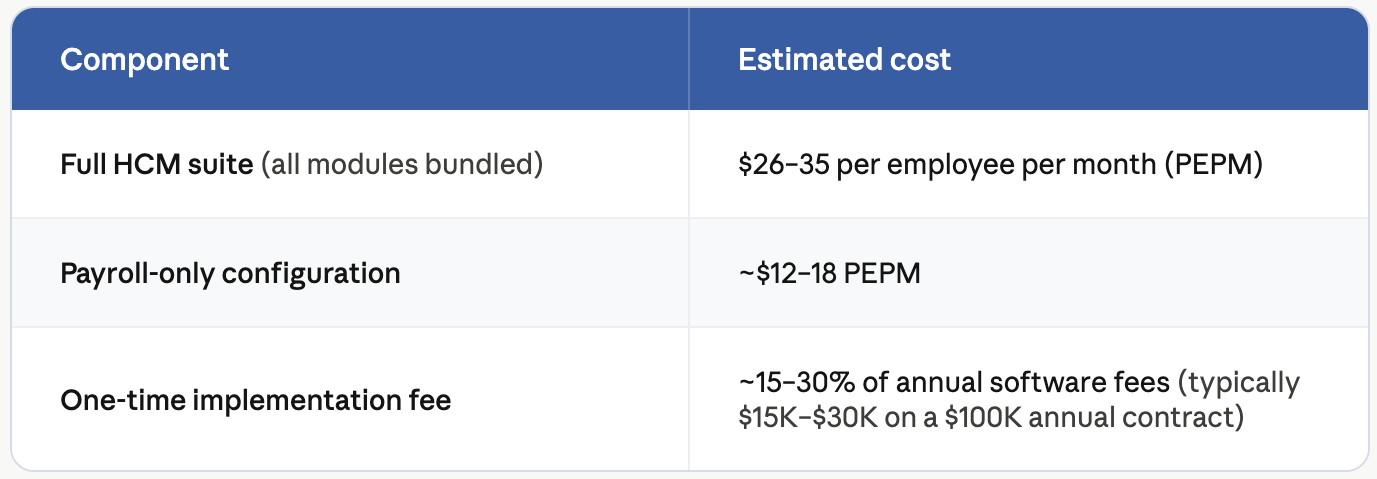
For a 200-employee company on the full HCM suite, expect to budget approximately $62,000–$84,000 per year for software, plus implementation costs in year one.
A few things to know about Paycom's pricing model:
It's premium-priced. Paycom consistently lands 20–30% higher than comparable mid-market peers like Paylocity or Paycor. The justification is that Paycom bundles everything into one platform, reducing the need for third-party tools. Whether that math works for your organization depends on how many standalone tools you'd otherwise be paying for.
Billing is per-paycheck, not per-month. Paycom charges on a per-paycheck basis, which means companies running weekly payroll cycles will pay more than those running biweekly or semi-monthly. This also means your costs can fluctuate with off-cycle payroll runs, which catches some buyers off guard.
Discounts are harder to come by. Paycom's sales team is known for holding firmer on pricing than some competitors. Multi-year commitments can unlock better rates, but don't expect the same level of negotiation flexibility you might find with ADP or Paycor.
Unlock Full HRIS Insights: Get comprehensive insights on Paycom and others — unlock detailed reviews, pricing, pros, and cons by signing up for our HRIS Marketplace.
What Paycom Does Well
1. Beti® — Employee-Driven Payroll That Actually Works
Beti is Paycom's flagship innovation, and it's the feature that generates the most conversation in the HR tech space. The concept: instead of payroll administrators manually reviewing, correcting, and processing payroll each cycle, Beti automates the process and puts employees in charge of verifying their own pay before submission.
Here's how it works in practice: Beti self-starts at the beginning of each pay period, automatically pulling live data from timecards, approved expenses, PTO requests, benefits changes, and compensation adjustments. Throughout the cycle, it alerts employees and managers of pending tasks — like missing punches or unapproved expenses. Employees then preview their paycheck through the Paycom mobile app, address any flagged issues, and approve their pay before it's processed.
A Forrester Consulting study (commissioned by Paycom) found that organizations using Beti experienced a 90% reduction in time spent processing payroll. Users consistently report cutting payroll processing from hours down to roughly 90 minutes, with far fewer post-processing corrections needed.
Beti is now available in the U.S., Mexico, Canada, the United Kingdom, and Ireland — a meaningful expansion for companies with North American or UK-based workforces.
2. True Single-Database Architecture
This isn't just a marketing term for Paycom — it's the foundational design principle that shapes the entire platform. Unlike vendors that have grown through acquisitions and stitch together separate systems behind a unified interface, Paycom built every module internally on one database from day one.
The practical benefit: data entered anywhere in the system is immediately available everywhere else. An employee's address change in HR automatically updates in payroll, benefits, and tax filings. A promotion logged in performance management instantly flows to compensation and reporting. This eliminates the re-keying, syncing delays, and data discrepancies that plague platforms built on multiple back-ends.
For HR teams that are tired of chasing data integrity issues across disconnected systems, Paycom's architecture is a genuine differentiator.
3. IWant™ — AI-Powered Data Access
Launched in 2025 and earning an HR Executive Top HR Product award, IWant is Paycom's command-driven AI engine. Rather than forcing users to learn how to drill through menus and build custom reports, IWant allows employees, managers, and administrators to ask questions in natural language — things like "How many employees are in our Denver office?" or "Show me my remaining PTO" — and get instant answers pulled from the single database.
This is a meaningful quality-of-life improvement, especially for managers and executives who need quick data access but don't live inside the HRIS every day. It also lowers the learning curve for new users, since you can query the system conversationally instead of memorizing where every feature lives.
IWant is still relatively new, and adoption will take time to mature. But it represents Paycom's strategy of using its unified database as a launchpad for AI features — a structural advantage that fragmented platforms can't easily replicate.
4. Mobile-First Employee Self-Service
Paycom has invested heavily in making its mobile app a full-featured experience, not a watered-down companion to the desktop version. Employees can clock in and out, view and approve their paychecks (via Beti), request PTO, enroll in benefits, complete onboarding documents, access training, and manage their personal information — all from their phone.
This matters because Paycom's entire philosophy revolves around shifting routine administrative work away from HR and toward employees. The more employees can handle on their own through the app, the less time HR spends on data entry, corrections, and fielding basic requests. Users consistently highlight the mobile experience as one of Paycom's strongest selling points.
5. Dedicated Support Model
Unlike vendors that route support requests through ticketing systems or call queues, Paycom assigns each client a dedicated specialist — typically located in the same state or region. This means you have a single point of contact who (ideally) knows your account, your configuration, and your history.
In G2's Spring 2026 reports, Paycom earned "Best Support," "Best Relationship," and "Easiest To Do Business With" badges. Many long-term users speak highly of their dedicated reps, describing them as responsive and knowledgeable.
That said, the support experience isn't universally perfect — which we'll cover in the drawbacks section.
6. Fast Implementation and Strong Product Roadmap
Paycom implementations typically run 2–3 months for mid-market companies, which is faster than many peers. Because everything is built on one database, there are fewer integration configurations and data mapping exercises required during setup.
Paycom also maintains an aggressive product roadmap. The company reinvests heavily in R&D and has historically developed all features organically rather than through acquisitions. Recent innovations include Beti's international expansion, IWant AI, payroll processing speed improvements, and the Paycom Everyday Pay feature for on-demand wage access.
Where Paycom Falls Short
1. Weak Third-Party Integration Capabilities
This is Paycom's most frequently cited limitation — and it's by design. Paycom believes strongly in the "all-in" approach: if you're going to use Paycom, you should use all of Paycom. They've built their own ATS, LMS, performance tool, and compensation module, and they'd prefer you use those instead of integrating with standalone best-in-class tools.
The result is that integrating Paycom with third-party HR solutions — such as a dedicated applicant tracking system, an external learning management platform, or a specialized performance management tool — can be painful. Paycom's API capabilities are limited compared to more integration-friendly platforms like Rippling or ADP.
Accounting and carrier integrations work reasonably well, but if your HR tech strategy involves a best-in-class stack with multiple point solutions, Paycom is going to fight that approach at every turn. For companies that want their HRIS to play nicely with a broader ecosystem, this is a dealbreaker.
2. Variable Support Quality Despite Dedicated Model
While Paycom's dedicated specialist model is a strength on paper, the execution varies. The single biggest complaint: Paycom tends to hire early-career professionals for client-facing support roles. Many dedicated reps are relatively junior, which can limit the depth of HR best-practice guidance they provide.
When your dedicated rep is strong, the experience is excellent. When they're not, the lack of robust escalation pathways means you can get stuck. Paycom doesn't always make it easy to escalate beyond your assigned specialist, and transitioning to a new rep can disrupt continuity.
Long-term users often report that the relationship improves over time as their rep gains experience with their account, but the first 6–12 months can be a learning curve for both sides.
3. Premium Pricing With Less Predictability
Paycom's per-paycheck billing model means your monthly costs aren't perfectly static. Off-cycle payroll runs, changes in payroll frequency, and headcount fluctuations can all shift your bill in ways that are harder to forecast compared to a straightforward PEPM model.
Combined with Paycom's premium positioning (20–30% above many peers), this can create budget friction — especially for finance teams that prefer predictable, flat-rate software spending. If you're comparing Paycom's total annual cost against Paylocity or Paycor, make sure you're modeling the per-paycheck math rather than just comparing PEPM quotes.
4. All-or-Nothing Philosophy Can Feel Rigid
Paycom's bundled approach means you're often purchasing modules you may not need or want. If your company already has a best-in-class ATS or LMS that you love, Paycom's stance is still going to push you toward replacing it with their built-in version. And because Paycom's integration capabilities are limited, running both side by side isn't always practical.
This isn't necessarily a flaw — plenty of companies prefer the simplicity of one vendor handling everything. But for organizations with strong opinions about specific HR tools, Paycom's inflexibility can feel restrictive.
What Real Users Are Saying in 2026
Paycom has earned strong reviews across major platforms. In G2's Spring 2026 Grid Reports, Paycom was named the best software in multiple HR categories and earned badges for Most Implementable, Best Support, Best Relationship, and Users Most Likely To Recommend. The platform also earned a TrustRadius Buyer's Choice award in 2026 and was listed on Software Advice's FrontRunners list.
What users consistently praise:
- Beti payroll — by far the most commonly cited positive. Users describe it as "revolutionary" and report dramatic time savings in payroll processing
- Single-database design — data accuracy, no re-keying, seamless flow between modules
- Mobile app — full functionality, not just a simplified view. Employees genuinely use it
- Dedicated support reps — when the relationship is good, it's very good
- IWant AI — newer feedback is enthusiastic, especially from managers who want quick data access without building reports
- Ease of use overall — the interface is described as modern, clean, and intuitive
What users consistently flag as concerns:
- Limited integrations — the most common frustration for companies using (or wanting to use) third-party HR tools
- Support rep quality varies — junior reps can't always provide deep HR guidance, and escalation paths aren't always clear
- Reporting can be clunky — while IWant helps, the traditional report builder is seen as less flexible than competitors
- Occasional platform bugs after updates — some users report that monthly software updates can introduce issues, though Paycom has shifted to quarterly update cycles to allow more testing time
The overall pattern: Users who fully commit to Paycom's ecosystem — using all modules and leaning into the self-service philosophy — tend to be the most satisfied. The platform rewards an all-in approach. Frustration is highest among buyers who try to use Paycom as just one piece of a broader tech stack, or who have strong preferences for external tools.
Paycom vs. Key Competitors
Understanding how Paycom stacks up against alternatives can help clarify whether its strengths align with your priorities:
- Paycom vs. ADP: ADP offers more integration flexibility, outsourcing options, and global payroll depth. Paycom wins on single-database architecture, employee self-service (Beti), and a more modern platform experience. ADP is the safer choice for companies that want outsourcing layers; Paycom is better for companies that want to drive employee ownership of HR data.
- Paycom vs. Paylocity vs. Paycor: Paylocity is more affordable and offers stronger community and engagement features. Paycor provides a solid mid-market experience at a lower price point. Paycom commands a premium but delivers a more unified platform and more advanced payroll automation through Beti. The choice often hinges on budget vs. platform depth.
- Paycom vs. Paycor vs. iSolved: iSolved is typically the most budget-friendly of the three, while Paycom sits at the top in both price and feature sophistication. Paycor falls in between. If cost is your primary driver, Paycom will be hard to justify.
- Paycom vs. Rippling: Rippling takes a different approach, integrating HR with IT and finance management and offering extensive third-party integrations. Paycom's advantage is its payroll automation depth and unified database. Rippling's advantage is flexibility and cross-functional reach. Companies with strong IT/HR overlap often gravitate toward Rippling; those focused on payroll efficiency lean toward Paycom.
For a broader view of the mid-market landscape, visit our guide to the Best HRIS Systems for Mid-Sized Companies.
Who Is Paycom Best For?
Paycom is a strong fit for:
- Companies that want a true one-stop-shop for HR and payroll. If your goal is to consolidate everything under one vendor and one database — without managing integrations across multiple tools — Paycom delivers that better than almost anyone.
- Organizations ready to embrace employee self-service. Paycom's model works best when employees actively engage with the platform. If your leadership is willing to drive adoption and shift routine tasks to employees, Paycom's ROI is highest.
- Mid-market companies with lean HR teams. Because Paycom bundles everything and Beti automates much of the payroll workload, smaller HR teams can manage more with less administrative overhead.
- Businesses tired of data integrity issues. If you've been burned by data discrepancies between disconnected systems, Paycom's single-database architecture directly solves that pain point.
- Companies that don't rely heavily on third-party HR tools. If you're comfortable using Paycom's built-in ATS, LMS, and performance modules (or are willing to switch), the all-in approach works well.
Paycom may not be the best fit for:
- Organizations that require deep third-party integrations. If you have a best-in-class ATS, LMS, or performance tool that you're not willing to give up, Paycom's limited integration capabilities will create friction. Consider ADP, Paylocity, or Rippling instead.
- Budget-conscious buyers. Paycom's premium pricing means there are comparable platforms available for 20–30% less. If your needs are fairly standard and price is a top-three decision factor, Paycor or Paylocity may offer better value.
- Companies with workforces that resist self-service adoption. Paycom's model depends on employee participation. If your workforce is unlikely to engage with a mobile app or review their own paychecks, you won't realize the platform's full value.
- Large enterprises with highly customized workflows. While Paycom has been pushing upmarket, its mid-market roots mean that companies with extremely custom requirements may find the platform less configurable than enterprise-grade options like UKG Pro or Workday.
What's New with Paycom in 2026
Paycom has continued to ship meaningful updates heading into 2026:
- IWant™ AI engine — Paycom's command-driven AI tool is now more deeply embedded across the platform, allowing natural-language queries to surface employee data instantly. It won an HR Executive Top HR Product award in 2025 and is seeing growing adoption among managers and administrators.
- International expansion — Beti is now available in the U.S., Mexico, Canada, the United Kingdom, and Ireland. Paycom's Global HCM product extends support to employees in 180+ countries with multi-language and multi-currency capabilities.
- Payroll processing speed improvements — Paycom recently rolled out a payroll engine update designed to reduce admin processing times further, building on the foundation Beti established.
- Paycom Everyday Pay — An on-demand wage access feature that lets employees access earned wages the next business day, delivered through the Vault Visa® Payroll Card with no fees or interest for employees.
- Quarterly update schedule — In response to user feedback about occasional bugs after monthly updates, Paycom has shifted to quarterly release cycles to allow for more thorough testing.
- G2 Spring 2026 recognition — Paycom earned top rankings across multiple categories in G2's Spring 2026 Grid Reports, including badges for Most Implementable, Best Support, Best Relationship, and Users Most Likely To Recommend.
Frequently Asked Questions
How much does Paycom cost per employee?
Most mid-market companies pay between $26 and $35 per employee per month for the full HCM suite. Payroll-only configurations run approximately $12–18 PEPM. Implementation fees typically add 15–30% of your first-year software costs. Keep in mind that Paycom bills per paycheck, so weekly payroll cycles will cost more than biweekly.
Is Paycom worth the premium price?
It depends on your priorities. Paycom's single-database architecture, Beti payroll automation, and deep self-service capabilities genuinely reduce admin workload and improve data accuracy. If you're consolidating multiple tools into one platform, the total cost of ownership may be comparable or lower. But if your needs are straightforward and you're not planning to use all modules, the premium over Paylocity or Paycor may be hard to justify.
What is Beti and how does it work?
Beti (Better Employee Transaction Interface) is Paycom's automated payroll experience. It self-starts each pay period, pulls live employee data, flags errors, and guides employees to review and approve their own paychecks before submission. The result is fewer payroll errors, faster processing, and less manual work for payroll administrators. A Forrester study found it reduced payroll processing time by 90%.
Can Paycom handle international payroll?
Yes, though with limitations. Paycom now processes native payroll in the U.S., Mexico, Canada, the UK, and Ireland. Its Global HCM product supports employee records in 180+ countries. However, Paycom's international capabilities are newer and less mature than dedicated global payroll providers like Deel or ADP's Celergo. For heavy international needs, also see our guide to evaluating global payroll vendors.
Does Paycom integrate with other HR tools?
This is Paycom's weakest area. Accounting integrations and benefits carrier connections work reasonably well, but integrating with third-party ATS, LMS, or performance tools is limited. Paycom's philosophy is that you should use their built-in modules for everything. If third-party integrations are a priority, consider ADP or Rippling, which offer far more open ecosystems.
How does Paycom compare to ADP?
ADP offers more integration flexibility, outsourcing layers, and global payroll depth. Paycom wins on single-database design, self-service innovation (Beti), and a more modern user experience. ADP is often the better choice for companies that want outsourcing or integration breadth; Paycom is better for companies that want to consolidate everything under one roof. Read our full Paycom vs. ADP comparison.
What is Paycom's IWant feature?
IWant is Paycom's AI-powered, command-driven search engine. It allows users to ask questions in natural language — like "How many employees do we have in Texas?" or "Show me my PTO balance" — and get instant answers from the single database. It eliminates the need to drill through menus or build custom reports for routine data requests.
Conclusion
Paycom is one of the most opinionated platforms in the mid-market HRIS space — and that's both its greatest strength and its primary limitation.
If you buy into Paycom's vision — one vendor, one database, employees driving their own data — the platform delivers a remarkably streamlined experience. Beti genuinely transforms payroll processing. The mobile app makes self-service feel natural rather than forced. And the single-database architecture eliminates entire categories of data integrity problems that other platforms struggle with.
But Paycom asks you to go all-in. It doesn't play well with third-party tools. It charges a premium for the privilege. And the support experience, while structurally sound with dedicated reps, isn't always consistent in quality.
For companies ready to commit fully, Paycom is one of the most powerful and efficient HCM platforms available. For those who want flexibility, integration options, or a lower price point, the market has strong alternatives.
If Paycom sounds like it could be the right fit — or if you're trying to narrow your shortlist — OutSail can help. Our advisory team works with hundreds of mid-market companies each year to match them with the right HRIS, and our service is completely free for buyers.
Need expert help with your HR implementation? Explore our HR Service Partner Finder to connect with the best HR consultants in the industry.
Looking for more vendor reviews? Browse the full OutSail Blog for buying strategies, HRIS comparisons, and industry news.
.png)
