Paycor vs Paycom vs iSolved: Which Mid-Market HCM Fits Your Needs?
Paycor, Paycom, and iSolved may look similar on paper, but their outcomes differ. See which mid-market HCM fits your payroll needs, service expectations, and budget.

The Mid-Market HCM Paradox
Mid-market HR teams face a frustrating reality: vendors with seemingly identical feature checklists that somehow produce very different customer experiences. Paycor, Paycom, and iSolved all promise comprehensive HCM—payroll, HR, benefits, time tracking, talent management—for companies in the 100-1,000 employee range. Their marketing materials blur together. Their demos showcase similar capabilities. Yet companies that chose one platform over another report dramatically different outcomes.
The confusion is understandable. All three vendors serve the same market segment, offer comparable core functionality, and price within similar ranges. But beneath the surface, these platforms differ meaningfully in their architectural approaches, service philosophies, and ancillary offerings. Paycor excels at bundling non-HRIS services like voluntary benefits and retirement plans. Paycom leads in AI-driven automation and single-database efficiency. iSolved delivers managed services at accessible price points with surprisingly strong recruiting tools.
This guide cuts through the feature-list similarity to help mid-market HR teams understand which platform's approach actually fits their needs.
Confused by Similar HCM Feature Sets?
OutSail's free HRIS Marketplace lets you compare Paycor, Paycom, iSolved, and 50+ other platforms based on what actually matters for your organization—not just feature checkboxes.
Paycor: The Full-Service HR Partner
Paycor has evolved from a regional payroll provider into a national mid-market HCM player, going public in 2021 and expanding aggressively through acquisition and organic growth. What distinguishes Paycor isn't just their software—it's their broader ecosystem of HR services that extend well beyond typical HRIS functionality.
Where Paycor Excels
Comprehensive Non-HRIS Services
Paycor's greatest differentiator is their suite of services beyond core HCM. They offer voluntary benefits administration, 401(k) retirement plan services, HR advisory support, and compliance assistance as part of their broader value proposition. For organizations wanting a partner that handles more than just software—one that can help with retirement plan selection, benefits strategy, and HR guidance—Paycor bundles these services in ways competitors don't match.
Retirement Plan Expertise
Paycor's 401(k) offering deserves particular attention. They provide retirement plan administration, investment advisory services, and participant education as integrated services. Companies evaluating standalone 401(k) providers alongside their HCM platform should factor in Paycor's ability to consolidate these relationships. The integration between payroll deductions, plan administration, and compliance reporting is notably smooth.
Voluntary Benefits Marketplace
Beyond standard medical, dental, and vision, Paycor offers extensive voluntary benefits—accident insurance, critical illness, pet insurance, legal services, and more—through their platform. For organizations wanting to expand employee benefit options without managing multiple vendor relationships, Paycor's marketplace simplifies administration while giving employees more choices.
Industry-Specific Solutions
Paycor has developed targeted offerings for specific industries including healthcare, manufacturing, restaurants, and nonprofits. These industry packages include pre-configured workflows, compliance templates, and reporting designed for sector-specific requirements. Organizations in these industries may find Paycor's tailored approach reduces implementation time and improves fit.
Acquired Talent Technologies
Paycor has acquired cutting-edge applicant tracking and performance management platforms to strengthen their talent suite. These acquisitions brought modern, purpose-built talent tools into Paycor's ecosystem, offering functionality that rivals standalone best-of-breed solutions.
Where Paycor Falls Short
Platform Integration Maturity
Paycor's growth through acquisition means their platform comprises multiple products brought together over time. While integration has improved, the seams occasionally show—different modules may have slightly different user experiences, and data flow between acquired products isn't always as seamless as natively-built alternatives like Paycom.
Implementation Variability
Customer experiences with Paycor implementation vary more than competitors. Some organizations report smooth deployments while others describe challenging rollouts. Much depends on the implementation team assigned and the complexity of the configuration.
Pricing Complexity
Paycor's bundled services model can make pricing comparison difficult. The value of included 401(k) services, voluntary benefits, and HR advisory support depends on whether you actually need these services. Organizations with existing retirement plan relationships or minimal interest in expanded benefits may find Paycor's bundled approach less compelling.
Paycom: The Automation-First Innovator
Paycom has built its reputation on a simple premise: the best HR software is the software employees use themselves. Their single-database architecture and relentless focus on automation have made them a favorite among organizations seeking efficiency through technology.
Where Paycom Excels
Single-Database Architecture
Paycom built their entire platform on a unified codebase from day one—they don't acquire companies or integrate third-party products. This architectural purity means data flows seamlessly between modules, reporting pulls from a single source of truth, and the user experience remains consistent throughout the platform. When you update information anywhere, it's immediately reflected everywhere.
Industry-Leading Automation
Paycom's automation capabilities exceed typical mid-market standards. Their BETI (Better Employee Transaction Interface) technology enables employees to verify their own payroll before it runs, catching errors before they become problems. Automated workflows handle routine tasks that other platforms require administrator attention for. The goal is minimizing human intervention in processes that don't require it.
AI and Machine Learning
Paycom has invested aggressively in AI-powered functionality. Their tools use machine learning for anomaly detection in payroll, predictive analytics for workforce planning, and intelligent recommendations throughout the platform. For organizations prioritizing AI in their HR technology strategy, Paycom delivers genuine capabilities rather than marketing promises.
Employee Self-Service Philosophy
Paycom designs every feature around employee self-service. The philosophy is that employees should handle their own HR transactions—updating personal information, managing benefits, submitting time-off requests, accessing pay information—without HR involvement. This approach dramatically reduces administrative burden and improves data accuracy since employees manage their own information.
Direct Data Management
Paycom's DDM (Direct Data Management) scorecard tracks how effectively organizations are using self-service capabilities, identifying opportunities to shift administrative tasks to employees. This focus on continuous improvement in self-service adoption distinguishes Paycom from competitors who offer self-service but don't actively optimize for it.
Where Paycom Falls Short
Service Model Expectations
Paycom's philosophy assumes organizations want less vendor interaction, not more. Their service model is designed around platform self-sufficiency rather than high-touch support. Organizations wanting extensive hand-holding, frequent check-ins, or managed services may find Paycom's approach feels hands-off.
Learning Curve
Paycom's extensive functionality and automation capabilities require investment to leverage fully. Organizations that implement Paycom but don't commit to learning its automation tools may not realize the platform's full value. The difference between a basic Paycom implementation and an optimized one is substantial.
All-or-Nothing Architecture
Paycom's strength—unified architecture—can be a constraint. They don't integrate with third-party point solutions as readily as competitors. Organizations wanting to pair Paycom's payroll with a different ATS or performance management tool will find limited flexibility. Paycom works best when you use Paycom for everything.
Premium Positioning
Paycom typically costs more than iSolved and often more than Paycor for comparable employee counts. The automation ROI can justify this premium, but organizations need to actually leverage the automation to realize value. Paying Paycom prices while using only basic functionality represents poor ROI.
iSolved: Managed Services and Value Leadership
iSolved has grown through a network model—acquiring regional payroll companies and integrating them into a unified platform—creating broad geographic coverage with local service delivery. Their approach emphasizes managed services and accessibility over technological sophistication.
Where iSolved Excels
Managed Services Model
iSolved's greatest strength is their managed services approach. Rather than handing organizations software and expecting self-sufficiency, iSolved provides hands-on support, proactive assistance, and ongoing service that feels more like partnership than vendor relationship. For HR teams that want help running their HCM rather than just access to tools, iSolved delivers.
Competitive Pricing
iSolved consistently prices below Paycom and often below Paycor for comparable functionality. Organizations with budget constraints that still need comprehensive HCM capabilities find iSolved offers strong value. The combination of managed services and lower pricing is unusual—typically you pay premium for high-touch service.
Recruiting Platform Strength
iSolved's applicant tracking and recruiting capabilities exceed expectations for their price point. Their talent acquisition tools include modern functionality—candidate relationship management, interview scheduling, offer management, and onboarding integration—that competes effectively with pricier alternatives. Organizations prioritizing recruiting technology may find iSolved surprisingly capable.
Local Service Delivery
iSolved's network model means many customers work with local representatives who understand regional business practices and compliance requirements. This local presence can mean faster response times, face-to-face relationships, and service that feels more personal than national vendors provide.
Flexibility in Implementation
iSolved's service-oriented approach extends to implementation flexibility. They can handle more of the configuration and setup work than self-service-oriented competitors, reducing the burden on internal HR teams during deployment.
Where iSolved Falls Short
Platform Maturity
iSolved's growth through acquisition means their platform evolved from integrating multiple regional systems. While they've made significant progress in unification, the platform occasionally feels less polished than purpose-built alternatives like Paycom. User experience can vary between modules, and some functionality feels less refined.
Automation Limitations
iSolved doesn't match Paycom's automation sophistication. Organizations seeking maximum efficiency through technology—extensive workflow automation, AI-driven processes, predictive analytics—will find iSolved more limited. The platform emphasizes service over self-service.
Scale Constraints
iSolved serves mid-market effectively but may feel constraining as organizations grow larger. Companies anticipating significant growth beyond 1,000 employees should evaluate whether iSolved will scale with them or if they'll eventually need to migrate to a more enterprise-capable platform.
Technology Innovation Pace
iSolved's innovation cycle tends to be slower than Paycom's aggressive development pace. Organizations prioritizing cutting-edge HR technology features may find iSolved trails competitors in releasing new capabilities.
Head-to-Head: Key Decision Factors
Paycor vs Paycom: Services vs Automation
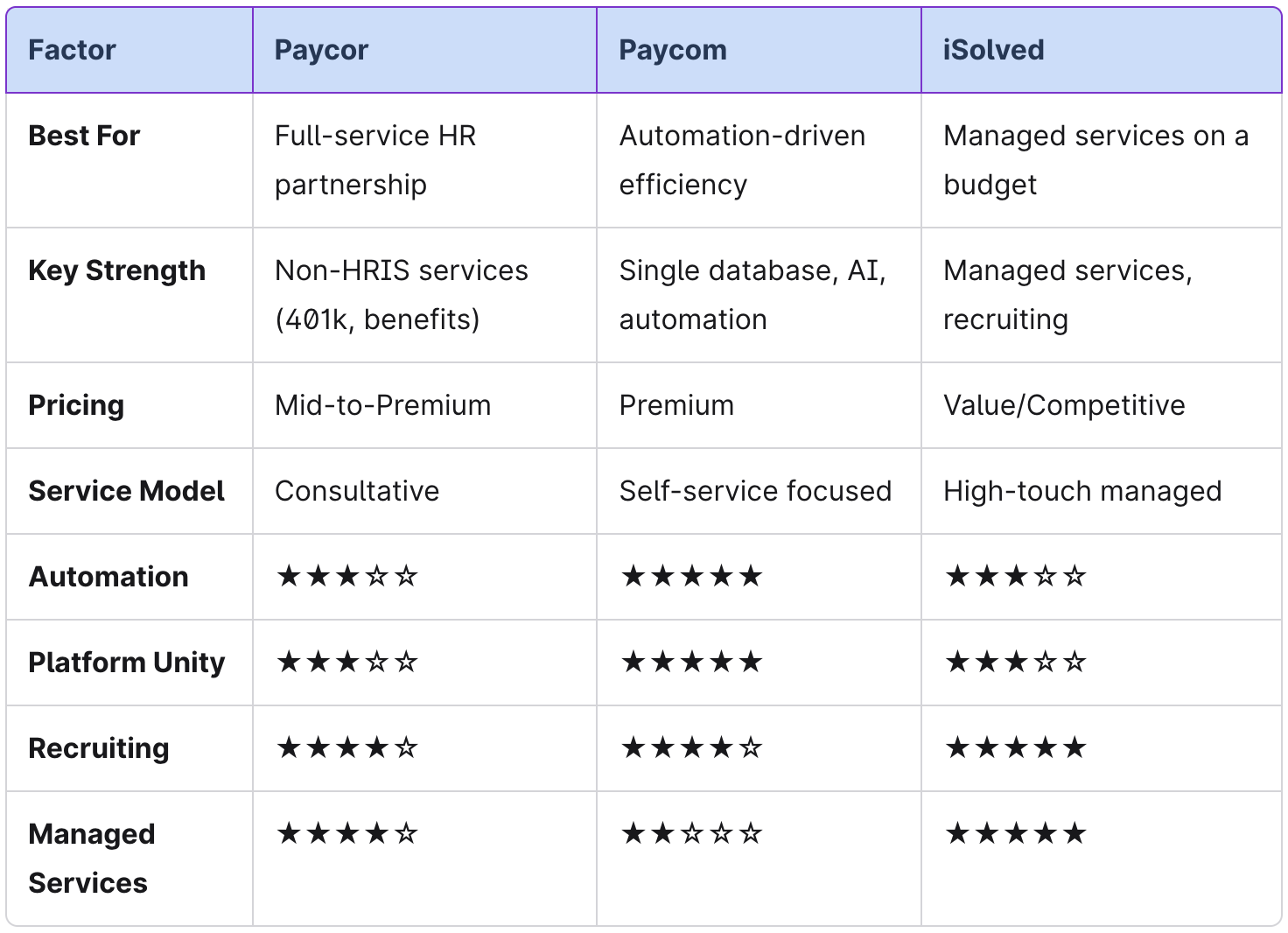
The Paycor vs Paycom comparison reflects fundamentally different value propositions. Choose Paycor if you want bundled services—401(k) administration, voluntary benefits, HR advisory—alongside your HCM platform. Paycor's value extends beyond software into services that simplify your broader HR operations. Choose Paycom if you want maximum efficiency through automation and AI. Paycom's single-database architecture and self-service philosophy deliver operational efficiency that service-heavy models can't match.
Paycom vs iSolved: Self-Service vs Managed Service
The Paycom vs iSolved decision comes down to how much help you want. Choose Paycom if your HR team is capable and wants technology that minimizes their administrative burden through automation. Paycom rewards organizations that invest in learning the platform and leveraging its automation capabilities. Choose iSolved if you want a partner who provides ongoing managed services and hands-on support. iSolved's model works well for leaner HR teams that need more vendor assistance.
Paycor vs iSolved: Breadth vs Value
The Paycor vs iSolved comparison balances service breadth against cost. Choose Paycor for their comprehensive non-HRIS services—particularly if you need 401(k) administration, extensive voluntary benefits, or HR advisory services integrated with your HCM. Choose iSolved for managed services at more accessible pricing. If your needs are primarily core HCM with strong recruiting, iSolved delivers without Paycor's premium.
Comparison Summary
Making the Decision: A Framework
Choose Paycor If:
- You want bundled non-HRIS services like 401(k) administration and voluntary benefits
- Retirement plan integration with your HCM is valuable
- You're in an industry (healthcare, manufacturing, nonprofit) where Paycor has specialized solutions
- You want a consultative vendor relationship with HR advisory services
- Consolidating vendor relationships across HR, benefits, and retirement is a priority
Choose Paycom If:
- Automation and efficiency are top priorities
- You want a single-database architecture with seamless data flow
- AI and machine learning capabilities matter to your HR strategy
- Your HR team is capable and wants to minimize administrative burden
- You're willing to invest in learning the platform to maximize its value
- You prefer self-service over vendor dependency
Choose iSolved If:
- Budget constraints make premium platforms impractical
- You want managed services and ongoing hands-on support
- Recruiting functionality is a particular priority
- Your HR team is lean and needs more vendor assistance
- You value local service delivery and personal relationships
- You prefer a service-oriented vendor over a technology-oriented one
Frequently Asked Questions
Which platform is most affordable?
iSolved typically offers the most competitive pricing among these three vendors. Paycom positions as premium with pricing to match. Paycor falls in between, though their bundled services can provide value that offsets higher base costs if you actually use those services.
Which platform has the best payroll?
All three process payroll effectively—this is table stakes for mid-market HCM. Paycom's single-database architecture means payroll integrates most seamlessly with time tracking, benefits, and HR data. Paycor and iSolved both deliver reliable payroll but from architectures that evolved through acquisition and integration.
Can these platforms handle complex scheduling?
All three offer time and attendance with scheduling capabilities, but none match dedicated workforce management platforms like UKG or Dayforce for complex scheduling scenarios. For standard scheduling needs, any of these platforms work. For complex shift-based operations with sophisticated forecasting requirements, consider workforce management specialists.
Which vendor provides the best customer service?
iSolved's managed services model typically delivers the highest-touch customer experience. Paycor offers consultative service, particularly around their non-HRIS offerings. Paycom's service model assumes platform self-sufficiency, which some customers experience as less supportive—though others appreciate the reduced vendor interaction.
How do implementation timelines compare?
Implementation timelines are roughly comparable—typically 8-16 weeks depending on complexity and scope. iSolved may move faster given their managed services approach to implementation. Paycom implementations require more client involvement in configuration. Paycor timelines vary based on which services are included.
Conclusion
The Paycor vs Paycom vs iSolved decision isn't about which platform has better features—all three offer comprehensive mid-market HCM functionality. The decision is about which approach fits your organization's needs and preferences.
Paycor delivers the most comprehensive service ecosystem, bundling 401(k) administration, voluntary benefits, and HR advisory services with their HCM platform. Organizations wanting to consolidate HR-adjacent services with a consultative partner find genuine value in Paycor's approach.
Paycom offers the most sophisticated technology, with single-database architecture, industry-leading automation, and aggressive AI investment. Organizations prioritizing efficiency through technology and willing to invest in platform mastery find Paycom rewards that commitment.
iSolved provides managed services at accessible pricing, combining hands-on support with surprisingly strong recruiting capabilities. Organizations with budget constraints or lean HR teams that need vendor assistance find iSolved delivers comprehensive HCM without premium pricing.
Choose based on what your organization actually needs—not feature checklists, but the service model, pricing approach, and vendor philosophy that fits how your HR team wants to work.
Ready to Compare Mid-Market HCM Platforms?
Feature lists look similar, but vendor approaches differ dramatically. OutSail's free HRIS Marketplace helps you compare Paycor, Paycom, iSolved, and dozens of other platforms based on what actually matters—service models, pricing structures, and real customer experiences.
What You Get with OutSail:
- Side-by-side platform comparisons — See real differences, not marketing claims
- Verified pricing benchmarks — Know what you should expect to pay
- Service model analysis — Match vendor approach to your needs
- Expert guidance — Advisors who've seen hundreds of HCM purchases


.png)
