Top 10 UKG Alternatives for Mid-Market & Enterprise 2026
Looking to switch from UKG in 2026? Compare the top 10 UKG alternatives for mid-market and enterprise companies — with pricing, pros, cons, and who each fits best.


UKG is one of the most recognized names in HR technology. It serves over 80,000 organizations globally, and its two flagship products — UKG Ready and UKG Pro — cover a wide range of workforce management needs for mid-market and enterprise companies alike.
But recognition and fit are two different things.
Many HR teams that initially chose UKG find themselves, a few years into the contract, wrestling with bloated module costs, implementation overruns, a UI that employees struggle to use, and a support model that feels reactive rather than proactive. For some organizations, UKG delivers exactly what they need. For others, the platform's weight and pricing become a burden rather than an advantage.
If you're evaluating whether to renew, renegotiate, or replace your UKG contract, this guide is for you. Below, we cover the 10 strongest UKG alternatives in 2026 — broken down by company size, use case, and the specific gaps they fill — along with the most common reasons buyers look to switch in the first place.
Ready to Find a Better Fit Than UKG?
OutSail helps HR and finance leaders evaluate, shortlist, and negotiate with HRIS vendors — at no cost to your organization. Our advisors have guided hundreds of companies through exactly this kind of evaluation.
Explore how OutSail's vendor matching works →
Why Companies Look for UKG Alternatives
Before comparing platforms, it helps to know what's driving the search.
Based on buyer conversations and public review data, these are the most common reasons companies look to leave UKG:
- High total cost of ownership. UKG Ready typically runs $20–$27 per employee per month (PEPM), while UKG Pro ranges from $26–$41 PEPM depending on modules. Implementation fees add another 20–70% of annual software costs on top of that. For a 500-employee company on Ready, you're looking at roughly $138,000 per year in licensing alone — before you account for implementation, training, or support.
- Unintuitive user experience. A recurring theme in UKG Pro reviews is that the interface feels layered and menu-heavy. Employees and managers alike report that routine tasks — submitting time-off requests, reviewing pay stubs, updating personal information — require more clicks than they should.
- Implementation complexity. UKG Pro implementations routinely stretch to four to six months, and buyers frequently report that the actual implementation cost exceeded original estimates. Data migration alone accounts for a large share of that overrun.
- Customer support concerns. Multiple reviews from 2025 and 2026 note that post-go-live support can feel slow or generic, particularly for organizations without dedicated account management.
- Module overbundling. UKG's à la carte model is a strength in theory, but many buyers end up purchasing modules they don't fully use. If your organization only needs core HR, payroll, and time — and doesn't require deep workforce management — you may be paying for capabilities that sit idle.
- Outgrowing or under-fitting the platform. Some organizations on UKG Ready eventually grow into territory where they need a more robust system. Others find UKG Pro more than they can operationally absorb given their headcount and HR team size.
None of this means UKG is a bad platform — for many industries and company profiles, it remains a strong choice. But if any of the above resonates, it's worth a structured comparison.
How to Evaluate UKG Alternatives
A vendor evaluation is only as good as the criteria you use. When comparing alternatives to UKG, consider:
- Functional coverage match. Does the alternative cover the modules you actually use in UKG — payroll, time and attendance, scheduling, talent management, benefits administration? Don't pay for gaps or redundant capabilities.
- Total cost of ownership, not just PEPM. Ask every vendor for an all-in quote that includes implementation, data migration, training, and year-two costs. Surprises in year one are common.
- Implementation timeline and methodology. If you're targeting a January 1 go-live, a platform with a six-month implementation runway isn't a realistic option.
- Scalability. Where will your company be in three to five years? Choose a platform that fits where you're going, not just where you are now.
- Customer support model. Dedicated CSMs, response SLAs, and community support quality vary widely. Get references and ask specific questions about post-go-live support.
- Integration compatibility. Map your current tech stack — ATS, ERP, benefits carriers, background check providers — and confirm pre-built connectors exist before signing.
The 10 Best UKG Alternatives in 2026
1. Workday HCM — Best UKG Pro Alternative for Enterprise

Best for: Enterprise organizations with 1,000+ employees seeking a unified finance and HR platform.
Workday is the most direct enterprise competitor to UKG Pro. Where UKG built its reputation in workforce management and time tracking, Workday's strength lies in the convergence of HR and finance — its planning, analytics, and financial management modules are best-in-class, and many CFOs push for Workday specifically because of how deeply it integrates with the finance function.
The platform covers the full HCM lifecycle: core HR, global payroll, recruiting, learning, talent management, workforce planning, and advanced analytics. It's cloud-native, built on a single data model, and updates continuously rather than in major annual releases.
Where it wins over UKG Pro: Finance-HR integration, people analytics depth, and a stronger global payroll story for multinational organizations.
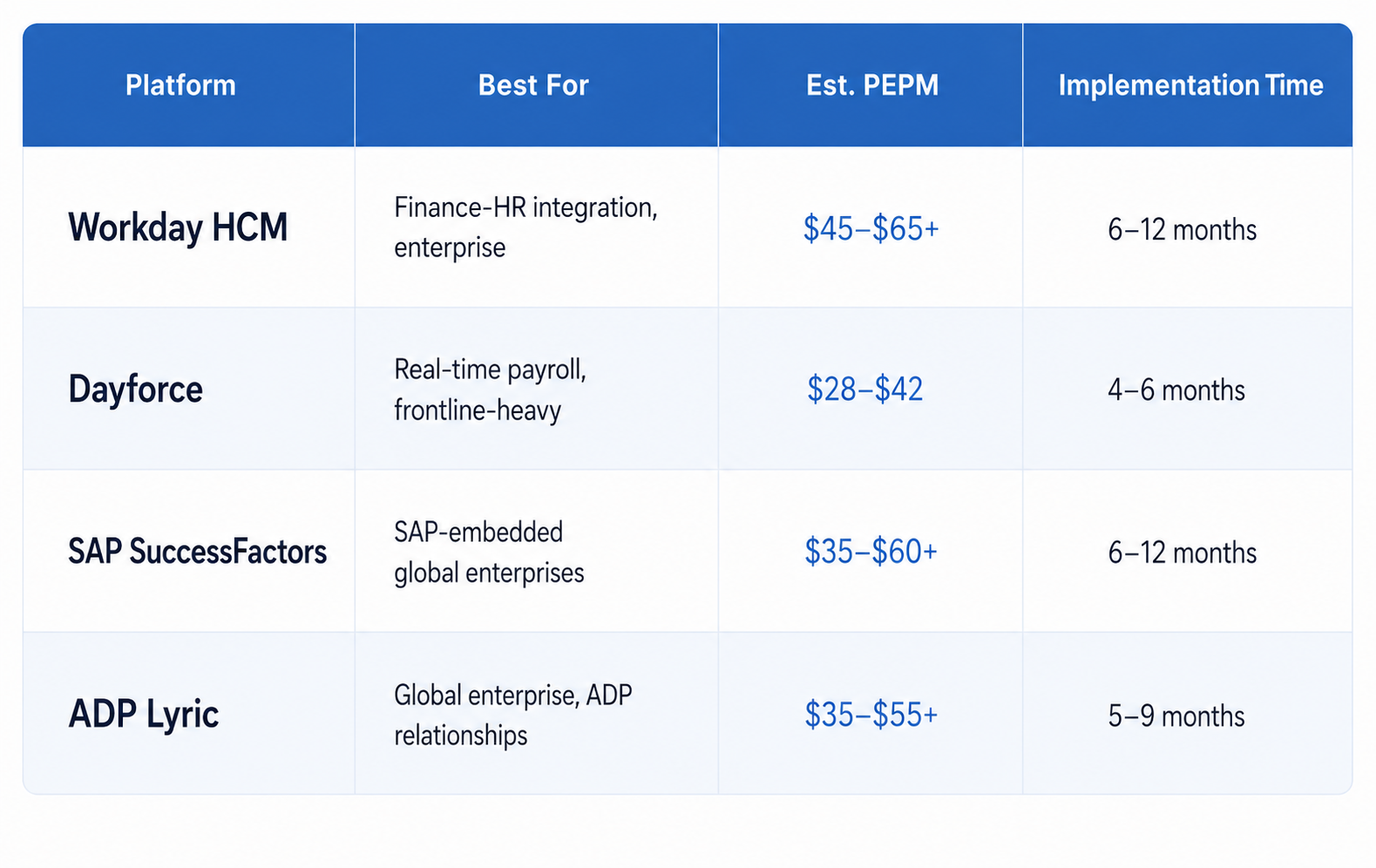
Where it trails: Workday is expensive — typically $45–$65+ PEPM for enterprise deployments — and implementations are lengthy (6–12 months is common). It requires significant internal resources and often third-party implementation support.
Pricing: Custom. Typically $45–$65 PEPM, with implementations starting in the $150,000–$500,000+ range.
Ideal company profile: 1,000–25,000 employees; organizations where the CFO is a co-buyer of the HR system.
2. Dayforce (Ceridian) — Best for Real-Time Payroll and Workforce Management

Best for: Mid-enterprise organizations (500–5,000 employees) with hourly workforces who need real-time payroll.
Dayforce is the platform most often mentioned in the same breath as UKG Pro when mid-enterprise buyers are shortlisting. Its defining capability is a single, real-time payroll engine — rather than running payroll in a batch at end-of-period, Dayforce calculates pay continuously as employees clock in and out. For organizations with high hourly headcounts, complex scheduling, or compliance requirements around overtime and labor law, this is a meaningful operational advantage.
Ceridian has aggressively invested in AI-powered scheduling and workforce planning features in recent years, and the platform now competes strongly with UKG's workforce management depth.
Where it wins over UKG Pro: Real-time pay calculation, scheduling for frontline workers, and a more modern UI that scores consistently higher in user experience reviews.
Where it trails: Talent management and recruiting modules are less mature than Workday's or ADP's. Global payroll coverage, while improving, is narrower than UKG Pro's.
Pricing: Custom. Estimated $28–$42 PEPM for mid-enterprise deployments.
Ideal company profile: 300–5,000 employees; healthcare, retail, manufacturing, and hospitality with hourly-heavy workforces.
For a deeper look, see OutSail's full UKG vs Dayforce enterprise workforce comparison.
3. ADP Workforce Now — Best UKG Ready Alternative for Mid-Market

Best for: Mid-market companies (100–1,000 employees) seeking proven payroll compliance and a wide integration library.
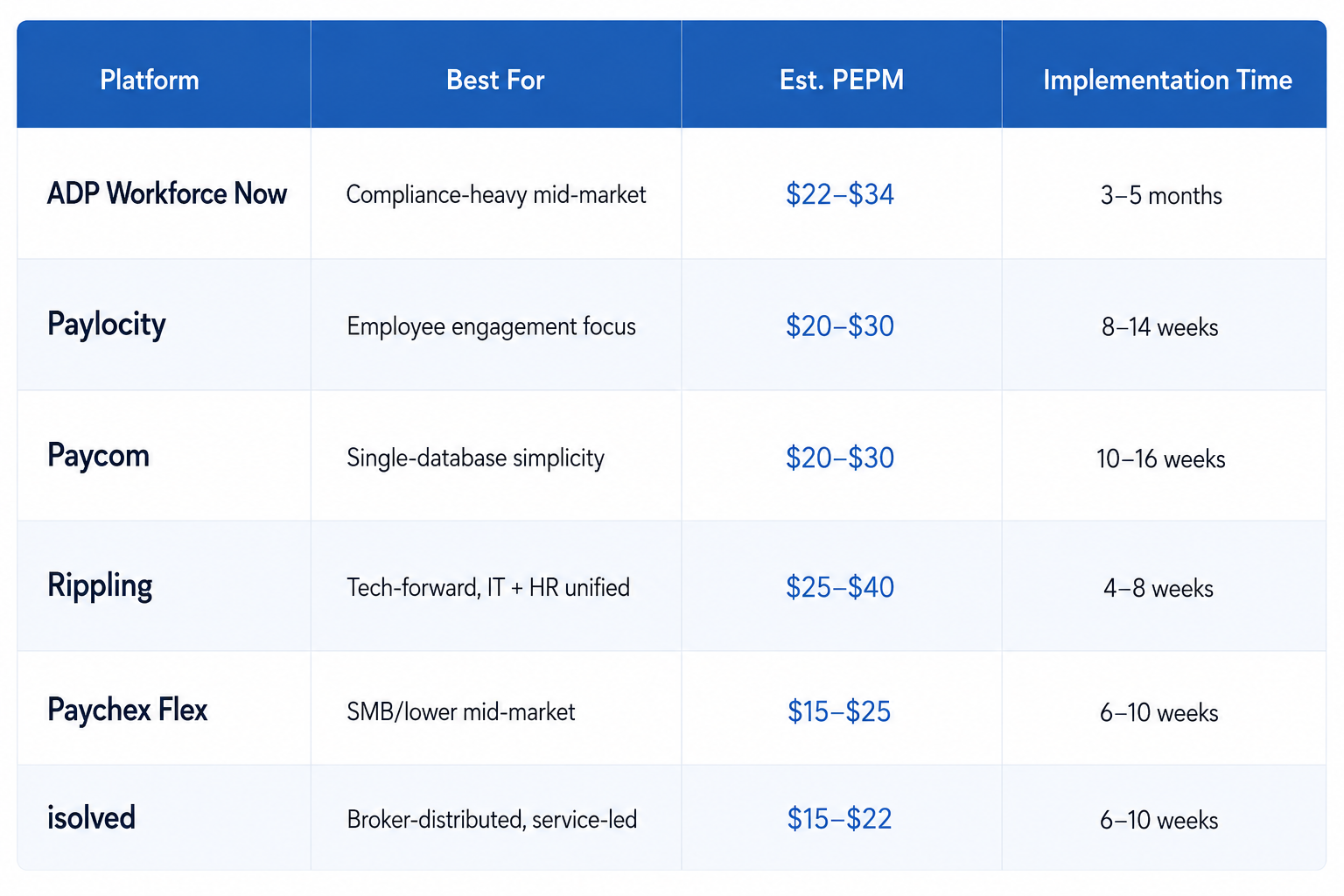
ADP Workforce Now is the most common alternative buyers consider when leaving UKG Ready. It serves the same general market — mid-sized organizations that need full-suite HR, payroll, time, and benefits administration — but it brings a broader integration ecosystem, deeper compliance infrastructure, and the brand reassurance that comes with ADP's scale.
ADP processes payroll for more organizations in the United States than any other provider. Its compliance update cadence, direct tax filing infrastructure, and multi-state payroll handling are mature capabilities that take years to build. For HR teams that spend meaningful time on compliance-related tasks, this is a real differentiator.
Where it wins over UKG Ready: Payroll compliance depth, integration library breadth (700+ pre-built connectors), and global payroll availability in 140+ countries.
Where it trails: The Workforce Now interface is functional but not especially modern. User experience reviews tend to rate it lower than newer platforms like Rippling or HiBob on visual design and ease of navigation.
Pricing: Custom. Typically $22–$34 PEPM depending on modules and headcount.
Ideal company profile: 100–1,000 employees; multi-state or international operations; organizations where payroll compliance is a primary concern.
OutSail's ADP Workforce Now review covers features, pricing, and real-world user feedback in detail.
4. Paylocity — Best for Mid-Market Companies Prioritizing Employee Engagement

Best for: Mid-market companies (100–1,000 employees) that want strong payroll combined with modern employee experience tools.
Paylocity occupies a distinctive position in the mid-market: it's one of the few platforms that pairs solid payroll and HR fundamentals with genuinely useful employee engagement features — surveys, peer recognition, community tools, and a mobile experience that employees actually use voluntarily.
If UKG Ready felt too operationally focused and not enough of a culture-building tool, Paylocity is worth a close look. Its UI is cleaner than most platforms in its price range, and its implementation timelines are considerably shorter than UKG Pro's (typically 8–14 weeks for mid-market deployments).
Where it wins over UKG Ready: Employee experience modules, mobile app quality, modern UI, and a service model that mid-market buyers consistently rate highly.
Where it trails: Paylocity's workforce management and scheduling capabilities are less robust than UKG Ready's for organizations with complex hourly workforces. It works best for 300+ employee companies; smaller organizations may find it overbuilt.
Pricing: Custom. Typically $20–$30 PEPM.
Ideal company profile: 300–2,500 employees; technology, professional services, and corporate environments where employee engagement and culture tools matter.
See OutSail's Paylocity review for a full breakdown of features and buyer fit.
5. Paycom — Best Single-Database HCM for Mid-Market

Best for: Mid-market companies (100–2,500 employees) that want a tightly integrated, single-database platform.
Paycom's pitch is simple: everything in one database, built from the ground up, with no integration seams between payroll, HR, time, and talent modules. That single-database architecture means employee data flows cleanly across the platform without the sync errors or reconciliation work that multi-module systems sometimes require.
Its employee self-service features — particularly Beti, a payroll self-service tool that has employees review and approve their own payroll before it processes — genuinely reduce HR administrative burden in ways that buyers notice post-implementation.
Where it wins over UKG Ready: Single-database architecture reduces data discrepancies, Beti payroll self-service is a genuine time saver for payroll teams, and the implementation process is more standardized.
Where it trails: Paycom's service model is more prescriptive than some buyers prefer — the platform is less configurable than UKG, and buyers who need heavy customization may hit walls. International payroll capabilities are limited compared to UKG.
Pricing: Custom. Typically $20–$30 PEPM.
Ideal company profile: 100–2,500 US-based employees; companies that prioritize a clean single system over broad customizability.
6. Rippling — Best for Tech-Forward Companies Combining HR and IT

Best for: Fast-growing, tech-forward companies (50–2,000 employees) that want a unified HR, IT, and payroll platform.
Rippling's core differentiator is the breadth of what it manages: HR, payroll, benefits, time, talent, and IT device management in a single platform. When an employee is hired or offboarded, Rippling can simultaneously update payroll, provision a laptop, grant app access, and enroll them in benefits — all from one workflow.
For technology companies, distributed teams, and organizations with high employee-to-IT-staff ratios, this automation across departments reduces manual coordination substantially. Rippling's UI is also among the most modern in its category, and its speed of implementation (often 4–8 weeks) outpaces UKG Ready by a wide margin.
Where it wins over UKG Ready: HR + IT unification, fastest implementation in the category, global employer of record (EOR) capabilities, and a product-forward UX that employees and HR teams alike tend to enjoy.
Where it trails: Rippling's workforce management depth — scheduling, complex time rules, union compliance — does not match UKG Ready's for industries like healthcare, manufacturing, or hourly-heavy retail. It's optimized for office-centric and knowledge-worker workforces.
Pricing: Modular. Base HR platform starts around $8 PEPM; full-suite deployments typically run $25–$40 PEPM depending on modules.
Ideal company profile: 50–2,000 employees; technology, SaaS, and professional services; remote-first or distributed teams.
7. Paychex Flex — Best for Smaller Mid-Market with Full-Service Payroll

Best for: Companies with 50–500 employees that want a managed payroll relationship with HR features included.
Paychex Flex sits in an interesting position: it's more than a small-business tool but less overwhelming than a full mid-enterprise suite. For companies that came from a PEO or a simple payroll provider and are stepping up for the first time to a full HRIS, Paychex Flex's guided setup, dedicated payroll specialists, and bundled HR advisory services reduce the operational burden on internal teams considerably.
Its workforce management features are improving, and for companies that don't have complex scheduling or union rules, it covers the core use cases well.
Where it wins over UKG Ready: Lower cost of entry, faster implementation, a managed payroll service option (where Paychex handles payroll runs), and a less resource-intensive ownership model.
Where it trails: Paychex Flex's analytics, reporting, and talent management features are not as deep as UKG Ready's. Growing companies may find they need to migrate again at the 500–1,000 employee mark.
Pricing: Custom. Typically $15–$25 PEPM.
Ideal company profile: 50–500 employees; companies stepping up from a basic payroll provider or PEO; organizations without a dedicated HR operations team.
8. SAP SuccessFactors — Best UKG Pro Alternative for SAP-Integrated Enterprises

Best for: Large enterprises (2,000+ employees) already running SAP ERP or S/4HANA.
For enterprise organizations deeply embedded in the SAP ecosystem, SuccessFactors is the most natural UKG Pro replacement. The integration with SAP financial systems, supply chain, and ERP is native rather than configured, which eliminates significant middleware complexity and cost.
SuccessFactors covers global payroll, core HR, recruiting, learning, and performance management at enterprise scale. Its compliance footprint across global jurisdictions is among the most mature in the category.
Where it wins over UKG Pro: Depth of SAP ERP integration, global compliance coverage in 100+ countries, and analytics capabilities that scale to very large organizations.
Where it trails: Implementation complexity and cost are at least as high as UKG Pro, and often higher. The UI receives mixed reviews — functional and thorough, but not particularly modern. Companies without existing SAP infrastructure gain less from the platform than SAP-native organizations.
Pricing: Custom. Typically $35–$60+ PEPM for large enterprise deployments.
Ideal company profile: 2,000+ employees with existing SAP infrastructure; global enterprises prioritizing compliance and ERP integration.
9. ADP Lyric (formerly ADP Alight / Enterprise) — Best for Large Enterprise Replacing UKG Pro
Best for: Large enterprises (2,500+ employees) that want ADP's global payroll depth in a modern cloud architecture.
ADP Lyric is ADP's reengineered enterprise HCM platform — designed to fill the gap between ADP Workforce Now (mid-market) and the full enterprise complexity that large organizations need. It targets the same buyer profile as UKG Pro and Workday: organizations with complex payroll, multi-country operations, and deep workforce analytics requirements.
For buyers who want ADP's compliance infrastructure at enterprise scale — without the configuration overhead of Workday or the workforce management-first DNA of UKG — Lyric is worth a serious look.
Where it wins over UKG Pro: ADP's global payroll infrastructure (140+ countries), brand-name reliability, and a cleaner architectural approach than the legacy UltiPro-derived foundations of UKG Pro.
Where it trails: ADP Lyric is still maturing as a platform — it hasn't yet built the implementation track record that UKG Pro or Workday have. Buyers should ask for specific reference customers at their scale.
Pricing: Custom enterprise pricing. Typically $35–$55+ PEPM.
Ideal company profile: 2,500–50,000 employees; multinationals; organizations with existing ADP relationships at the divisional level.
10. isolved — Best for Service-Bureau-Dependent Mid-Market Companies
Best for: Mid-market organizations (50–500 employees) that work through HR/payroll brokers and want deep partner-channel support.
isolved is a platform primarily distributed through HR service bureaus and broker partners — meaning the buying experience is often more curated and relationship-driven than going direct to a vendor like UKG. For companies that want a hands-on implementation partner and ongoing payroll management support (rather than owning the system entirely in-house), isolved's channel model is a genuine differentiator.
It covers core HR, payroll, time, benefits, and talent in a fully bundled suite, and its pricing is often more accessible than UKG Ready for smaller mid-market companies.
Where it wins over UKG Ready: Lower price point, a service-bureau distribution model that provides hands-on support, and simpler onboarding for HR teams without large internal technical resources.
Where it trails: isolved doesn't have the depth of workforce management features, analytics sophistication, or brand recognition of UKG. Companies expecting to scale past 500–700 employees may outgrow it.
Pricing: Custom. Typically $15–$22 PEPM through reseller channels.
Ideal company profile: 50–500 employees; companies working with an HR broker or consultant who recommends and manages the relationship; organizations without robust internal HRIS administration capacity.
OutSail's isolved review covers the platform in detail, including module availability and user feedback.
UKG Ready Alternatives: Quick Comparison
UKG Pro Alternatives: Quick Comparison
How Much Does UKG Cost vs. Its Alternatives?
One of the most common questions buyers ask when evaluating alternatives is whether they can reduce overall spend. The answer depends on which modules you're currently using and which you actually need.
UKG Ready runs $20–$27 PEPM for the full suite, with implementation adding 20–40% of annual costs on top. UKG Pro ranges from $26–$41 PEPM, with implementation fees often reaching 40–70% of annual software costs for enterprise deployments.
Platforms like Paylocity, Paycom, and Rippling often come in at comparable or slightly lower PEPM rates for mid-market buyers, but with meaningfully shorter implementation timelines and lower implementation costs. The total first-year cost difference can be substantial.
For enterprise buyers considering Workday or SAP SuccessFactors, the licensing cost is likely to be higher than UKG Pro — but buyers often justify that premium through reduced integration complexity, finance-HR unification value, or global payroll coverage.
To get a precise comparison for your organization, our HRIS pricing comparison guide walks through cost benchmarks across all major platforms in one place.
What to Do Before Switching from UKG
Switching HRIS platforms is a serious undertaking. Before you start demos, do the following:
- Audit your current usage. Which UKG modules are you actively using, and which did you buy but never fully implement? Paying for unused capabilities is a signal you may be able to find a better-fit (and cheaper) alternative.
- Document your non-negotiables. Time and attendance complexity, shift scheduling rules, multi-state payroll requirements, union agreements, or specific compliance needs should be documented before you evaluate alternatives. These are where platforms differentiate most meaningfully.
- Check your contract. UKG contracts typically run two to three years. Understand your renewal window, early termination provisions, and data portability terms before initiating conversations with other vendors.
- Build your internal stakeholder map. HRIS replacements require buy-in from HR, Finance, IT, and often legal. Know who the decision-makers and influencers are before you start the evaluation.
- Consider using an advisor. HR technology evaluations are time-consuming and expertise-intensive. Vendor-agnostic advisors like OutSail can compress timelines, provide current market pricing benchmarks, and handle vendor outreach on your behalf — at no cost to your organization.
For a deeper look at UKG's platform strengths and where it fits best, review OutSail's UKG Pro review and UKG Ready review.
Conclusion
UKG built a strong business by serving organizations that need deep workforce management capabilities. But the HR technology market has matured considerably, and buyers now have more purpose-fit alternatives than at any point in the industry's history.
Whether you're on UKG Ready and want a more modern, lower-cost mid-market platform, or on UKG Pro and ready for a system that better aligns with your finance team's priorities, the alternatives in this guide are worth a structured look.
The key is not to choose the most popular platform — it's to choose the platform that fits your headcount, your workflows, your budget, and your internal capacity to implement and maintain it.
Ready to Start Your UKG Evaluation?
OutSail's advisors specialize in exactly this: helping mid-market and enterprise companies build structured, vendor-agnostic evaluations that lead to confident, well-negotiated outcomes. There's no cost to your organization — vendors pay for access to buyers, not the other way around.
Book a free consultation with an OutSail advisor →
Frequently Asked Questions
What is the best alternative to UKG Pro for enterprise companies?
The best UKG Pro alternatives for enterprise companies are Workday HCM and Dayforce (Ceridian), depending on your priorities. Workday is the stronger choice for organizations where finance and HR integration is a strategic priority, or where global analytics depth matters most. Dayforce leads when real-time payroll, frontline workforce scheduling, and a more modern user experience are the primary drivers. SAP SuccessFactors is the top choice for enterprises already running SAP ERP infrastructure.
What is the best alternative to UKG Ready for mid-market companies?
For mid-market companies leaving UKG Ready, Paylocity and ADP Workforce Now are the most frequently considered alternatives. Paylocity offers a more modern UI, stronger employee engagement tools, and faster implementation timelines. ADP Workforce Now is the stronger choice if payroll compliance complexity, multi-state operations, or a large integration library are the priority. Rippling is worth evaluating for technology-forward companies that want HR and IT unified on a single platform.
How much does it cost to switch from UKG to another HRIS?
The total cost of switching from UKG includes new platform licensing, implementation and data migration services, training, and potential overlap costs during transition. For mid-market companies (200–500 employees), expect total first-year costs of $80,000–$250,000 depending on the platform chosen and deployment scope. Enterprise replacements (1,000+ employees) can range from $300,000 to well over $1 million in year one. Getting accurate quotes requires a structured evaluation — vendors price aggressively for competitive displacement opportunities.
How long does it take to implement a UKG alternative?
Implementation timelines vary significantly by platform and company size. Mid-market platforms like Paylocity, Rippling, and Paycom typically implement in 8–16 weeks. ADP Workforce Now generally takes 3–5 months. Enterprise platforms like Workday and SAP SuccessFactors typically require 6–12 months. Dayforce falls in between, often 4–6 months for mid-enterprise deployments. Timeline accuracy depends heavily on data readiness, internal project resources, and the number of integrations required.
What should I look for when evaluating UKG competitors?
When evaluating UKG competitors, prioritize these criteria: total cost of ownership (not just PEPM), implementation timeline and methodology, customer support model post go-live, workforce management depth for your specific industry, global payroll coverage if you have international employees, and integration compatibility with your existing tech stack. It's also worth evaluating configurability — some platforms are more prescriptive than UKG, which is a tradeoff between ease of use and flexibility. For a structured approach, OutSail's HRIS requirements builder helps you document your priorities before starting vendor conversations.
.png)
