Observing HR Tech Buying Behavior in 2026
What hundreds of HR software evaluations reveal about shifting buyer priorities, rising vendors, AI adoption, and the state of the market in 2026


One of my favorite exercises every year is digging into the data behind our advisory projects.
Every company that works with OutSail has gone through the same intake process for 6+ years. We ask about their current systems, priorities, integration needs, vendor preferences, budget confidence, and what they're hoping to achieve with a new platform.
With 2026 officially at the halfway mark, we pulled data from 2024, 2025, and the first six months of 2026 to see what has actually changed.
Some findings were exactly what we expected. Others surprised us.
Let's dive in!
HiBob Has Officially Arrived
One of the questions we ask every client is simple:
"Are there any vendors you'd like to see on your shortlist?"
For us, this serves as a useful proxy for market buzz. Which vendors are buyers actively thinking about before they even start their evaluations?
The leaders this year were Rippling, Workday, Paylocity, and HiBob.
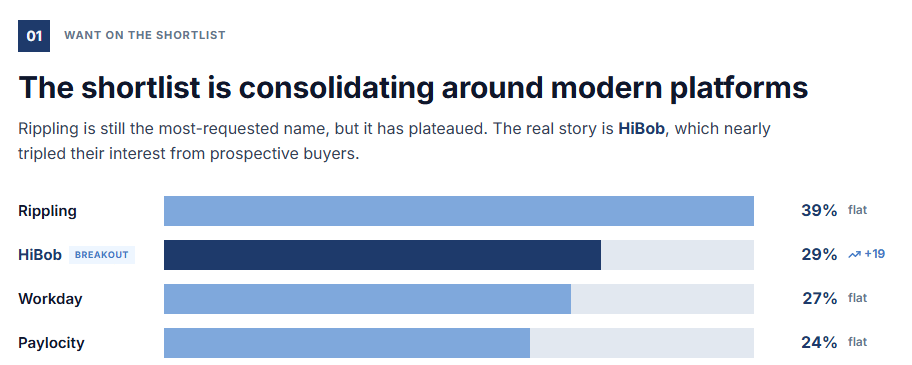
Rippling, Workday and Paylocity’s request ratio has consistently been strong over the last several years.
The breakout story is HiBob.
Buyer requests for HiBob have roughly tripled since 2024.
Part of that growth comes from starting on a smaller base than vendors like Workday and Paylocity. But that only explains part of the story.
The bigger takeaway is that HiBob has successfully moved from "interesting challenger" to "mainstream consideration."
When buyers begin mentioning you before the evaluation even starts, you've crossed an important threshold in market awareness.
The HRIS Market Isn't As Saturated As We Thought
Another question we ask every client:
"What system are you using today?"
Historically, the assumption has been that the HRIS market is largely saturated. Most organizations already have something in place and vendors simply compete to steal customers from one another.
The data tells a different story.
In prior years, roughly 9% of our clients came to us without an existing HCM or HRIS platform. In 2026, that number jumped to 16%.
That's a surprisingly large increase.
Some of it can be explained by M&A activity, carve-outs, and newly formed organizations spinning up independent systems.
But that doesn't explain all of it.
There remains a meaningful greenfield market of organizations that still haven't fully adopted modern HR technology.
For vendors, that's encouraging news. Not every opportunity requires displacement. There are still buyers entering the market for the first time.
A couple of retention stories also stood out.
Both Paycom and Dayforce saw decreases in the percentage of clients moving off their platforms compared to prior years. It's only one data point, but it suggests those vendors may be doing a better job retaining customers in 2026.
Ashby Is Having A Moment
Integration requests often reveal trends before they show up elsewhere.
When buyers tell us which systems they need to keep, it provides a glimpse into which vendors are gaining traction and becoming embedded within organizations.
The biggest winner this year was Ashby.
In 2024, Ashby appeared on roughly 1% of integration requests. In 2026, it's showing up on 16%. That's an enormous jump.
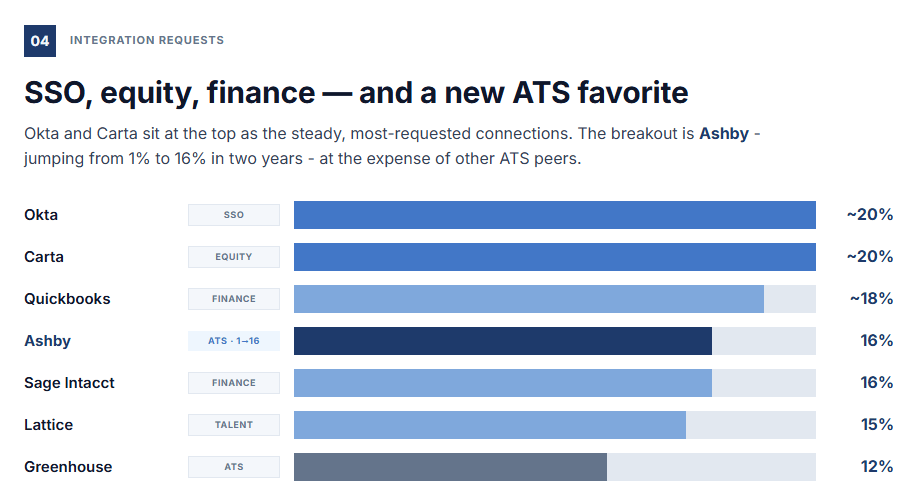
At the same time, Greenhouse has moved in the opposite direction.
Last year, Greenhouse appeared on nearly 20% of integration requests. This year, it's closer to 9%.
That doesn't mean Greenhouse is disappearing. Far from it.
But it does suggest that Ashby has firmly established itself as one of the most significant challengers in the recruiting technology market.
Another surprise was Sage Intacct.
While integrations like Okta, Carta, QuickBooks, and NetSuite have remained remarkably consistent year over year, Sage Intacct saw a noticeable increase and now appears on roughly 12% of all client projects.
Reporting Is Rising Faster Than Anything Else
In the intake survey, every client is asked to identify their top three priorities for a new system.
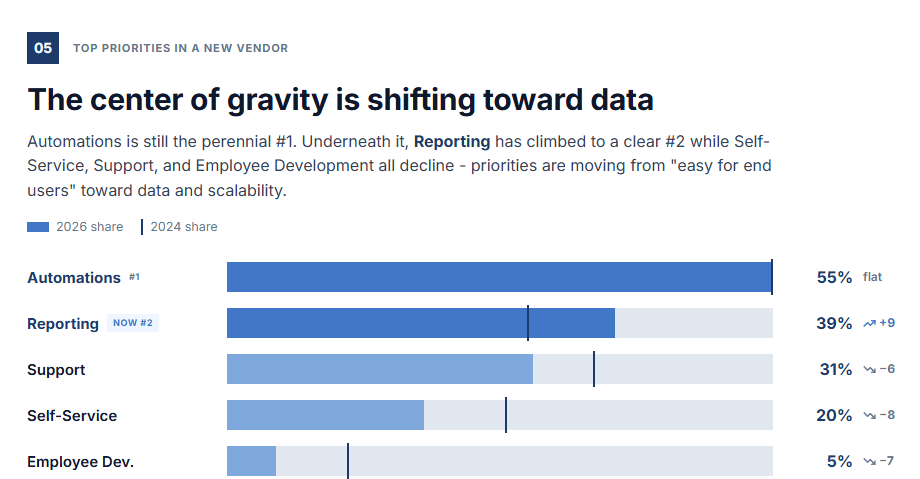
The consistent winner remains automation. More than half of buyers cite automation, workflows, and reducing manual processes as a top objective.
What is seeing a surge is requests for better reporting.
Historically, reporting appeared on roughly 30% of buyer priority lists. This year it's approaching 40%.
My suspicion is that this is tied to the fact that we're seeing greater executive involvement in HR technology decisions.
CEOs, CFOs, and leadership teams increasingly want visibility into workforce data, they are not viewing HCM as an HR-only system and they want to be more hands-on with data in an AI era.
Better reporting sits right at the center of that demand.
Interestingly, reporting's rise appears to be coming at the expense of two historically important categories.
Customer support declined from roughly 37% of buyers citing it as a priority to 31%.
Employee self-service and user experience fell from approximately 28% to 20%.
Both remain important, but each is getting squeezed by the executive pressure on reporting and data.
AI Is Growing... But Slower Than The Headlines Suggest
The final finding may be the most interesting.
Beyond our structured questions, we also ask buyers an open-ended question:
"Are there any other priorities we should know about?"
- In 2024, exactly 0% of those responses mentioned AI.
- In 2025, that number rose to 0.7%.
- This year, it's 4.8%.
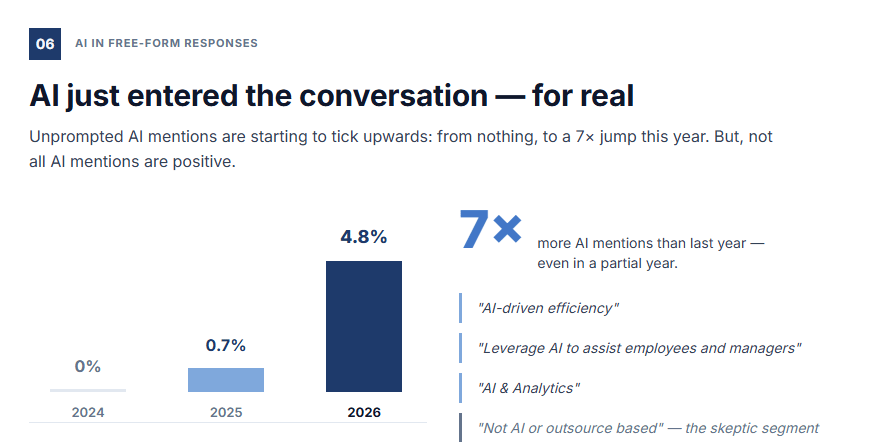
That's nearly a sevenfold increase in a single year.
Clearly, AI is becoming part of the conversation.
But the more interesting observation is how small the number still is.
For all the headlines, keynote speeches, and LinkedIn debates, fewer than 5% of buyers are proactively bringing up AI during software evaluations.
And some of those mentions aren't positive. Several buyers are specifically telling us they don't want AI heavily involved in their processes.
The takeaway isn't that AI doesn't matter. It absolutely does.
The takeaway is that buyers are still focused on fundamentals first: Automation. Reporting. Integrations. Payroll. Compliance. Service.
The AI conversation is growing rapidly, but it hasn't yet overtaken the practical realities of running HR.
Final Thoughts
The biggest takeaway from this year's data is that the market feels surprisingly healthy.
Budget confidence has remained relatively stable.
New buyers continue entering the market.
Established vendors continue generating strong interest.
And emerging players like HiBob and Ashby are proving that there's still room to break into the mainstream conversation.
And, while the headlines will tell you that AI is the only story in HR Tech, the data tells a different story.
Most organizations are still trying to solve the same challenges they've always had: automate work, improve reporting, streamline operations, and give their teams better tools.

.png)
