HRIS for Government Contractors: DCAA Compliance, Timekeeping, and Security Clearance Tracking
Government contractors have unique HRIS requirements — DCAA timekeeping, direct/indirect labor distribution, security clearance tracking, and CUI handling. Here's what to look for in 2026.


Government contracting is one of the most compliance-intensive operating environments in American business. Federal contractors must satisfy auditors, maintain meticulous records, allocate labor costs across multiple cost objectives, protect Controlled Unclassified Information, and track employee security clearances — all while running day-to-day HR and payroll operations that have to work flawlessly.
Most mainstream HRIS platforms were not built with these requirements in mind. A system that works beautifully for a retail chain or a technology company can create serious audit exposure for a defense contractor when it lacks the specific controls that the Defense Contract Audit Agency (DCAA) requires, or when it can't support the contract-specific labor distribution that FAR cost principles demand.
This guide covers what government contractors actually need from an HRIS in 2026 — and how the five platforms most commonly considered by GovCon organizations (ADP Workforce Now, UKG, Paycom, Paylocity, and Dayforce) stack up against those requirements.
Why Standard HRIS Evaluation Criteria Aren't Enough for GovCon
Before getting into specific platform capabilities, it helps to understand what makes the government contracting environment different from other HRIS buyers.
DCAA audit exposure is real and ongoing. The Defense Contract Audit Agency conducts floor checks — real-time audits of timekeeping practices — as well as accounting system audits that evaluate whether a contractor's systems produce reliable cost data. An HRIS that can't produce a clean, supervisor-approved, daily time entry audit trail doesn't just create operational friction; it creates findings that can affect contract award eligibility.
Labor allocation is far more granular than standard payroll. Commercial companies typically track labor by department or cost center. Government contractors must allocate labor across contract line item numbers (CLINs), task orders, indirect cost pools (overhead, G&A, fringe), and unallowable cost categories — often simultaneously for the same employee in the same pay period. An HRIS that can't support this level of labor distribution forces contractors into manual reconciliation that introduces both compliance risk and operational overhead.
Security clearance management sits at the intersection of HR and national security. Most HRIS platforms handle basic employee credential tracking. Government contractors need to track Standard Form 86 (SF-86) submission status, investigation outcomes managed through the Defense Counterintelligence and Security Agency (DCSA), clearance levels (Confidential, Secret, Top Secret, TS/SCI), periodic reinvestigation dates, and access authorizations — with the ability to alert HR and the Facility Security Officer (FSO) when clearances are approaching expiration or reinvestigation windows.
CUI and CMMC requirements affect the HRIS itself as a system. If your HRIS stores employee data that could include Controlled Unclassified Information — and for many defense contractors, it does — the platform and its cloud infrastructure may fall within your CMMC assessment scope. As of Phase 1 of the CMMC rollout (which began November 2025), contractors handling CUI are required to demonstrate compliance with NIST SP 800-171 controls. Cloud Service Providers used by contractors to handle CUI must meet FedRAMP Moderate Baseline or equivalent requirements. This is not a future consideration — it is an active contractual obligation on DoD solicitations in 2026.
With these requirements as context, here is what to evaluate in an HRIS vendor.
Explore OutSail's HRIS Evaluation Tools
OutSail's evaluation platform helps GovCon HR teams build structured vendor scorecards that include compliance-specific criteria — alongside traditional functional requirements. Our advisors have experience in regulated industries and can help identify which platforms have the configuration depth your contracts require.
Access OutSail's evaluation tools at no cost →
The 6 HRIS Requirements That Define a GovCon-Capable Platform
1. DCAA-Compliant Timekeeping Architecture
DCAA timekeeping requirements are not a checklist of features. They are a set of controls and practices that must be embedded in how the system works — not just available as optional configurations.
The non-negotiable requirements under FAR, DFARS, and DCAA's Contract Audit Manual:
- Daily time entry enforcement. Employees must record time each day, not at the end of the week or pay period. An HRIS that allows backdated weekly entry is not DCAA-compliant regardless of how it's marketed. The system must enforce — not merely encourage — daily entry.
- Employee self-entry with supervisor approval. Employees must record their own time. Supervisors cannot enter time on behalf of employees. The system must enforce this separation and document the approval chain — who approved what, and when.
- 100% time accounting. Every employee — not just those working on government contracts — must account for all of their time across all cost objectives. This includes indirect time (overhead tasks, business development, training, leave) as well as direct contract time.
- Immutable correction records. When a time entry must be corrected, the original entry must remain visible, the correction must be documented with a reason, and both the employee and an approving supervisor must sign off. Systems that allow silent overwrites fail DCAA floor checks.
- Contract/task order charge code assignment. Time must be charged to the specific contract, task order, or indirect cost objective it reflects. Vague cost center codes are insufficient. The system must support a charge code structure that maps to your accounting system and your contract line items.
- Audit trail accessibility. DCAA auditors can conduct floor checks without advance notice. Your system must produce a complete, current audit trail on demand — including employee time entries, approval history, correction records, and system access logs.
- What this means for HRIS selection: Many HRIS platforms have time and attendance modules that meet commercial payroll needs. Fewer have the specific combination of daily-entry enforcement, immutable correction records, and charge code flexibility required for DCAA compliance. Evaluate the timekeeping module with a GovCon-specific scenario, not just a general demo.
2. Direct and Indirect Labor Distribution
For government contractors, the payroll register is not the end of the labor cost story — it is the beginning. After payroll runs, labor costs must be distributed across the full chart of accounts that your cost accounting system uses, including:
- Direct labor costs by contract, task order, and CLIN
- Indirect cost pools: fringe benefits, overhead, and general and administrative (G&A) expenses
- Independent research and development (IR&D) or bid and proposal (B&P) accounts
- Unallowable cost categories (which cannot be billed to the government under FAR 31.205)
An HRIS that processes payroll accurately but cannot export a labor distribution report that maps to these cost categories forces your accounting team to reprocess payroll data manually in a separate system. This manual step is both expensive and introduces reconciliation errors between what the HRIS shows and what the accounting system records.
What to evaluate: Can the HRIS produce a labor distribution report — not just a standard payroll register — that shows hours and costs by employee, by charge code, by cost objective, by pay period? Can that report be exported in a format that integrates directly with your accounting system (GCS Premier, CostPoint, QuickBooks, Sage Intacct, or similar)? Does the integration maintain the mapping between HRIS cost centers and accounting system cost objectives without manual remapping each period?
3. Security Clearance and Certification Tracking
Most HRIS platforms offer some form of employee credential or certification tracking. Government contractors need a more specific capability: the ability to track the full lifecycle of personnel security clearances, including submission status, investigation type, clearance level, adjudication outcomes, access authorizations, and reinvestigation dates — and to surface alerts before critical deadlines.
What GovCon HR teams need to track:
Clearance level and status. Confidential, Secret, Top Secret, or TS/SCI — and the current adjudication status (active, interim, denied, revoked, or under reinvestigation).
SF-86 submission and investigation tracking. The date the SF-86 was submitted through NBIS eApp (the successor to e-QIP), investigation type (NACLC, Tier 3, Tier 5), and current status within the DCSA investigation pipeline.
Periodic reinvestigation dates. Secret clearances require reinvestigation every ten years. Top Secret clearances require reinvestigation every five years. TS/SCI clearances may require continuous evaluation. An HRIS that doesn't surface upcoming reinvestigation windows forces the FSO to manage this manually outside the system.
Access authorizations. Which facilities, programs, or compartments an employee is authorized to access — particularly for Special Access Programs (SAPs) and Sensitive Compartmented Information (SCI) programs where access is separate from the underlying clearance level.
Expiration and lapse alerts. Automated notifications to HR and the FSO when a clearance is approaching reinvestigation, when an interim clearance is expected to resolve, or when a clearance has lapsed due to a gap in employment.
The integration question: Security clearance records maintained by DCSA are managed through government systems (DISS — Defense Information System for Security) that are not directly accessible by commercial HRIS platforms. What your HRIS should provide is a structured records layer where your FSO can maintain up-to-date clearance information derived from DISS and company security records, with workflow automation for alerts and reporting. This is a records management and workflow capability, not a direct government system integration.
4. Controlled Unclassified Information (CUI) Handling and Data Security
Government contractors who store, process, or transmit CUI through their HRIS are subject to DFARS 252.204-7012 and, increasingly, CMMC requirements. Whether your HRIS falls within your CMMC assessment scope depends on what data it contains and how it is configured — but the question must be answered before you select a platform, not after.
The HRIS data types most likely to constitute CUI:
- Personnel records for employees with security clearances, particularly if they contain investigation-related information
- Export control data (ITAR/EAR) on employees with access to controlled technical data
- Employee information linked to specific classified programs or contracts
- Certain categories of personally identifiable information (PII) that meet the CUI Registry definition
What to evaluate in the HRIS vendor:
Does the vendor maintain a current FedRAMP authorization? For cloud-based HRIS platforms used by DoD contractors, FedRAMP Moderate Baseline authorization is the floor requirement under DFARS 252.204-7012 for systems that handle CUI. Confirm the vendor's current FedRAMP status through the official FedRAMP Marketplace (marketplace.fedramp.gov) — not through the vendor's sales materials.
Does the vendor's data processing agreement address CUI handling requirements? Your contract with the HRIS vendor should specify that the vendor understands it may be processing CUI, agrees to appropriate security controls, and will support your CMMC assessment documentation requirements.
What are the data residency options? CUI must be stored on infrastructure within the United States. If your HRIS vendor uses global data centers, confirm that US-resident data storage is available and contractually required for your account.
What access controls exist? The principle of least-privilege access is a CMMC Level 2 requirement. Your HRIS should support role-based access controls granular enough to restrict employee data to only the users with a legitimate need to access it.
CMMC Phase 1 context (active as of 2026): DoD is currently in Phase 1 of CMMC rollout, which requires Level 1 and Level 2 self-assessments as conditions of award for new contracts with CMMC requirements. Beginning November 10, 2026, Level 2 C3PAO assessment certifications become mandatory for applicable contracts. Contractors that have not yet evaluated whether their HRIS and other cloud systems are within their CMMC assessment scope are behind the curve on a live compliance obligation.
5. Multi-Contract Payroll and Labor Cost Reporting
Government contractors frequently operate across multiple active contracts simultaneously, each with its own labor categories, billing rates, and cost accounting requirements. An employee working on three task orders in the same week may need different billing rates, different fringe benefit rates, and different overhead pool assignments depending on which contract they're charging.
Standard payroll systems process one pay rate per pay period per employee. Government contracting requires the ability to apply different billing rates and cost accounting treatments to the same employee's time within the same payroll cycle, based on charge codes.
What to evaluate:
Can the system support multiple pay codes and earnings types that map to different cost objectives without creating a separate employee record for each rate?
Can project-based billing rates be maintained in the HRIS, or does the system assume a single rate that must be reconciled against contract billing rates in a separate system?
Can the HRIS generate a cost report by contract that shows both direct labor costs (at billing rates) and indirect cost pool allocations — the information a project manager and contract administrator need to monitor contract budget consumption?
Does the system support the distinction between billable and non-billable indirect time — a category that must be tracked accurately for both cost accounting and contract compliance purposes?
6. OFCCP Compliance Reporting and Affirmative Action Plans
Federal contractors and subcontractors above defined size thresholds are subject to oversight by the Office of Federal Contract Compliance Programs (OFCCP), which enforces affirmative action requirements under Executive Order 11246, Section 503 of the Rehabilitation Act, and the Vietnam Era Veterans' Readjustment Assistance Act (VEVRAA).
This creates HRIS requirements that go beyond standard EEO reporting:
- Affirmative Action Plan (AAP) data. Annual AAP preparation requires workforce utilization data, availability data, and placement rate analysis by job group, race, and gender. The HRIS must be able to export this data in formats compatible with AAP preparation tools or provide native AAP analytics.
- Veteran status tracking. VEVRAA requires contractors to track and report on the hiring, placement, and utilization of covered veterans — including recently separated veterans, disabled veterans, active duty wartime or campaign badge veterans, and Armed Forces Service Medal veterans.
- Disability self-identification. Section 503 requires contractors to invite employees to self-identify as individuals with disabilities at hire, three years after hire, and every five years thereafter, and to maintain confidential records of these self-identification responses separately from general personnel files.
- Audit-ready records retention. OFCCP audits can require documentation going back three years. The HRIS must support records retention policies that preserve required documentation for the full audit window.
How the Five Leading Platforms Compare for GovCon Requirements
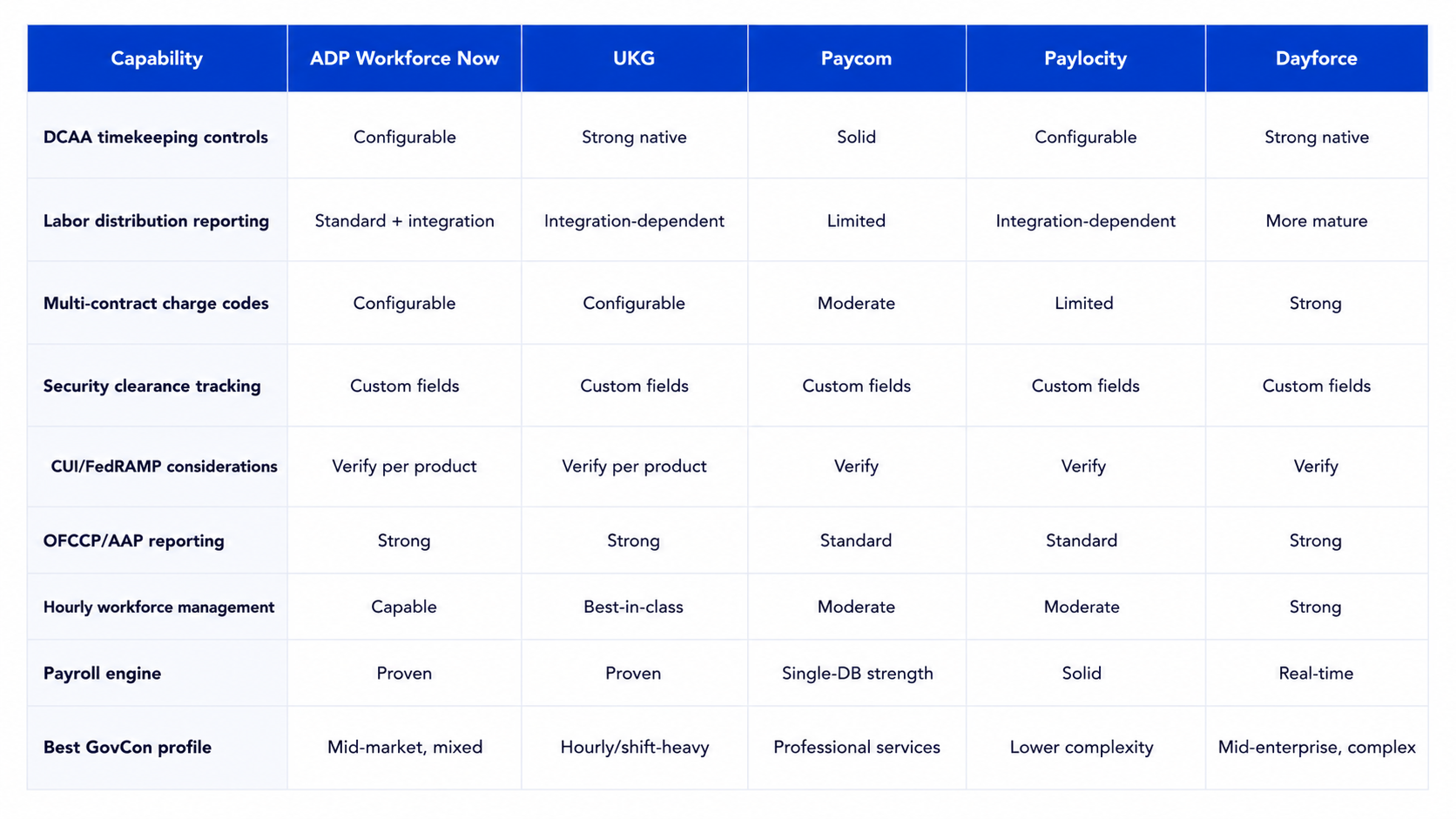
With the requirements framework established, here is how ADP Workforce Now, UKG, Paycom, Paylocity, and Dayforce compare across the dimensions that matter most for government contractors.
ADP Workforce Now

Overall GovCon fit: Strong for mid-market to enterprise contractors
ADP Workforce Now is the most widely deployed HRIS platform in the mid-market, and it brings meaningful advantages for government contractors — particularly around payroll compliance depth and integration ecosystem.
Timekeeping: ADP's time and attendance module supports daily entry enforcement and supervisor approval workflows. Its charge code/cost center framework can be configured to support contract-specific labor allocation, though achieving full DCAA compliance typically requires working with ADP's implementation team to configure the specific controls your accounting system requires. Labor distribution reports are available natively and can be formatted for export to common accounting systems.
Labor distribution: ADP supports labor distribution reporting — a standard module within Workforce Now that shows hours and earnings by pay code, cost center, and department. For contractors needing integration with GovCon accounting systems, ADP's extensive integration marketplace includes connections to Unanet, QuickBooks, Sage Intacct, and similar platforms commonly used in the federal contracting space.
Security clearance tracking: ADP's HR module supports custom fields and document management that can be configured for clearance tracking. This is not a purpose-built clearance management module, but with appropriate configuration it can serve as a records repository with alert workflows for reinvestigation dates.
Data security: ADP maintains FedRAMP authorization for certain products. Confirm the specific Workforce Now deployment's current authorization status through the FedRAMP Marketplace. ADP's enterprise security infrastructure (SOC 2 Type II, ISO 27001) meets baseline requirements, but GovCon buyers should verify whether their specific data processing configuration meets DFARS 252.204-7012 standards for CUI.
Best for: Mid-market GovCon firms (100–2,500 employees) seeking a proven payroll engine, compliance infrastructure, and broad integration ecosystem. ADP is particularly strong for contractors with both government and commercial work who need a platform that handles both without requiring separate systems.
See OutSail's ADP Workforce Now review for a full feature and pricing breakdown.
UKG (UKG Ready and UKG Pro)

Overall GovCon fit: Strong for workforce-intensive contractors with hourly employees
UKG's heritage is in workforce management — specifically, the time and attendance capabilities originally developed by Kronos. This gives UKG a meaningful advantage for government contractors with large hourly or shift-based workforces, such as those in facilities management, security services, base operations support, or defense manufacturing.
Timekeeping: UKG's time and attendance platform is among the deepest in the market for compliance-oriented time tracking. The system supports daily entry requirements, supervisor approval workflows, and configurable rules engines that can enforce charge code assignment. For contractors who need to distinguish labor categories (e.g., journeymen vs. apprentices on a prevailing wage contract), UKG's labor category management is robust. UKG Ready — positioned for mid-market organizations — provides strong time compliance at a lower cost structure than UKG Pro.
Labor distribution: UKG supports project-level time tracking and cost center allocation. However, for full DCAA labor distribution at the contract CLIN level, most GovCon deployments of UKG involve integration with a dedicated cost accounting system rather than relying on UKG's native reporting alone. This is a common architectural choice for mid-enterprise contractors.
Security clearance tracking: Like ADP, UKG does not offer a purpose-built security clearance management module. It supports custom credential tracking and document management that can be configured for clearance workflows. Organizations with substantial cleared personnel typically supplement UKG with a dedicated FSO tool for DISS integration and NISPOM compliance tracking.
Data security: UKG holds SOC 2 Type II certification and FedRAMP authorization for applicable products. Verify current authorization status for the specific UKG product and deployment model you're considering.
Best for: Government contractors with large hourly, shift-based, or multi-location workforces — particularly facilities management, base operations support, technical services with field technicians, and defense manufacturing. UKG's scheduling and workforce management depth is a genuine differentiator for these profiles.
OutSail's UKG Pro review and UKG Ready review cover both platforms in detail.
Paycom

Overall GovCon fit: Solid for single-database simplicity; limited for complex labor distribution
Paycom's core architectural strength is its single-database model — all HR, payroll, time, and talent data lives in one system with no integration seams. For government contractors whose primary compliance challenge is timekeeping accuracy and payroll integrity rather than complex multi-contract labor distribution, this architecture is genuinely valuable.
Timekeeping: Paycom's time and attendance module supports daily entry, supervisor approvals, and configurable charge codes. Its Beti payroll self-service feature — which allows employees to review and confirm their own payroll before processing — can serve as an additional accuracy control that complements DCAA compliance requirements. The single-database design means time data flows directly into payroll without transformation, reducing reconciliation errors.
Labor distribution: This is where Paycom shows limitations for complex GovCon environments. The platform's labor distribution capabilities are designed for standard commercial use cases — cost center and department allocation — rather than the granular contract-CLIN-task-order tracking that cost-plus government contractors require. Organizations with complex multi-contract portfolios will likely need to export payroll data to a separate cost accounting system for full labor distribution processing, and the data structure may require transformation.
Security clearance tracking: Paycom's HRIS can store custom employee data fields, making basic clearance-level tracking possible. Purpose-built clearance workflow management is not a native feature.
Data security: Paycom holds SOC 2 Type II certification and meets standard enterprise security requirements. GovCon buyers should confirm whether Paycom's cloud infrastructure meets the FedRAMP requirements applicable to their contracts.
Best for: Professional services, consulting, and IT government contractors in the 100–2,500 employee range where the workforce is primarily salaried knowledge workers, contract complexity is moderate, and the primary DCAA requirement is clean daily timekeeping and audit trails rather than complex indirect cost pool management.
See OutSail's Paycom review for a detailed platform breakdown.
Paylocity

Overall GovCon fit: Appropriate for lower-complexity GovCon firms; not purpose-built for the environment
Paylocity is a well-regarded mid-market HRIS with strong employee experience features, solid payroll fundamentals, and above-average user experience scores. For government contractors, it is a viable option when the compliance environment is relatively straightforward — primarily time-and-materials contracts with hourly tracking requirements, limited indirect cost pool complexity, and no significant CUI handling in the HRIS itself.
Timekeeping: Paylocity's time and attendance module supports configurable approval workflows and charge code tracking. Daily entry enforcement is configurable but not always the default behavior — confirm during demo that the DCAA-required controls can be implemented as system enforcement, not just policy guidance.
Labor distribution: Paylocity's labor distribution capabilities are designed for standard cost center allocation. For GovCon firms needing contract-level labor distribution across multiple indirect pools, Paylocity will require integration with a separate accounting system and custom export configuration.
Security clearance tracking: Paylocity's document management and custom fields can support basic clearance record-keeping. This is not a specialized capability.
Employee experience: Where Paylocity genuinely differentiates from the rest of this group is in employee-facing features — its community tool, mobile app quality, survey and recognition capabilities, and modern interface score consistently higher in user reviews than the other platforms on this list. For GovCon organizations that struggle with employee engagement in cleared workforce environments (where communication restrictions can limit standard engagement tools), these features provide real value.
Data security: Paylocity holds SOC 2 Type II certification. FedRAMP authorization status should be verified for GovCon buyers with CUI requirements.
Best for: Professional services and IT government contractors with relatively straightforward DCAA requirements, salaried workforces, and organizations that prioritize employee engagement tools alongside compliance. Less suited to organizations with significant cost-plus contract portfolios or large classified workforces.
OutSail's Paylocity review covers features, pricing, and user feedback in depth.
Dayforce (Ceridian)
Overall GovCon fit: Strong for mid-enterprise contractors with complex payroll and workforce management needs
Dayforce's defining capability is its real-time payroll engine — the system calculates pay continuously as time is entered, rather than in a batch at the end of a pay period. For government contractors with hourly workforces, shift differentials, overtime rules, and multiple pay rates on the same contract, this real-time calculation architecture has genuine operational advantages.
Timekeeping: Dayforce's time and attendance module supports daily entry requirements, supervisor approval workflows, and configurable pay rules that can accommodate the complexity of government contracting environments — including different overtime rules by contract, multiple labor categories, and shift differentials that must flow into contract billing rates. The real-time nature of the calculation means payroll discrepancies surface before the payroll run, rather than in post-processing.
Labor distribution: Dayforce's project tracking and labor allocation capabilities are more mature than most mid-market competitors, supporting allocation of time and costs across multiple cost objectives within a single pay period. For contractors needing integration with GovCon accounting systems, Dayforce's API layer and integration connectors facilitate export to cost accounting platforms. The platform's reporting depth includes the kind of labor cost detail that supports DCAA audit requirements.
Security clearance tracking: Dayforce's core HR module can store custom employee data including clearance levels and dates. Purpose-built clearance management is not a native feature.
Data security: Dayforce holds SOC 2 Type II certification and FedRAMP authorization for applicable products. The platform's recent privatization by a private equity firm in late 2025 is a vendor stability consideration worth evaluating, though it has not yet affected product investment or customer service delivery. Verify current FedRAMP status through the official Marketplace.
Best for: Mid-enterprise GovCon organizations (300–5,000 employees) with significant hourly workforces, multiple contract types, complex pay rules, and integration requirements with cost accounting systems. Dayforce's real-time payroll engine is a meaningful advantage for contractors whose pay calculation complexity creates regular reconciliation challenges.
See OutSail's Dayforce review for a full feature and pricing breakdown.
Platform Comparison at a Glance
What None of These Platforms Does Natively — and What to Do About It
It is worth being direct about a limitation shared by all five platforms in this comparison: none of them offers a purpose-built, NISPOM-compliant security clearance management module with direct DISS integration.
The Security systems used by the government (DISS, NBIS, JPAS for legacy records) are government-controlled systems. Commercial HRIS platforms cannot integrate directly with them. Managing clearance records requires a human process — your FSO or security manager updates clearance records in the HRIS based on information from DISS, not through automated feed.
This means the "security clearance tracking" capability of any HRIS platform is fundamentally a records management and workflow automation function, not a live integration with government clearance databases. Organizations with large cleared workforces (50+ cleared personnel) typically use a dedicated FSO management tool (such as ISI Security Control or similar) that is purpose-built for NISPOM compliance, and maintain basic clearance data in the HRIS for HR workflow purposes (onboarding, role assignment, alert notifications).
The same applies to ITAR export control tracking. If your organization employs foreign nationals or manages ITAR-controlled technical data, the access control records for those employees need to be maintained carefully — but the compliance framework for ITAR is separate from your HRIS, requiring dedicated export control management processes and often a Technology Control Plan that sits outside any standard HRIS platform.
For DCAA compliance, similarly, organizations above a certain complexity threshold — particularly those on cost-plus contracts with multiple indirect cost pools — typically use a dedicated GovCon accounting system (such as Unanet, QuickBooks Government, or Sage Intacct's government contracting module) alongside their HRIS, rather than trying to achieve full DCAA cost accounting from an HRIS alone.
The HRIS provides the payroll engine, the timekeeping controls, the HR record system of truth, and the labor distribution export. The GovCon accounting system provides the full cost accounting and billing framework. These systems need to integrate well — but they are separate tools serving different functions.
Evaluation Criteria Specific to GovCon HRIS Selection
When building your vendor scorecard for a GovCon HRIS evaluation, add these criteria to the standard functional requirements your team is assessing. OutSail's compliance-ready HRIS guide provides a broader framework for regulated industry evaluation that complements the government-specific criteria here.
Timekeeping compliance questions to ask in demos:
- Show me how the system prevents an employee from entering a week's worth of time at the end of the week. Does it enforce daily entry or only recommend it?
- What happens when an employee needs to correct a previously approved time entry? Walk me through the correction workflow.
- How does the system prevent a supervisor from entering time on behalf of an employee?
- Can I see the complete audit trail for a single employee's timesheets, including all corrections, approvals, and system access events?
Labor distribution questions:
- Can you show me a labor distribution report that breaks out costs by charge code, labor category, and cost pool — not just by department?
- What format does the labor distribution export use, and which GovCon accounting systems does it integrate with directly?
- How does the system handle an employee who charges time to three different contracts in the same day?
Security and compliance questions:
- What is your current FedRAMP authorization status, and which specific product and deployment model does it cover?
- What CUI-handling provisions are in your standard data processing agreement?
- Does your infrastructure support US-only data residency for all employee records?
- What is your approach to CMMC Phase 1 compliance documentation for customers who include your platform in their assessment scope?
Conclusion
Government contracting is one of the few operating environments where an HRIS selection failure has consequences beyond operational inconvenience. A timekeeping system that doesn't meet DCAA standards doesn't just create administrative headaches — it creates findings that affect contract eligibility, billing approval, and audit outcomes. An HRIS that stores CUI on infrastructure that doesn't meet DFARS security requirements isn't a technology problem; it's a contractual compliance issue.
The five platforms covered in this guide — ADP Workforce Now, UKG, Paycom, Paylocity, and Dayforce — all have meaningful capabilities that GovCon HR teams can work with. None is a purpose-built GovCon system, and none eliminates the need for a separate cost accounting solution for complex contract portfolios. But the right one, properly configured, can provide the timekeeping controls, labor distribution reporting, and HR infrastructure that government contractors need to operate compliantly and efficiently.
The difference between a compliant and a non-compliant configuration often comes down to implementation depth — and that is where having an experienced advisor in your corner pays for itself.
Find the Right HRIS for Your Government Contracting Environment
OutSail helps GovCon HR teams build structured, compliance-aware HRIS evaluations. Our advisors understand the regulatory environment federal contractors operate in and can help you shortlist platforms that meet DCAA, CMMC, and OFCCP requirements — at no cost to your organization.
Schedule a GovCon HRIS evaluation consultation →
Frequently Asked Questions
What HRIS platforms are DCAA compliant?
No mainstream HRIS platform is "DCAA certified" — DCAA does not certify or approve commercial software products. DCAA compliance is a property of how a timekeeping system is configured and used, not of the software itself. What DCAA auditors evaluate is whether the contractor's timekeeping system produces reliable, daily, employee-entered, supervisor-approved time records with an immutable audit trail and charge code assignments that map to contract cost objectives. ADP Workforce Now, UKG, Paycom, Paylocity, and Dayforce all have time and attendance modules that can be configured to meet these requirements — but configuration and internal controls matter as much as the platform choice.
Do government contractors need a separate system for DCAA timekeeping, or can their HRIS handle it?
Many mid-market government contractors handle DCAA timekeeping within their HRIS, particularly when their contract portfolio is primarily time-and-materials or fixed-price with moderate labor complexity. Contractors with cost-plus contracts, multiple indirect cost pools, and complex billing rate structures typically find that their HRIS handles payroll and time tracking while a dedicated GovCon accounting system (Unanet, QuickBooks Government, Sage Intacct's GovCon module) handles the full cost accounting, billing, and DCAA audit reporting. The two systems need a clean integration for labor distribution data to flow correctly.
How should HR teams track security clearances in an HRIS?
Security clearances should be tracked in the HRIS as a records management function — not through a live integration with government clearance databases, which is not available to commercial software. Configure custom fields to capture clearance level, investigation type, adjudication date, reinvestigation date, and access authorizations. Set up workflow alerts to notify HR and the Facility Security Officer (FSO) when clearances are approaching reinvestigation windows (typically 5 years for TS and 10 years for Secret). The FSO should update clearance records in the HRIS based on information from DISS, maintaining the HRIS as the single source for HR workflow purposes while DISS remains the authoritative government clearance record.
What does CMMC mean for an HRIS selection in 2026?
CMMC (Cybersecurity Maturity Model Certification) Phase 1 became active in November 2025, requiring defense contractors handling CUI to demonstrate compliance with NIST SP 800-171 controls as a condition of contract award. If your HRIS stores employee data that constitutes CUI — including certain personnel records for cleared employees — the platform and its cloud infrastructure may fall within your CMMC assessment scope. Cloud Service Providers used to handle CUI must meet FedRAMP Moderate Baseline or equivalent requirements under DFARS 252.204-7012. When selecting an HRIS, confirm the vendor's current FedRAMP authorization status through the FedRAMP Marketplace, evaluate their data processing agreement for CUI provisions, and confirm US-only data residency is available and contractually required.
Which HRIS is best for defense contractors with large hourly workforces?
For defense contractors with large hourly, shift-based, or multi-location workforces — facilities management, base operations support, security services, defense manufacturing, and similar — UKG's time and attendance platform offers the deepest workforce management capabilities in this comparison group. UKG's scheduling, shift management, and labor compliance features handle the complexity of hourly government workforces more natively than ADP, Paycom, Paylocity, or Dayforce. For contractors with primarily salaried professional services workforces, ADP Workforce Now or Dayforce may offer a better overall fit.


.png)
