HRIS for Energy and Utilities: Field Workforce Management, Safety Compliance, and Union Contracts
Energy and utilities companies have complex HRIS needs — field crew scheduling, OSHA safety tracking, union CBA compliance, prevailing wage, and per diem management. Here's the 2026 buyer's guide.

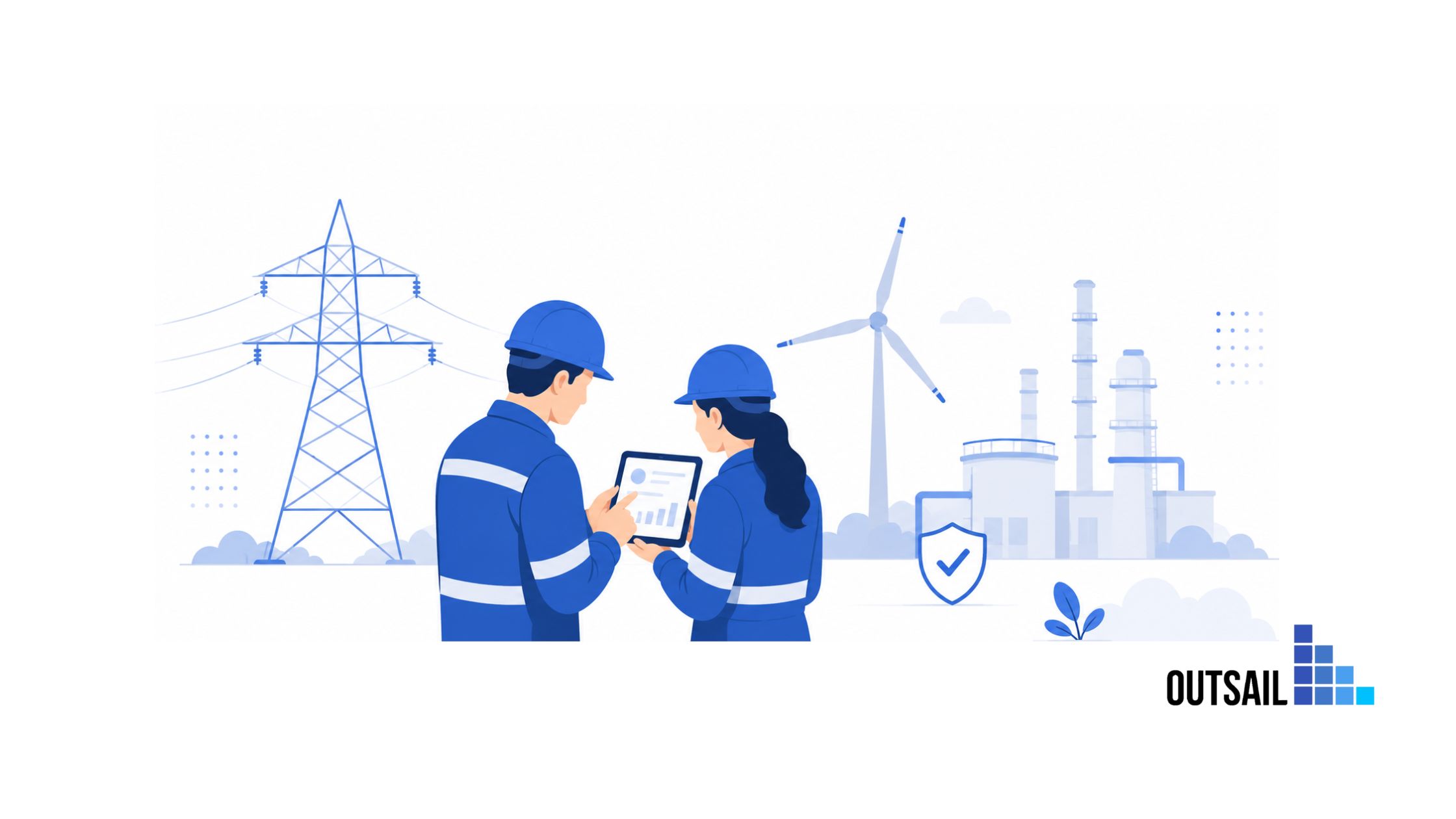
The energy sector is not a kind environment for generic HR software. A platform built for a 500-person professional services firm handles payroll, time, and benefits just fine — but it buckles under the specific pressures that define workforce management in power generation, oil and gas, electric utilities, pipeline operations, renewable energy construction, and transmission and distribution work.
Those pressures are specific. A crew of lineworkers rotating through twelve-hour shifts at multiple substations across three states requires time tracking that captures location, job code, and shift differential simultaneously. A gas utility with 1,800 union employees across four local IBEW agreements needs payroll that knows which CBA rate applies in which jurisdiction — and can produce accurate remittance reports for each union trust fund without manual reconciliation. A wind farm construction project needs certified payroll that generates WH-347 forms automatically, tracks fringe benefits separately from base wages, and survives a Department of Labor audit.
Underneath all of it: safety. OSHA recordkeeping obligations — 300 Log maintenance, 300A summary posting, electronic submission to OSHA's Injury Tracking Application — carry current penalties of $16,550 per serious violation and up to $165,514 per willful or repeated violation.
This guide covers what energy and utilities operators actually need from an HRIS, and how UKG, ADP Workforce Now, and Dayforce address those requirements — alongside newer purpose-built entrants Miter and Lumber that are building compelling vertical-specific capabilities worth serious consideration.
The 7 HRIS Requirements That Define the Energy and Utilities Vertical
1. Field Crew Scheduling and Time Capture
Energy and utilities workforces are rarely in one place. Transmission and distribution crews move between job sites daily. Offshore or remote energy workers may cycle through 14-days-on / 14-days-off rotations. Pipeline inspection crews work a fixed project duration at a remote location and then move to the next site. Renewable energy construction workers may be deployed to a project months from their home state.
Standard HRIS time and attendance assumes employees are in a fixed location with predictable schedules.
Field energy workforces require:
- Mobile time capture with offline functionality. Field crews work in areas with limited or no cellular coverage — underground vaults, remote transmission corridors, offshore platforms. The HRIS time app must capture punches offline and sync when connectivity is restored, or support physical time capture methods (kiosks, electronic crew manifests) that integrate with the central system.
- GPS and geofencing-based time tracking. For field service and construction crews, geofenced clock-in verification confirms employees are at the right job site at the recorded time — a compliance and billing accuracy requirement, not just an operational convenience.
- Rotational scheduling support. 24/7 operations in generation, transmission, pipeline, and processing require scheduling engines that manage rotating shift patterns, track fatigue hours where DOT or internal policies apply, and alert schedulers to overtime accumulation before it happens rather than after.
- Multiple job codes per day. A lineworker may move between a distribution maintenance task, a capital project CLIN, and overhead time within the same shift. The time system must capture each segment against the correct cost code, enabling the job-cost reporting that project accounting requires.
- Crew-level scheduling visibility. Supervisors need to see crew composition across all active sites simultaneously — not just individual employee schedules. This is a workforce management capability that most standard HRIS time modules don't offer natively.
2. OSHA Safety Incident Tracking and Recordkeeping
Safety incident management is not an optional HRIS module for energy and utilities employers — it is a compliance obligation with meaningful financial penalties for failure.
- OSHA 300 Log requirements. Employers with ten or more employees in covered industries must maintain an OSHA 300 Log of work-related injuries and illnesses. Entries must include the employee's name, job title, date, location, description, and outcome. The log must be available to employees and their representatives on request, and must be retained for five years.
- 300A Summary posting. The annual summary of the 300 Log must be posted in a visible workplace location from February 1 through April 30 each year.
- Electronic submission. Establishments with 100 or more employees in designated high-hazard industries — which explicitly includes utilities and oil and gas — must electronically submit injury and illness data through OSHA's Injury Tracking Application (ITA). The 2025 data submission deadline was March 2, 2026.
- What this means for HRIS selection: The platform must support OSHA 300 Log recordkeeping natively, with workflows that capture incident details (first report of injury, treatment type, lost workdays, job transfer or restriction), generate the 300 Log and 300A Summary automatically, and support electronic export or direct submission in the ITA-compatible format. Platforms that require manual entry or separate EHS (Environmental Health and Safety) system maintenance create reconciliation overhead and audit exposure.
- Beyond OSHA 300 recordkeeping: Energy and utilities employers increasingly want the HRIS to support safety certification tracking — who holds a valid OSHA 10-Hour card, who is current on LOTO (Lockout/Tagout) certification, who has completed DOT-required drug and alcohol training, and whose safety credentials are approaching expiration. Automated alerts before credential expiration keep field crews deployable and schedulers informed without manual tracking.
3. Union Collective Bargaining Agreement (CBA) Management
Unionization rates in utilities, oil and gas, and energy construction run substantially above the national average. The IBEW represents electrical utility workers across most of the US. The Operating Engineers, Pipefitters, Teamsters, and United Mine Workers cover downstream and midstream energy workers. LIUNA and UA represent significant portions of energy construction labor.
Each union agreement defines wage rates, overtime rules, premium pay conditions, fringe benefit contributions (health and welfare, pension, apprenticeship, vacation, and JATC funds), and often seniority-based work assignment rules that an HRIS must enforce automatically.
CBA complexity in payroll terms:
- Multiple rate tables. A single CBA may include journey worker rates, apprentice rates at multiple percentage levels, foreman premiums, working foreman premiums, and hazard pay differentials — each applying to different employees at different times. The payroll system must maintain these rate tables and apply the correct rate to each employee based on their classification, seniority level, and work assignment.
- Union fringe benefit contributions. Unlike employer-paid benefits that are a percentage of wages and flow into company-managed plans, union fringe benefits are contractually specified dollar amounts per hour worked that must be remitted to union trust funds — separate from payroll taxes and separate from employer-sponsored benefits. Accurate fringe tracking and remittance reporting is a CBA compliance requirement, not just a payroll convenience.
- Overtime calculation by agreement. Many utility union agreements specify overtime thresholds that differ from FLSA's standard 40-hour weekly threshold — daily overtime after 8 hours, double time on Sundays or holidays, and weekend premium pay that stacks differently than regular FLSA overtime. The payroll system must calculate these agreement-specific rules correctly without manual override.
- Multi-union workforces. A large utility operator may employ workers under the IBEW, LIUNA, Operating Engineers, and Teamsters agreements simultaneously — each with its own rate tables, fringe schedules, and remittance requirements. The HRIS must maintain separate CBA configurations for each agreement and apply them correctly by employee classification.
- Union remittance reporting. Monthly or quarterly remittance reports for each union trust fund must reconcile hours worked by employee, trust fund contributions due, and payments made. These reports follow trust fund-specific formats — not a standard payroll export.
For a detailed breakdown of shift differential pay compliance in regulated industries, including the interplay between CBA rules and FLSA requirements, OutSail's shift differential pay guide covers the mechanics thoroughly.
4. Prevailing Wage and Certified Payroll
Energy companies that perform construction, renovation, or rehabilitation work on public projects — including work under federal energy contracts, utility infrastructure grants, or DOE-funded programs — are subject to the Davis-Bacon Act and its prevailing wage requirements.
Prevailing wage compliance requirements:
Employees on covered projects must be paid the prevailing wage rate for their classification in the applicable county or metropolitan area, as determined by the Department of Labor's wage determination. The base rate plus fringe benefits must together meet or exceed the prevailing wage — and fringe benefits can be paid as cash supplements or through bona fide benefit plans.
- Certified payroll reporting. Projects subject to Davis-Bacon require weekly submission of WH-347 Certified Payroll Reports showing each worker's name, classification, hours worked by day, hourly rate, gross wages, deductions, and net wages, plus a statement of compliance signed by the contractor. Manual preparation of WH-347 reports for projects with dozens of workers across multiple classifications is one of the most time-consuming and error-prone tasks in energy project HR.
- Prevailing wage and union rates. For unionized energy workers, the prevailing wage rate often mirrors or exceeds the applicable CBA rate — but this must be verified by project and jurisdiction. The HRIS must be able to layer prevailing wage rules over CBA rules for applicable employees and generate certified payroll that accounts for both.
5. Per Diem and Travel Management
Energy field workforces routinely work away from their home base — sometimes for weeks or months at a time. Per diem allowances, travel reimbursements, and mobilization/demobilization payments are significant payroll items that most standard HRIS platforms handle poorly.
Per diem complexity in energy:
Tax treatment by duration. Per diem payments for employees working temporarily away from their tax home are non-taxable up to IRS-specified limits (the standard General Services Administration rates, or substantiated actual costs). Per diem payments to employees assigned to a location for an indefinite period may become taxable. The HRIS must track work location duration per employee and apply the correct tax treatment.
Contractual per diem requirements. CBA agreements and project-specific employment terms often specify per diem rates that differ from IRS allowances. The payroll system must pay the contractually required amount, track the taxable/non-taxable split, and report accordingly.
Mobilization pay. Many energy project agreements include mobilization (travel-to-project) and demobilization pay — lump sum or per-hour payments for the travel day to and from the project site that may carry different pay codes, overtime treatment, and benefit contribution rules than regular work hours.
Field expenses. Beyond per diem, field workers may incur tool purchases, PPE maintenance, or other job site expenses that require reimbursement through an integrated expense workflow that connects to payroll and job cost reporting.
6. Multi-State, Multi-Entity Compliance
Energy operators frequently work across multiple states — a regional utility serves multiple state jurisdictions, a pipeline operator crosses state lines, a renewable energy developer builds projects in different states each year. Each state adds its own new-hire reporting requirements, unemployment insurance accounts, workers' compensation carriers and classifications, and wage-and-hour rules.
For energy companies with multiple legal entities — separate subsidiaries for generation, transmission, and distribution operations, or joint ventures on specific projects — the multi-entity payroll and HR challenges covered in other verticals apply here with equal force.
Additionally, DOT-regulated energy workers (pipeline operators, hazardous materials transporters) are subject to DOT drug and alcohol testing requirements that create additional HRIS integration requirements — specifically, the need to track random selection pool participation, testing outcomes, and return-to-duty clearances in a way that satisfies DOT program manager requirements without mixing medical information into general HR records.
7. Certification and Compliance Credential Tracking
The energy and utilities workforce operates under dense certification and qualification requirements that directly affect deployment decisions. A lineworker cannot be assigned to energized work without a current arc flash certification. A pipeline welder must hold a valid weld procedure qualification for the pipe specification they're working on. A confined space rescue team member needs current attendant certification.
When certifications lapse, deployment decisions must change immediately — and schedulers need to know before they schedule someone for work they are no longer qualified to perform.
The HRIS must support:
- Certification records by employee, including issue date, expiration date, and issuing body
- Automated alerts to HR and supervisors when certifications are approaching expiration (typically 30/60/90 day windows)
- Integration with or parallel records management for DOT drug testing compliance
- Training completion tracking tied to certification maintenance (required refresher training that keeps a certification current)
- Credential verification workflows for new hires, particularly for craft workers who claim journey worker status
Find the Right HRIS for Your Energy or Utilities Operation
OutSail's advisory team understands the compliance and operational environment that energy and utilities HR teams work in. We can help you build a structured, vendor-agnostic evaluation that accounts for CBA management, safety recordkeeping, field crew scheduling, and the other requirements unique to this vertical — at no cost to your organization.
Start a free evaluation consultation →
Platform Comparison: UKG, ADP Workforce Now, Dayforce, Miter, and Lumber
UKG Pro and UKG Ready

Overall energy/utilities fit: Best-in-class for shift-heavy field operations and large utility employers
UKG has explicitly positioned its platform for energy and utilities — and its depth of workforce management capability justifies that positioning. UKG's Kronos heritage built one of the deepest time and attendance engines in the market, and for the rotating shifts, fatigue tracking, and complex scheduling rules that define generation, transmission, and processing operations, UKG's WFM capabilities are genuinely specialized.
Field scheduling: UKG's scheduling module supports complex rotational patterns, skills-based scheduling (ensuring only qualified workers are assigned to specific tasks), demand-based coverage planning, and automated overtime alerts. For 24/7 operations — power generation, refinery operations, pipeline monitoring centers — UKG's scheduling depth is a real differentiator.
Union and CBA support: UKG Pro supports multiple union rate tables, CBA-specific overtime rules, and fringe benefit tracking. For large utility operators with established IBEW or OS&E relationships, UKG Pro's union payroll configuration is one of the more mature in the mainstream HRIS market. CBA rate table management, including apprentice step progression, requires configuration during implementation but once configured handles the calculation complexity reliably.
Safety and OSHA: UKG Pro supports OSHA 300 Log recordkeeping through its HR and safety modules. The depth of integration between the incident tracking module and employee records is stronger than most mid-market platforms. Safety certification tracking is supported through UKG's credential management capability.
Shift differential and per diem: UKG's pay rule engine handles shift differentials with a configurability that matches the complexity of energy sector pay structures — daily overtime, weekend premiums, hazard pay, and stacking rules. Per diem management requires integration with an expense or travel management module, as UKG's native per diem handling is less purpose-built than some alternatives.
Best for: Large utility operators (500+ employees), multi-union energy employers, and oil and gas companies where 24/7 shift operations and complex workforce management are the primary operational challenges.
See OutSail's UKG Pro review and UKG Ready review for detailed feature and pricing breakdowns.
ADP Workforce Now

Overall energy/utilities fit: Strong for multi-state compliance and established utility employers seeking payroll reliability
ADP's core strengths — payroll compliance depth, multi-state tax infrastructure, and a broad integration ecosystem — translate well to mid-market and enterprise energy employers. ADP's construction-specific edition of Workforce Now includes certified payroll (WH-347) generation, prevailing wage tracking, and job costing capabilities that apply equally to energy companies performing Davis-Bacon-covered work.
Multi-state compliance: ADP's compliance team maintains one of the largest regulatory update operations in the payroll industry, covering federal, state, and local wage-and-hour requirements across all 50 states. For energy operators working across multiple states — a common operational reality in transmission, pipeline, and renewable energy development — ADP's multi-state payroll infrastructure handles the regulatory complexity reliably.
Union payroll: ADP supports CBA-based payroll configuration, including union rate tables, fringe benefit tracking, and remittance reporting. For established utility operators with long-standing union relationships, ADP's familiarity in the market and its construction/prevailing wage expertise give it credibility in the CBA management area.
OSHA and safety: ADP's base HRIS supports injury and illness recordkeeping, but the integration depth for OSHA 300 Log automation varies by configuration. Energy employers with intensive safety recordkeeping requirements typically supplement ADP with a dedicated EHS system rather than relying on HRIS-native OSHA tracking.
Certified payroll: ADP's construction edition generates WH-347 certified payroll reports and supports prevailing wage rate configuration — a capability set shared with Miter and Lumber but backed by ADP's larger implementation and support infrastructure.
Integration ecosystem: ADP's 700+ pre-built integrations include connections to ERP systems (Oracle, SAP, NetSuite, Sage), safety management platforms, and project management tools commonly used in energy — a meaningful advantage for large operators with complex technology ecosystems.
Best for: Mid-to-large energy operators (200–5,000+ employees) performing multi-state work, Davis-Bacon-covered construction, or seeking an established payroll partner with deep compliance infrastructure and broad integration options.
OutSail's ADP Workforce Now review provides a full feature and pricing breakdown.
Dayforce (Ceridian)
Overall energy/utilities fit: Strong for real-time payroll accuracy and complex shift environments
Dayforce's defining capability — its real-time payroll engine that calculates pay continuously as time is entered — addresses one of the most persistent pain points in energy sector payroll: the discovery of calculation errors after the pay cycle closes. In shift-heavy environments with complex overtime rules, shift differentials, and CBA-mandated premiums, real-time calculation means discrepancies surface before paychecks are issued rather than after.
Real-time payroll for shift complexity: The combination of Dayforce's real-time calculation and its configurable pay rules engine makes it particularly well-suited for energy workforces with daily overtime thresholds, weekend double-time, holiday premiums, and hazard pay differentials that stack in ways that batch-processing payroll systems frequently get wrong.
Workforce management depth: Dayforce's workforce management module has improved significantly and is now competitive with UKG for many shift-based industries. It supports rotational scheduling, skills-based assignment, and real-time labor cost visibility that operations and finance teams in energy organizations find valuable.
Union CBA support: Dayforce supports union rate tables and CBA-specific pay rules. For energy employers where payroll accuracy on the first run is a priority — minimizing the off-cycle corrections that damage trust with union employees — Dayforce's real-time calculation is a genuine differentiator.
Safety and OSHA: Dayforce's safety module supports incident tracking and OSHA recordkeeping, though energy employers with the most intensive safety documentation needs typically integrate Dayforce with a dedicated EHS platform. The API-based integration with platforms like Intelex, VelocityEHS, or Cority is well-supported.
Per diem management: Dayforce handles per diem and allowance payments with reasonable flexibility, and its expense management integration allows field employees to submit expense reports that sync directly with payroll for timely reimbursement.
Best for: Mid-enterprise energy operators (300–3,000 employees) where real-time payroll accuracy for complex shift and CBA environments is the primary operational driver, and where workforce management depth alongside payroll is equally important.
See OutSail's Dayforce review for a detailed feature breakdown.
Miter — A Compelling Vertical-Specific Entrant

Overall energy/utilities fit: Purpose-built for field-based construction and infrastructure work; strongest for energy construction and project-based operations
Miter is worth serious attention for energy operators performing construction, infrastructure, and project-based work — particularly renewable energy construction, pipeline installation, transmission line construction, and utility substation builds.
Unlike the established HRIS platforms above, Miter was built from the ground up for contractors and field-based operations, not adapted from a general-purpose HR platform. That architecture produces genuinely different capabilities in the areas energy construction companies care about most.
Certified payroll and prevailing wage: Miter generates WH-347 certified payroll reports automatically, manages prevailing wage rate configurations by project and jurisdiction, handles the fringe benefit split between base wages and benefit plans required for Davis-Bacon compliance, and produces union fringe remittance reports. These are not bolted-on features — they are core platform capabilities that Miter built its product around.
Job costing integration: Miter connects HR, payroll, time tracking, and field operations data to produce real-time fully-burdened labor cost by job — including wages, taxes, benefits, and union fringes. For energy construction project managers who need to know labor cost by cost code on a current basis, not at month close, this is operationally significant.
Field time capture: Miter's mobile time tracking is built for field crews — offline sync, geofencing verification, and daily field reporting tied to the same app. New hires complete onboarding entirely on their phone, including I-9, W-4, certifications upload, and direct deposit setup.
Per diem and expense management: Miter handles per diem, reimbursements, and corporate card expenses in a single flow integrated with payroll — a more streamlined approach than the separate module configurations required in larger HRIS platforms.
Limitations to know: Miter has fewer public long-term references than UKG, ADP, or Dayforce. It is best suited for companies whose primary HRIS challenge is project-based field workforce management — not ongoing utility operations with 24/7 rotating shifts and large established union workforces. Integration with ERP systems is currently strongest with Procore and Sage Intacct; buyers using other systems should verify coverage.
Best for: Energy construction contractors (50–500 field employees), renewable energy developers during the construction phase of projects, and utility companies managing capital project workforces separately from their ongoing operations workforce.
Lumber — An AI-First Purpose-Built Challenger

Overall energy/utilities fit: Strongest for energy contractors seeking AI-powered compliance automation; ideal for Davis-Bacon and union-heavy project work
Lumber is the most recent entrant in this comparison and the one with the most ambitious AI-first positioning. Founded specifically for the construction and field-based trades, Lumber has built its platform around AI-powered compliance automation — particularly for the certified payroll, union reporting, and prevailing wage workflows that are among the most time-consuming in energy project HR.
AI-powered CBA management: Lumber's most differentiated capability is its approach to CBA complexity. Rather than requiring HR teams to manually configure rate tables from CBA documents, Lumber uses AI to parse CBA documents — converting union contracts, rate sheets, and addendums into validated, audit-ready payroll rate configurations. This dramatically reduces the implementation work required to bring a new CBA into the system and reduces the error rate in rate configuration, which is the most common source of union payroll compliance issues.
Agentic compliance platform: In 2025, Lumber acquired Pivla and launched an agentic compliance platform that adds autonomous monitoring across certified payroll submissions — scanning WH-347 reports for prevailing wage risks and errors before submission, and applying AI-driven timesheet review against state and federal labor rules before payroll runs.
Certified payroll and prevailing wage: Lumber automates WH-347 generation, prevailing wage rate application by project and jurisdiction, fringe benefit tracking, and union remittance reporting — claiming a 95% reduction in certified payroll processing time versus manual methods.
Field time capture: Lumber supports geo-fencing verification, biometric confirmation options, and offline sync. Its mobile app supports Spanish-language time entry, relevant for energy construction workforces with significant Spanish-speaking labor.
Safety tracking: Lumber includes safety monitoring within its field operations module — tracking safety incidents, OSHA records, and crew compliance at the job site level.
Implementation speed: Lumber typically implements in one to two weeks for most construction and field operations companies — substantially faster than the enterprise platforms above.
Limitations: Lumber is primarily optimized for the construction and project phase of energy work. For large utility operators with ongoing 24/7 operations, complex scheduling of an established workforce, and long-term union relationships requiring deep CBA configuration, UKG or Dayforce's depth is better suited. Lumber is the right platform for the energy contractor and project developer, not the large investor-owned utility.
Best for: Energy construction contractors and developers (25–500 employees) performing Davis-Bacon or union-wage project work who want purpose-built AI-powered compliance automation rather than a configured general-purpose platform.
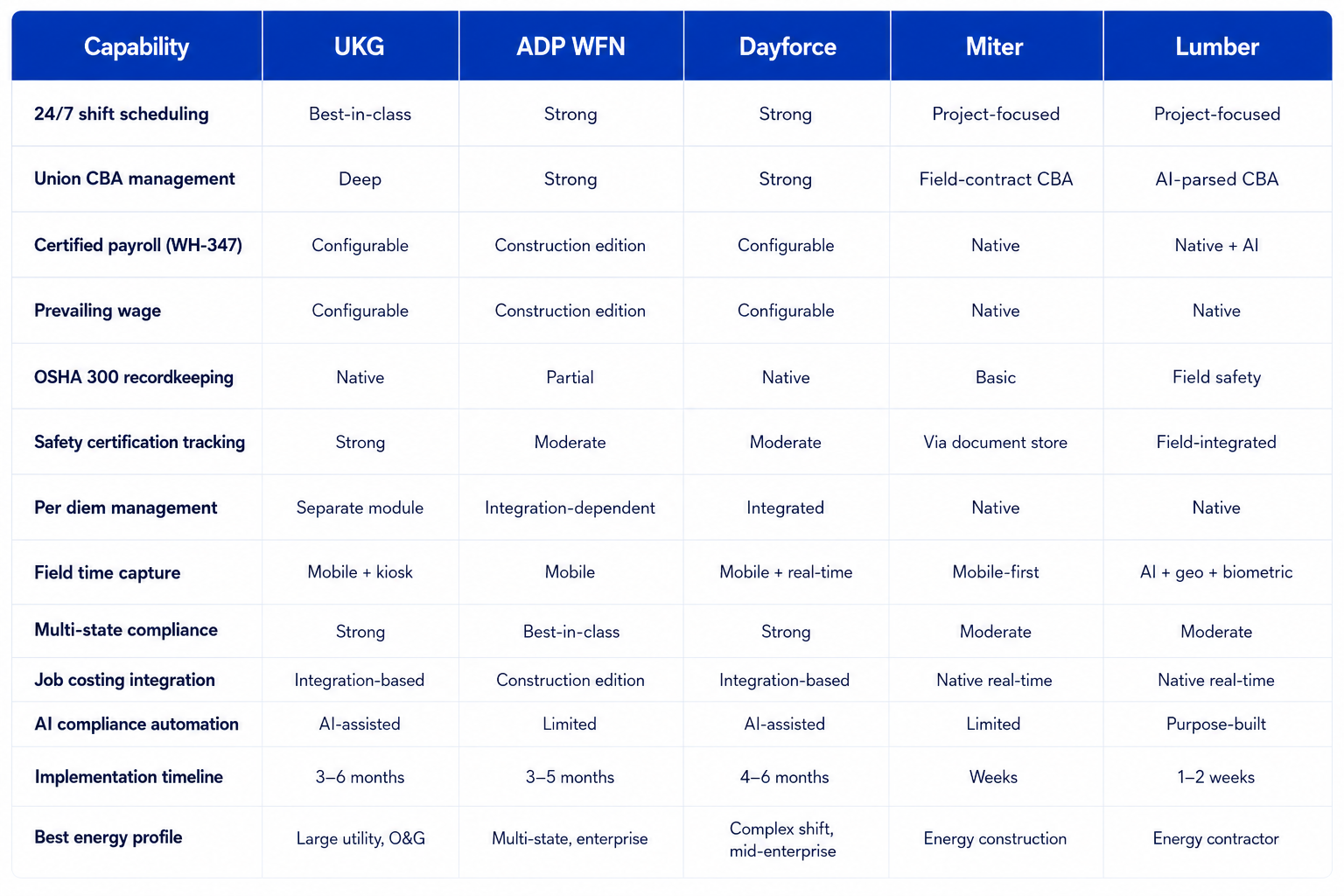
Platform Comparison at a Glance
The Centralized Utility vs. the Field-Based Energy Contractor: Different Problems
The energy and utilities vertical is not monolithic. The HRIS requirements of a regional investor-owned electric utility (IOU) with 3,000 employees, stable multi-decade union relationships, and 24/7 generation and distribution operations are fundamentally different from those of an energy construction contractor managing 200 field workers across a two-year utility-scale solar project.
For established utility operators — IOUs, large co-ops, regulated gas distribution companies, pipeline operators — the priority is typically depth of workforce management (scheduling, fatigue tracking, shift coverage), mature CBA management for established agreements, robust OSHA recordkeeping, and an integration ecosystem that connects to their enterprise ERP and EHS systems. UKG and Dayforce address these requirements most completely. ADP serves well for operators where payroll compliance and multi-state infrastructure are the primary concern.
For energy construction contractors and project developers — renewable energy EPC firms, transmission line contractors, pipeline installation contractors, energy infrastructure subcontractors — the priority is certified payroll automation, prevailing wage compliance, project-based job costing, field crew time capture, and rapid deployment for project-duration workforces. Miter and Lumber address these requirements more directly than any general-purpose HRIS, and their purpose-built architectures produce faster implementations and less configuration overhead.
Many large energy operators find themselves running both types of workforce simultaneously — an ongoing utility operation workforce alongside a capital project construction workforce. The right architectural answer is often two systems: a mature WFM platform (UKG, Dayforce) for ongoing operations, and a purpose-built field operations platform (Miter or Lumber) for construction projects, with integration between them at the employee record level.
OutSail's guides to HRIS for manufacturing companies and HRIS for construction and field services cover adjacent verticals with significant overlap in requirements — useful complements to this guide for operators at the intersection of energy production and industrial construction.
Evaluation Criteria Specific to Energy and Utilities
When building your vendor scorecard for an energy sector HRIS evaluation, include these criteria alongside standard functional requirements. OutSail's compliance-ready HRIS guide provides a broader regulated industry evaluation framework.
Timekeeping and field operations questions:
- Show me how an employee clocks into three different job codes during the same shift with location capture.
- What happens when a field employee is in an area with no cellular connectivity? How does the time data sync?
- How does the scheduling module handle a 14-on/14-off rotational pattern across multiple work sites?
Union and CBA questions:
- How are CBA rate tables maintained, and what happens during a contract renegotiation when rates change mid-year?
- Show me the union remittance report for a single trust fund and how it reconciles with payroll records.
- How does the system handle an employee moving between union classifications within the same pay period?
Safety and OSHA questions:
- Generate a sample OSHA 300 Log and 300A Summary from the system. Can it export in ITA-compatible format?
- Show me how a safety certification expiration alert flows from the HRIS to the relevant supervisor and scheduler.
- What happens to a scheduled assignment when an employee's required certification lapses?
Prevailing wage and certified payroll questions:
- Generate a WH-347 form for a sample pay period on a prevailing wage project.
- How are fringe benefits handled — cash equivalents vs. bona fide benefit plan payments — in prevailing wage calculations?
- Can the system manage prevailing wage and CBA rates simultaneously for the same employee on the same project?
Conclusion
The energy and utilities sector demands more from its HRIS than most industries. The combination of 24/7 shift complexity, multi-union workforce management, OSHA safety obligations, prevailing wage and certified payroll requirements, field crew deployment logistics, and multi-state compliance creates an environment where generic HR platforms create compliance risk rather than reducing it.
The platforms covered in this guide address that complexity from different angles. UKG and Dayforce bring the depth of workforce management that large, established utility operators need. ADP brings the multi-state compliance infrastructure and integration ecosystem that multi-state energy operators depend on. Miter and Lumber bring purpose-built field operations and compliance automation capabilities that are transforming how energy construction contractors manage project-phase workforces.
The right choice depends on which type of workforce you're primarily managing, which compliance requirements are most operationally burdensome, and how fast you need to be operational. Getting that match right — rather than defaulting to the most recognized brand — is what an objective, requirements-driven evaluation delivers.
Ready to Evaluate HRIS Options for Your Energy or Utilities Operation?
OutSail's advisory team helps energy and utilities HR leaders build structured evaluations that account for the specific compliance and operational requirements of this vertical — at no cost to your organization.
Book a free energy sector HRIS evaluation →
Frequently Asked Questions
What is the best HRIS for electric utilities and power companies?
For established electric utility operators with 24/7 shift operations and established union workforces, UKG Pro or UKG Ready is the most commonly recommended platform — its Kronos-heritage time and attendance and workforce management depth addresses the scheduling complexity of generation and transmission operations more natively than most alternatives. Dayforce is a strong alternative when real-time payroll accuracy for complex CBA environments is the priority. ADP Workforce Now is the best choice for multi-state utility operators where compliance infrastructure and integration ecosystem breadth are the primary decision drivers. For utilities managing capital project construction alongside ongoing operations, Miter or Lumber should be evaluated as a purpose-built complement for the project-phase workforce.
What HRIS features are required for Davis-Bacon Act compliance in energy construction?
Davis-Bacon Act compliance requires an HRIS capable of: maintaining prevailing wage rate determinations by classification, project, and county or metropolitan area; calculating whether base wages plus fringe benefits meet or exceed the applicable prevailing wage rate; supporting both cash fringe payments and bona fide benefit plan fringe contributions; generating WH-347 Certified Payroll Reports showing each worker's name, classification, hours, wages, and deductions; and producing a signed statement of compliance for each weekly submission. Miter and Lumber provide this capability natively and purpose-built. ADP's construction edition and UKG and Dayforce with appropriate configuration also support it, though with more implementation overhead.
How should energy companies handle OSHA recordkeeping in an HRIS?
Energy companies should look for an HRIS that supports OSHA 300 Log maintenance natively — including first report of injury workflows, lost workday tracking, restricted/transferred day recording, and automatic 300A summary generation. For covered establishments (typically 100+ employees in high-hazard industries including utilities and oil and gas), the system should support electronic data export in ITA-compatible format for the March 2 annual submission deadline. Beyond recordkeeping, the HRIS should support safety certification tracking with expiration alerts, integration with or native support for DOT drug and alcohol testing records, and documentation management for safety training completions.
How do energy companies manage multiple union agreements in one HRIS?
Managing multiple union CBAs requires an HRIS with a flexible rate table architecture — the ability to maintain separate rate configurations for each agreement, apply the correct classification and rate to each employee based on their union membership and job assignment, calculate CBA-specific overtime rules (daily OT, weekend double-time, holiday premiums) separately from FLSA standard rules, track fringe benefit contributions per employee per hour for each trust fund, and generate remittance reports in the format each union trust fund requires. UKG Pro and Dayforce have the most mature multi-union CBA management among the platforms in this comparison. Lumber's AI-powered CBA parsing is an emerging capability that addresses the configuration burden of maintaining complex agreements, particularly during renegotiation cycles.
What is the difference between Miter and Lumber for energy companies?
Both Miter and Lumber are purpose-built field workforce platforms designed for contractors and project-based operations rather than general-purpose HRIS platforms. Both handle certified payroll, prevailing wage, union compliance, field time capture, and job costing natively. The key differences: Lumber places heavier emphasis on AI-powered automation — AI-parsed CBA configuration, AI-driven timesheet anomaly detection, and agentic certified payroll compliance scanning — while Miter's strength is in the integration of field operations (production tracking, daily reports, scheduling) alongside the HR and payroll layer. Lumber implements in roughly one to two weeks; Miter's timeline is similar. Both are most appropriate for energy construction contractors during the project phase, rather than for established utility operations.
.png)
