HRIS for Franchise Operations: Multi-Entity Payroll, Brand Compliance, and Scalable Onboarding
Franchise operations have unique HRIS needs — multi-EIN payroll, rapid location onboarding, per-location compliance, and brand standards enforcement. Here's the 2026 buyer's guide.

Running a franchise isn't like running a single-location business at scale. It's an operationally distinct model with a specific set of challenges that most HRIS platforms weren't designed to solve.
A franchisee with twelve quick-service restaurant locations doesn't just need payroll software that processes twelve sets of employees. They need a platform that handles twelve separate EINs, tracks compliance across twelve different local wage ordinances, onboards new crew members across all locations through a consistent process, and generates reporting that the franchisor can use to confirm brand standards are being met — all while keeping the individual location manager's experience simple enough that they'll actually use it.
Meanwhile, the franchisor trying to support a growing network of hundreds of franchisees has entirely different needs: visibility into HR and compliance data across the system without the legal exposure that comes with exercising joint employer control, the ability to mandate consistent onboarding and training processes, and tooling that scales as new franchisees open locations faster than any IT team can manually configure.
These are not the same problems that a 500-person professional services firm faces. They require different architectural thinking about how the HRIS is structured, how access and permissions are organized, and what reporting the system produces.
This guide covers the five requirements that define a franchise-capable HRIS, how the three platforms most widely deployed in the franchise space — ADP, Paychex, and UKG Ready — address them, and how to structure your evaluation to find the right fit for your franchise's size and operating model.
The Five Franchise-Specific HRIS Requirements
1. Multi-EIN Payroll Processing
This is the foundational architectural requirement that separates franchise-capable HRIS platforms from standard ones. Most payroll platforms assume one employer identification number per account. Franchise operators don't work that way.
A franchise group with 20 locations may operate under a single EIN if it's structured as one legal entity across all units. More commonly — especially for larger operators or those who have grown through acquisition of additional franchise units — each location or a group of locations operates under a separate legal entity with its own EIN. This is standard practice for liability segregation, SBA financing requirements, and franchisor approval structures.
The difference between an HRIS that handles multi-EIN natively and one that requires a separate account per entity is enormous in practice. A system requiring separate accounts means separate logins, separate payroll configurations, separate year-end filings without central reconciliation, and no cross-location reporting. An operator with 15 locations manages 15 separate payroll accounts rather than one centralized platform with 15 entities underneath it.
What multi-EIN capability actually requires:
A single login that provides visibility across all entities, with the ability to drill into or report on any individual entity or combination of entities. Per-entity payroll processing with each entity's own tax IDs, bank accounts, and pay schedules, processed from one interface. Consolidated reporting that aggregates labor costs, headcount, and compliance metrics across entities while maintaining separate legal records per entity. Cross-entity reporting for owners who want to see total labor as a percentage of revenue across the whole portfolio, not just per location.
When evaluating any HRIS for franchise use, this is the first question to ask: "Show me how you manage multiple EINs under one client relationship, and demonstrate what happens at payroll processing and year-end reporting."
2. Rapid New-Location Onboarding and Rollout
Franchise growth is measured in new location openings. A multi-unit operator adding two or three locations per year is common. Some franchise development agreements require annual opening schedules of ten or more new units. Each new location needs to be operational for HR and payroll purposes — often within days of signing a lease or receiving franchisor approval to open.
That speed requirement creates a problem for HRIS platforms that treat each new location as a fresh implementation project. If standing up a new location requires calling the vendor, completing a configuration form, waiting for processing, and scheduling training — all of which adds two to three weeks to a process the operator wants to complete in two to three days — the HRIS is a bottleneck rather than an enabler.
What scalable new-location onboarding requires:
Templated entity setup that allows a new location to be configured from a master template rather than built from scratch. Location managers should be able to activate a new location with basic configuration (location address, EIN, bank account) using a standardized template that pre-populates pay codes, compliance rules, onboarding workflows, and benefits eligibility. Onboarding packet automation that triggers a standard employee onboarding flow the moment a new hire is entered — I-9, W-4, direct deposit setup, policy acknowledgments, role-specific training assignments — without requiring HR to manually send documents to each new employee at each location. Role-based access provisioning that gives a new location manager the right system permissions immediately, without an IT ticket or vendor involvement.
The mass onboarding scenario: When a franchise operator opens a new restaurant location, they may need to hire and onboard 30–50 employees within a two-week window before the opening date. An HRIS that requires individual manual processing for each new hire will be overwhelmed by this. Platforms with bulk onboarding capabilities — the ability to set up an onboarding portal for a specific location, distribute it to all incoming hires simultaneously, and process completed packets in bulk — handle this scenario reliably. Platforms without it create the kind of opening-week chaos that affects the first payroll run and damages location manager confidence in the system from day one.
3. Per-Location Compliance Tracking
Franchise operations spanning multiple cities and states face a compliance environment that is more granular than most multi-state employers. State-level employment law is only the beginning. Many franchise-heavy markets — food service, retail, personal services — operate in cities and counties that have their own minimum wage rates, predictive scheduling ordinances, sick leave accrual requirements, tip credit rules, and ban-the-box hiring restrictions.
A franchise operator with six locations in Seattle, Denver, Chicago, Dallas, New York, and Atlanta is managing six different local compliance environments on top of six different state environments. The HRIS must apply the right rules automatically to each location rather than requiring the operator to manually configure and maintain each jurisdiction's requirements.
What per-location compliance requires from the HRIS:
Jurisdiction-aware wage and hour rules that automatically apply the correct minimum wage, overtime threshold, and tip credit treatment to each location based on its address — not just its state. Predictive scheduling compliance for locations in cities with fair workweek ordinances (San Francisco, Chicago, Seattle, New York, Philadelphia, and others). These ordinances require advance notice of schedules, penalty pay for last-minute changes, and good faith estimates of hours — requirements the scheduling and payroll modules must enforce. Sick leave accrual automation that tracks accruals per the local ordinance in effect at each location, including local carryover caps and usage rules. I-9 and E-Verify management that maintains separate, audit-ready records for each location without mixing documentation across entities.
The joint employer dimension: The ongoing legal uncertainty around joint employer liability in the franchise context — addressed by the proposed American Franchise Act introduced in Congress in September 2025 — means that how HR decisions are made and documented at the location level matters for both franchisors and franchisees. An HRIS that enforces consistent compliance processes at every location, with clear documentation that the franchisee is making the HR decisions, helps maintain the operational and legal separation that the franchise model requires. Franchisors who provide HR software to franchisees should work with legal counsel to ensure that providing technology doesn't inadvertently increase joint employer exposure.
4. Franchisor Reporting and Brand Compliance Infrastructure
For franchise systems with a large franchisee network, the franchisor's HR and operations team needs visibility across the system without being operationally responsible for it. This creates a specific reporting and access requirement that most HRIS platforms weren't built to accommodate.
What franchisor-level reporting requires:
Multi-entity roll-up reporting that allows the franchisor to see workforce metrics — headcount by location, turnover rates, average hours, labor cost as a percentage of sales — across franchisee-operated units without having operational access to franchisee employee records. Compliance dashboard visibility showing which locations are current on required certifications (food handler licenses, safety training, harassment prevention training) and which are overdue — information that affects brand standards and, in regulated industries, license renewal. Onboarding completion tracking to confirm that new hires at each location have completed the required brand training modules, policy acknowledgments, and any franchisor-mandated orientation programs before they begin working with customers.
The access model challenge: Giving a franchisor visibility into franchisee HR data while maintaining clear separation of HR decision-making authority requires a carefully designed permission model. The HRIS should allow read-only or reporting-level access for franchisor staff to franchisee data, without granting the franchisor administrative access that could create joint employer exposure. Not all HRIS platforms support this kind of tiered access model at the franchisee/franchisor level. Confirm during demos whether this architecture is supported natively or requires custom configuration.
5. Frontline Workforce Features: Scheduling, Tips, and High-Turnover Onboarding
The workforce at most franchise operations is hourly, frontline, and high-turnover. The specific features this population needs from an HRIS are different from those of a salaried professional workforce:
Tip tracking and compliance. In food service and hospitality franchises, tip management — including tip pooling, tip credit calculations, and FLSA compliance for tipped minimum wage — must be accurate at the point of payroll processing. A tip error that surfaces on payday is a trust issue with employees in a labor market where they have other options.
Split shifts and variable scheduling. Franchise locations operate across open, mid, and closing shifts with variable hour allocations. The scheduling and time module must handle split shifts, overtime thresholds across locations when the same employee works at multiple franchise units, and last-minute schedule changes that trigger compliance requirements in predictive scheduling jurisdictions.
Mobile-first employee experience. Hourly frontline workers access their HRIS almost exclusively from mobile devices. An HRIS with a strong desktop experience but a poor mobile app will have low adoption among hourly employees, leading to missed punches, paper timesheets, and payroll errors. Clock-in, schedule viewing, pay stub access, and onboarding document completion should all be fully functional on mobile without downloading a dedicated app.
Fast, low-friction rehire workflows. Average annual turnover at quick-service restaurant franchises runs above 100%. The HRIS must support efficient rehire processing — recognizing returning employees and pre-populating their information, minimizing the number of onboarding steps for re-hires who have been inactive for less than a year, and getting them to first punch as quickly as possible.
OutSail's guide to HRIS for retail and hospitality: managing frontline workers at scale covers the frontline workforce HRIS requirements in more depth for operators where this is the primary driver.
Get Expert Guidance on Your Franchise HRIS Selection
OutSail helps multi-unit franchise operators and franchisors identify the right HRIS for their operating model — at no cost. Our advisors understand franchise-specific requirements and can help you build a structured evaluation that accounts for your entity structure, growth pace, and compliance footprint.
Start a free consultation with an OutSail advisor →
How ADP, Paychex, and UKG Ready Compare for Franchise Operations
ADP Workforce Now

Overall franchise fit: Best for large multi-unit operators and enterprise franchise groups
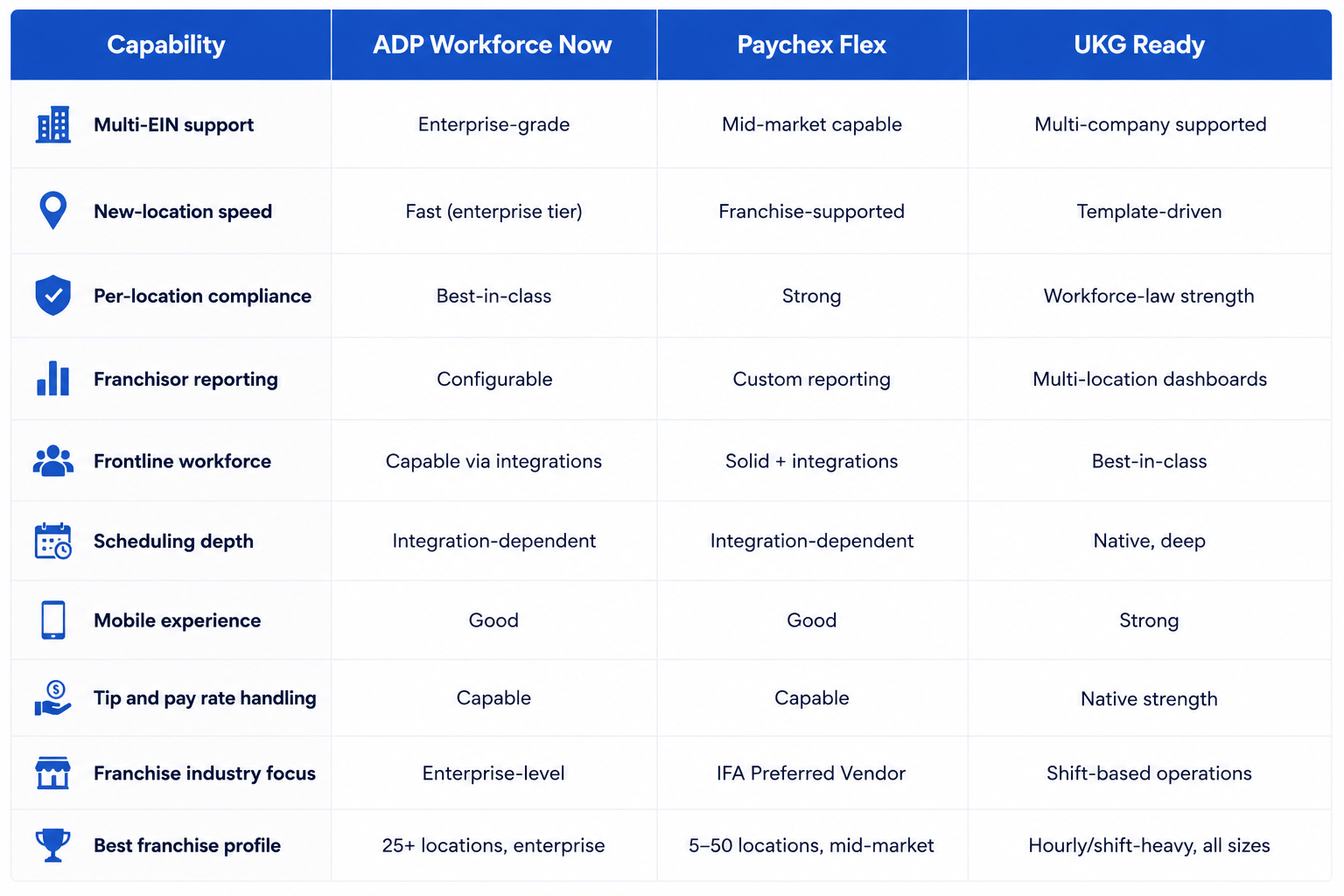
ADP Workforce Now is the most widely deployed payroll platform in the franchise space at enterprise scale, and for good reason. ADP's multi-entity architecture is genuinely built for the complexity of large franchise groups — including operators with dozens or hundreds of locations across multiple states under multiple legal entities.
Multi-EIN capability: ADP Workforce Now supports multi-client and multi-company configurations that allow large franchise operators to manage multiple EINs from a centralized administration interface. ADP's enterprise-tier client management is purpose-built for this structure, with consolidated reporting across entities and individual payroll processing per entity. For operators at the scale of 20+ locations, this is among the strongest multi-EIN architectures in the mainstream HRIS market.
New-location onboarding: ADP's implementation templates and onboarding workflows support new location standup, though the speed of configuration depends on the tier of service and the operator's relationship with their ADP account team. Large enterprise clients often have dedicated ADP support resources that accelerate new location setup. Smaller franchise operators on lower service tiers may experience more friction.
Compliance infrastructure: ADP's compliance team is one of the largest in the payroll industry, maintaining updates across federal, state, and local wage-and-hour requirements in real time. ADP's SmartCompliance module extends this across jurisdictions, and the platform's multi-state payroll handling — including automatic minimum wage application and overtime rules by location — is among the most mature in the market. For franchise operators in complex multi-jurisdiction environments, ADP's compliance depth is a significant operational advantage.
Franchisor reporting: ADP's analytics and reporting modules can be configured to produce the multi-entity roll-up reports that franchisors need. This typically requires configuration work during implementation and may involve ADP's professional services team for custom report development.
Frontline workforce features: ADP Workforce Now's time and attendance and scheduling modules are capable for franchise use, though their depth of workforce management features for complex scheduling environments is not as specialized as UKG's Kronos-heritage tools. ADP integrates with scheduling platforms like HotSchedules and 7shifts that many franchise operators already use, which is often a more practical path than replacing a purpose-built scheduling tool.
Best for: Enterprise franchise groups with 25+ locations, complex multi-state compliance needs, and existing ADP relationships at the corporate level. ADP's scale and compliance infrastructure are genuine differentiators at this size.
See OutSail's ADP Workforce Now review for a detailed breakdown of features, pricing, and user feedback.
Paychex Flex

Overall franchise fit: Best for mid-market franchise operators seeking dedicated franchise support
Paychex holds a formal Preferred Vendor status with the International Franchise Association (IFA), giving it a recognized commitment to the franchise vertical that generic HR platforms lack. Paychex's franchise support team understands multi-location payroll complexity, and its product architecture scales from small single-location operators up through large multi-unit enterprise franchisees without requiring a platform migration.
Multi-EIN capability: Paychex Flex supports multi-company payroll with centralized management, allowing franchise operators to run multiple legal entities from a single account relationship. Paychex's dedicated franchise support team helps configure the multi-entity structure during onboarding, which is a meaningful advantage over self-service platforms where multi-EIN setup is a DIY exercise.
New-location onboarding: Paychex's onboarding tools support new location setup, and the platform includes digital onboarding workflows that can be deployed quickly for new hires at new locations. Paychex's mobile-friendly onboarding portal allows new employees to complete I-9, W-4, and direct deposit setup from their phones before their first day. For franchise operators on aggressive expansion timelines, Paychex's franchise support team can be engaged to accelerate new-entity configuration.
Compliance infrastructure: Paychex's compliance updates and multi-state payroll handling are mature capabilities. The platform automatically calculates taxes for all 50 states and handles local payroll tax requirements, including city and county taxes that affect franchise operations in major markets. Paychex's HR compliance library and support team can assist franchisees with local ordinance compliance questions.
Franchisor reporting: Paychex's reporting capabilities allow consolidated data views across locations, and the platform's analytics tools can produce the labor cost and workforce metrics that franchise operators and their franchisors need. Custom report development is available through Paychex's professional services team.
Frontline workforce features: Paychex Flex integrates with popular restaurant and retail scheduling platforms — including HotSchedules (now Fourth) — which is the workflow most franchise operators in food service and retail already use. Paychex's time and attendance module handles tip tracking, multiple pay rates, and shift-based payroll with solid reliability.
Pricing approach: Paychex's pricing for franchise operators is typically custom-quoted based on location count, employee volume, and modules selected. The IFA preferred vendor relationship often includes negotiated pricing for IFA member franchise systems.
Best for: Mid-market franchise operators with 5–50 locations who want a platform with dedicated franchise expertise, scalable pricing, and a managed-service option for payroll processing. Paychex is particularly strong for franchise operators who want more hands-on support than a self-serve platform provides.
OutSail's Paychex review covers features, strengths, and limitations in detail.
UKG Ready

Overall franchise fit: Best for franchise operators with hourly, shift-based, or frontline-heavy workforces
UKG Ready's Kronos heritage makes it the strongest time and attendance and workforce management platform of the three options here. For franchise operations where scheduling complexity, shift coverage, and labor cost management are the primary operational challenges — food service, convenience retail, hospitality, fitness — UKG Ready's workforce management depth is a genuine differentiator.
Multi-EIN capability: UKG Ready supports multi-company and multi-location configurations. For franchise operators with multiple entities, UKG Ready's multi-company structure allows centralized management with location-level separation of payroll records and compliance configurations. The platform's reseller network (approximately 200 resellers in the US and Canada) means many franchise operators access UKG Ready through a local implementation partner who handles the entity configuration.
New-location onboarding: UKG Ready includes configurable onboarding workflows and document management that support new location standup. The platform's talent acquisition module integrates with onboarding, allowing candidates who accept an offer to move seamlessly into the onboarding process without re-entering information. UKG's onboarding templates can be configured at the corporate level and deployed to new locations without rebuilding from scratch.
Compliance infrastructure: UKG Ready's compliance features are strong, particularly for the wage-and-hour rules that affect shift-based workforces — overtime thresholds, meal break enforcement, predictive scheduling requirements, and local minimum wage tracking. UKG's Kronos-era focus on time compliance means these rules are embedded in the core time and attendance module, not bolted on.
Franchisor reporting: UKG Ready's reporting and analytics capabilities include workforce visibility tools that can be configured for multi-location roll-up views. The platform's dashboards provide labor cost, scheduling, and productivity metrics that franchise operators and their operations teams use to manage location performance.
Frontline workforce features: This is UKG Ready's strongest competitive dimension for franchises. Its scheduling module — including demand-based scheduling, shift swapping, absence management, and POS integration capabilities — is purpose-built for the operational complexity of frontline, shift-based workforces. The mobile app supports clock-in/clock-out with geofencing, schedule viewing, and shift swap requests from any device.
Tip and pay rate management: UKG Ready handles multiple pay rates per employee, tip credit calculations, and tip pool distributions — requirements that are non-negotiable for franchise operators in food service and hospitality.
Best for: Franchise operators where workforce scheduling, frontline compliance, and labor cost management are the primary operational challenges. Particularly strong for food service, hospitality, fitness, personal care, and retail franchise systems with hourly, shift-based workforces.
See OutSail's UKG Ready review for a detailed feature and pricing breakdown.
Platform Comparison at a Glance
The Centralized vs. Decentralized HR Model Question
Before selecting an HRIS, franchise operators need to make a structural decision that the platform should support: who owns HR for each location, and how centralized or decentralized is that function?
Centralized HR model: A franchisor or a franchisee's corporate HR team manages HR operations for all locations from a central function. Location managers have limited access — typically scheduling, time approvals, and new hire entry — while payroll processing, compliance management, and policy administration are handled centrally. This model requires an HRIS with strong role-based access controls that give location managers exactly what they need without exposing them to functions they shouldn't touch.
Decentralized HR model: Each location manager, or a small regional HR coordinator, manages HR operations with limited central oversight. This is common in large franchise networks where each franchisee is a separate owner-operator. The HRIS must be simple enough for a manager whose primary job is running a restaurant or retail store to use correctly without HR training, while still producing the compliance documentation and reporting the system requires.
Hybrid model: The most common real-world structure, where central HR or the franchisor's support team handles system configuration, compliance updates, and reporting while location managers handle day-to-day operational tasks — scheduling approvals, new hire entry, time corrections. The HRIS role-based access model must accommodate this split without creating security gaps or compliance risks.
Defining your operating model before platform selection ensures you evaluate HRIS capabilities in the context of how your organization actually works, rather than assessing features in the abstract.
Multi-State Payroll: The Compliance Multiplier
For any franchise operator with locations across multiple states, the payroll compliance footprint is a multiplier, not an additive. Every state where a location operates adds its own minimum wage, overtime, sick leave, unemployment insurance, and new-hire reporting requirements. Every city with its own wage ordinance adds another layer.
An operator with locations in California, Texas, and New York is simultaneously managing California's daily overtime threshold (over 8 hours per day), Texas's federal-minimum compliance environment, and New York City's living wage ordinance — all in the same payroll cycle, across different location employees.
OutSail's guide to multi-state payroll challenges and HRIS solutions provides a detailed framework for evaluating how HRIS platforms handle this complexity — including what to test in demos and which compliance scenarios catch platforms out.
For franchise operators who also manage seasonal volume changes — additional hiring surges around holidays, summer seasons, or peak periods for their specific franchise category — OutSail's seasonal hiring at scale: HRIS features covers the onboarding volume and compliance considerations that apply.
What to Evaluate in a Franchise HRIS Demo
Standard HRIS demos show you the system working in its best-case scenario with clean data and a simplified configuration. Franchise evaluations need to stress-test specific operational scenarios that expose where platforms fall short.
The multi-EIN scenario: Ask the vendor to demonstrate opening a new legal entity (simulating a new location with its own EIN) from the client's perspective. How long does it take? What does the process require from the franchise operator vs. the vendor? What does the experience look like the first time a new location manager logs in?
The mass onboarding scenario: Ask to see what happens when 30 new employees are onboarded simultaneously for a new location opening. Can all 30 be added and have onboarding packets sent in a single workflow? How does the system handle incomplete I-9 documentation flagging across the batch?
The cross-location overtime scenario: If an employee works at two franchise locations in the same week — common for operators who share a labor pool across nearby units — how does the system calculate overtime? Does it aggregate hours across both locations, or does it treat each location as a separate employee record?
The franchisor reporting scenario: Ask to see a report that shows headcount, turnover rate, and average weekly hours across all entities simultaneously. If this requires manual export and reconciliation, that's a meaningful operational cost.
The tip calculation scenario: For food service and hospitality franchises, demonstrate how the system handles tip credit calculations, tip pooling, and the interaction between tipped minimum wage and regular overtime calculations for a tipped employee who works more than 40 hours.
Conclusion
The franchise operating model is one of the most structurally distinct environments in HR technology. The combination of multi-entity payroll, rapid location expansion, per-location compliance variation, frontline workforce complexity, and the unique franchisor-franchisee relationship creates requirements that most general-purpose HRIS platforms handle awkwardly — if at all.
ADP, Paychex, and UKG Ready each address this environment with different strengths. None is a purpose-built franchise management platform in the way that FranConnect serves franchise development workflows. But all three have the depth of payroll infrastructure, compliance coverage, and multi-entity architecture to serve franchise operations well when properly configured.
The right choice depends on your size, your workforce profile, your growth pace, and how you divide HR responsibility between corporate and location levels. Getting that match right from the outset — rather than discovering the limitations at your tenth location opening — is what a structured evaluation process delivers.
Ready to Find the Right HRIS for Your Franchise?
OutSail helps franchise operators and franchisors build structured, vendor-agnostic HRIS evaluations that account for multi-entity payroll needs, frontline workforce requirements, and brand compliance infrastructure — at no cost.
Book a free franchise HRIS evaluation consultation →
Frequently Asked Questions
What is the best HRIS for franchise businesses?
The best HRIS for a franchise business depends primarily on the size of your franchise group, your workforce type, and your growth trajectory. ADP Workforce Now leads for enterprise-scale franchise operators (25+ locations) with complex multi-state and multi-entity payroll requirements. Paychex Flex is the strongest choice for mid-market franchise operators (5–50 locations) who want dedicated franchise support, managed payroll services, and a platform that scales without migration. UKG Ready is best for franchise operators with large hourly, shift-based workforces where scheduling and frontline labor management are the primary operational challenges — particularly food service, hospitality, and retail. All three platforms support multi-EIN payroll, though the implementation approach and native capability depth vary significantly.
What does multi-EIN payroll mean for franchise operators?
Multi-EIN payroll refers to the ability to process payroll for multiple legal entities — each with its own Employer Identification Number — from a single HRIS platform and administrative login. Many franchise operators structure their business with separate legal entities per location, or per group of locations, for liability and financing reasons. Without multi-EIN support, operators must maintain separate payroll accounts per entity, which means separate logins, separate year-end filings, and no consolidated reporting across the portfolio. A franchise-capable HRIS handles multiple EINs under a single client relationship, with per-entity payroll processing, tax filing, and compliance configuration combined with cross-entity roll-up reporting.
How should a franchise operator handle HR for new location openings?
New franchise location onboarding typically requires three parallel workstreams that should be sequenced carefully: legal entity setup (registering the new EIN, state tax accounts, and unemployment accounts), HRIS configuration (creating the new entity in the platform, applying compliance rules for the new location's jurisdiction, and configuring the onboarding workflow), and employee onboarding (processing new hire paperwork for the full opening crew, typically 30–50 employees, within a compressed two-week window). Platforms with templated new-entity setup and bulk onboarding capabilities reduce this to a matter of days rather than weeks. Operators who plan franchise expansion should ask specifically about new-entity setup time during HRIS vendor demos — the answer reveals how much operational friction each new opening will create.
How do franchisors give franchisees HRIS support without creating joint employer liability?
The joint employer question is legally complex and evolving — particularly in light of the American Franchise Act introduced in Congress in September 2025, which seeks to clarify the standard for joint employer status in franchise relationships. From a technology perspective, franchisors can reduce joint employer risk by providing franchisees with access to an HRIS platform rather than mandating a specific platform with franchisor administrative access to franchisee employee data. If the franchisor does require a specific platform (common in large national franchise systems), the access and permission model should give the franchisor reporting visibility — labor metrics, compliance status, training completion — without granting administrative access to individual employee records or the ability to make HR decisions in the system. Franchise organizations should involve employment counsel when designing the technology and data access architecture.
What compliance features does a franchise HRIS need for multi-state operations?
Multi-state franchise operators need an HRIS that automatically applies the correct minimum wage, overtime rules, sick leave accrual requirements, and tip credit treatment to each location based on its geographic address — not just its state. In major franchise markets, this includes city and county ordinances, not just state law: Seattle's $20.29 minimum wage, New York City's predictive scheduling law, California's daily overtime threshold, and Chicago's fair workweek ordinance all apply differently to the same employee population depending on which location they work at. Platforms that require manual configuration updates when state or local wage laws change create ongoing compliance maintenance burden. Platforms with automatic compliance updates — maintained by a dedicated compliance team — reduce this to zero. OutSail's guide to multi-state payroll challenges and HRIS solutions provides a framework for evaluating this capability across competing platforms.



.png)
