HR Technology Consulting and Consultant Matching: Start Here
Find the right HR technology consultant for selection, implementation, optimization, or integrations. See how OutSail matches vetted, platform-specific experts.

Key Takeaways
- The best HR technology consultant for your project is often an independent specialist, not the firm ranking first. Strong practitioners win work by referral and rarely market themselves.
- Match on platform and project fit before brand. An expert in your exact system (Workday, UKG, Dayforce, ADP) beats a bigger firm learning it on your budget.
- A project-based consultant brings HRIS platform skills that are hard to recruit, without the cost or turnover risk of a permanent hire.
- Consultant pricing follows the engagement model (fixed project, advisory retainer, managed delivery, or hourly), not a single rate. Scope and platform drive the number.
- OutSail's core HR software selection service is free because vendors pay a commission, and its matching service connects you with vetted, platform-specific consultants at below-market rates.
The hardest part of an HR technology project usually isn't the software.
It's finding the right person to help you choose it or run it.
Search "HR technology consultant" and you meet the firms with the biggest marketing budgets.
The specialist who has actually rebuilt a broken Workday configuration, run a clean UKG payroll migration, or steered a first HRIS selection is often an independent expert who never reaches page one.
The strongest practitioners stay busy through referrals, so many barely market at all.
That gap matters more as budgets tighten.
Fewer than one in three organizations plan to increase HR technology spending this year, and buyers increasingly want better systems rather than more of them (Sapient Insights 2025–2026 HR Systems Survey).
Meanwhile the cost of a wrong decision reaches well past the price of the software, into lost productivity and months of manual workarounds (SHRM).
Getting the right expertise on the project is how you avoid that bill.
Not sure what kind of HR technology help you need?
OutSail can help you pinpoint where your systems are leaking time and money, and what kind of expertise would fix it.
What Is HR Technology Consulting?
HR technology consulting is expert help selecting, implementing, optimizing, and integrating the systems that run HR, including HRIS, HCM, and payroll platforms.
A consultant assesses your current setup, recommends a path, and either advises your team or does the hands-on work.
The goal is a system that fits your business and gets adopted by your people, without the wasted spend of a wrong decision.
It is a narrower field than general HR consulting.
This work is about systems and the operations they support, not policy writing, compensation design, or employee relations.
When you bring in an HR technology consultant, you are buying knowledge of the market, the platforms, and the failure points that surface during a selection or a rollout.
That knowledge is worth paying for, because the market is enormous: the Sapient survey alone references 1,539 HR technology solutions.
OutSail works squarely in this lane: HR technology advisory, HRIS selection, and consultant matching.
Across the 1,500+ organizations OutSail has guided, one pattern holds.
The teams that get the best outcomes match the right kind of help to the right moment.
What Does an HR Technology Consultant Actually Do?
An HR technology consultant helps a company choose, deploy, or improve its HR systems.
Most engagements focus on one phase of that work rather than all of it, which is exactly why matching the consultant to the specific problem matters so much.
Typical work includes:
- System selection: requirements, vendor evaluation, RFP management, and demos.
- Implementation: configuration, data migration, testing, and go-live.
- Optimization: fixing an underperforming system that went live months or years ago.
- Integration: connecting the HRIS to payroll, benefits, ATS, and identity systems.
- Change management: training, communication, and adoption.
- Audits: reviewing a tech stack for gaps, risk, and cost.
A single consultant rarely does all six equally well.
A selection advisor thinks in requirements and market fit.
An implementation specialist lives inside one platform.
The skill you need depends entirely on where you are in the cycle.
Knowing what the work involves is the easy part.
The harder question is whether your situation actually calls for outside help.
When Should You Hire an HR Technology Consultant (and When You Shouldn't)?
You should hire an HR technology consultant when a project carries real risk and your team lacks the time or the platform knowledge to run it alone.
It is worth being honest about the reverse case too, because paying for help you don't need is its own kind of waste.
Hire an HR technology consultant when:
- You are migrating platforms or leaving a PEO.
- A rollout has stalled or a live system is underperforming.
- You need platform-specific skills your team doesn't have and can't easily recruit.
- A merger, rapid growth, or a global expansion is straining your systems.
- You are running an involved integration or an AI-readiness or compliance review.
You may not need one when:
- You are adding a routine tool with a light footprint.
- You are making a first, straightforward HRIS selection at a smaller company, where a free selection service may be enough.
There is a resilience argument worth weighing here too.
A consultant brings skills that are hard to recruit, like deep expertise in your exact HRIS platform, without the cost of a permanent hire.
A single internal specialist is one resignation away from a knowledge gap.
Project expertise, especially when it is backed by a network rather than one person, gives you continuity and depth without adding permanent headcount for a temporary need.
If you do need help, the next decision is what kind, and the options differ more than most buyers expect.
What Are the Six Ways to Get HR Technology Help?
"HR technology consultant" is not one thing.
There are six common ways to get the help, and the right choice depends on your phase, your budget, and how much of the work you want to own.
The table below is the fastest way to see where you fit.
Two of these rows are OutSail.
As a software broker and advisor, OutSail helps you select a vendor, and because vendors pay a commission when you buy, the core selection service is free to you and stays vendor-agnostic.
As a consultant matching service, OutSail finds and vets the specialist for the work after selection.
The "watch-out" column exists for one reason: always ask a resource how it is paid before you sign.
Do HR Technology Consultants Specialize by Platform?
Yes. The strongest consultants specialize, usually in one or two platforms such as Workday, UKG, Dayforce, ADP Workforce Now, SAP SuccessFactors, Oracle HCM, Paylocity, or isolved.
Platform depth is what separates a consultant who fixes a broken configuration in a week from one who spends your budget learning the system on the job.
Two things follow from this.
First, platform fit usually beats brand.
The right expert for your Dayforce problem may be a two-person shop, not the largest firm on the results page.
Second, specialization creates a subtle conflict: an implementation partner certified in a single platform is not a neutral voice on whether that platform is right for you.
For an honest read on which system to buy, ask someone whose revenue does not depend on the answer.
Platform depth is also the hardest kind of expertise to bring on directly: hiring a full-time Workday specialist for a one-time optimization rarely pencils out, while matching to a proven platform expert for the length of the project does.
When OutSail matches a consultant, platform experience is one of the first screens, so you meet people who already know your system rather than people learning it on your time.
For platform selection depth, the 2026 HRIS buyer's guide breaks down fit by company size.
Once you know the type of help you need, the job becomes judging any one candidate on evidence.
How Do You Evaluate an HR Technology Consultant?
Evaluate an HR technology consultant on evidence, not polish.
A strong one will answer all of these questions without hesitation:
- Platform experience: have they done this on your exact system, recently?
- Project track record: can they point to comparable work and describe how it went?
- Independence: how are they paid, and does it bias their advice?
- References: will they connect you with past clients who ran a similar project?
- Availability: can they start and finish inside your timeline?
- Scope fit: are they right-sized for the job, so you don't over-buy a big firm or under-buy a solo practitioner?
- Working style: advisory guidance, or hands-on delivery?
Watch for a few red flags: a consultant who has only ever worked in one platform but claims neutrality on platform choice, one who won't share references, or one who can't scope the work clearly.
A structured selection process, the kind SHRM recommends for any HR technology purchase, applies just as well to choosing the consultant as it does to choosing the software.
This checklist mirrors the screen OutSail already runs on its partner network.
Consultants are vetted on platform expertise, client references, delivery record, and the engagement size they handle well, so the shortlist you see has already cleared the bar.
There is a catch to all this vetting advice, though: the strongest candidates are often the hardest to find in the first place.
Ready to skip the sourcing and vetting?
OutSail matches you with vetted, platform-specific consultants screened on exactly these criteria, sized to your project, scope, and budget.
Why Are the Best HR Technology Consultants So Hard to Find?
The best HR technology consultants are hard to find because they win work through referrals, not marketing.
Many run lean, skip SEO and paid ads, and keep a full pipeline without ever needing a polished website.
So when you search, the results favor the firms that spend the most on visibility, not the ones with the deepest fit for your platform and problem.
The result is a familiar grind.
Buyers cold-call firms for weeks, sit through mismatched intro calls, and often settle for whoever was easiest to reach rather than whoever was right for the job.
The consultant who would have been perfect never surfaced, because being findable and being good are two different things.
Matching flips that.
Instead of hunting through a market you don't work in every day, a partner who does maintains the network, screens the candidates, and brings you the two or three who actually fit.
The sourcing burden moves off your desk.
That is the gap OutSail was built to close.
How Does HR Technology Consultant Matching Work?
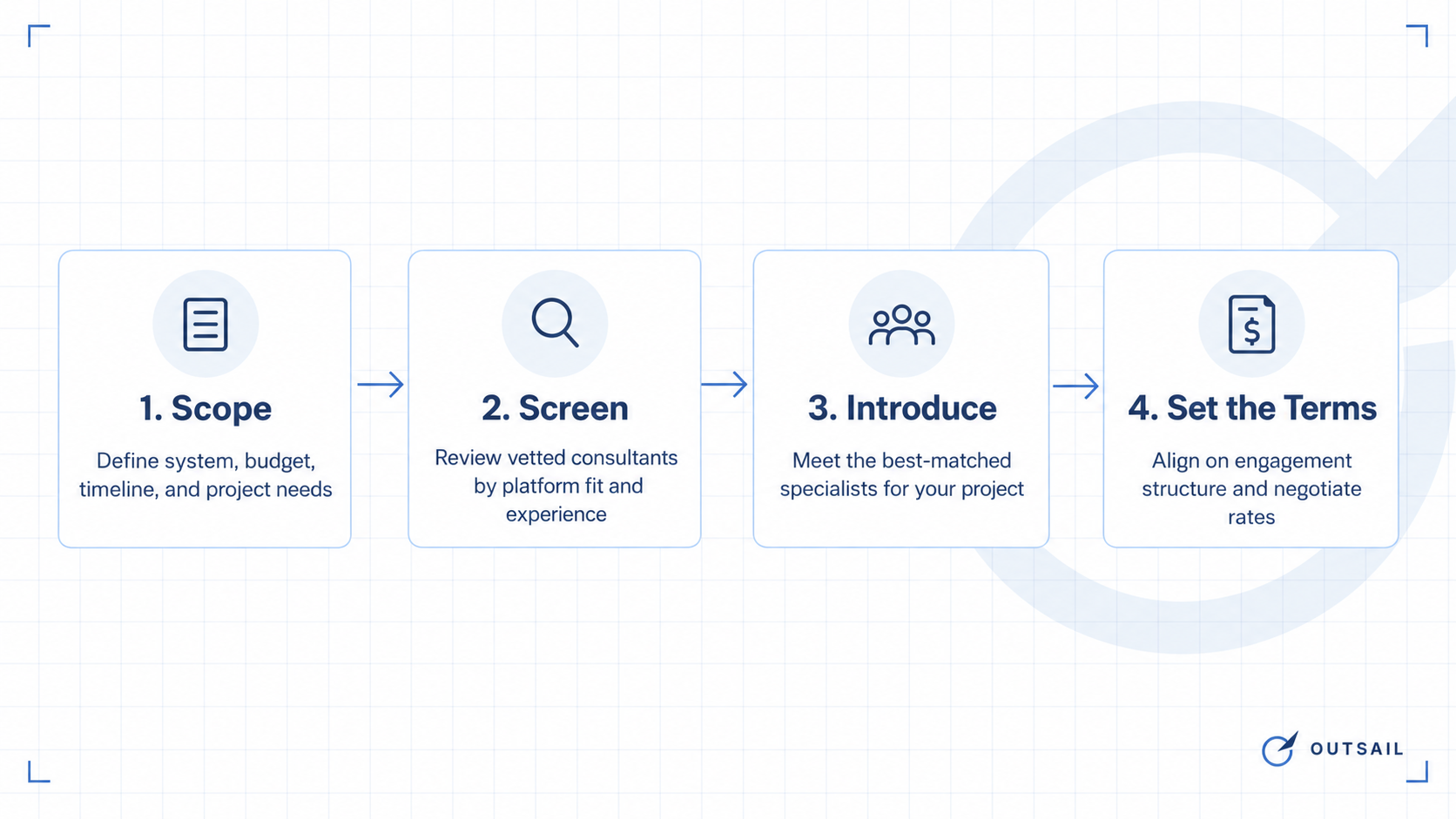
HR technology consultant matching connects you with pre-vetted specialists chosen against your real requirements, instead of leaving you to source and screen firms yourself.
Done well, it turns a weeks-long search into a shortlist in days.
Here is the process OutSail runs:
- Scope the work: system, project type, budget, timeline, company size, industry, geography, and working style.
- Screen the network: match those requirements against consultants already vetted on platform expertise, references, and delivery record.
- Introduce the fit: bring you the two or three best-matched partners, not a directory to sift through.
- Set the terms: use established network relationships to negotiate below-market engagement rates rather than accepting a first quote.
Matching on more than platform is what keeps the fit tight.
A consultant who is brilliant on Workday but only handles enterprise programs is the wrong call for a 300-person team, and matching on scope and working style catches that before an introduction is ever made.
Cost is usually the next question, and it is one competitors rarely answer straight.
How Much Does an HR Technology Consultant Cost?
HR technology consultant cost depends on the engagement model and the scope, not a single rate.
Most work is priced one of four ways: a fixed project fee, a monthly advisory retainer, a managed (hands-on delivery) engagement, or an hourly rate for smaller tasks.
What you pay tracks the platform, the size of the project, and how much of the work the consultant owns versus advises.
The four common engagement models:
- Fixed project: one price for a defined outcome, like a data migration or a go-live. Best when the scope is clear.
- Advisory retainer: a monthly fee for ongoing guidance while your team does the work.
- Managed engagement: the consultant runs the project hands-on. Higher cost, less lift for your team.
- Hourly: for scoped, smaller fixes and one-off questions.
What drives the number: the platform, the size and length of the project, the state of your data, and the depth of support you need.
A short optimization on a system you already run costs far less than a full implementation.
As a rough benchmark on timelines, a well-supported mid-market HRIS rollout typically runs three to six months, while large enterprise deployments stretch beyond a year (Paycom), and cost scales with that length.
Keep consultant cost separate from software cost, since they are often confused.
Enterprise platforms like Workday and SAP SuccessFactors frequently require a third-party implementation partner, and that engagement is a large budget line on top of the software itself.
Where matching helps on cost: because OutSail negotiates through established network relationships, matched engagements are often priced below what a firm quotes a cold inquiry.
How Can OutSail Help With Your HR Technology Project?
OutSail is an independent HR technology advisory firm built to help mid-market companies select, implement, and get real value from the systems that run HR.
Brett Ungashick and the OutSail team specialize in HR technology advisory, HRIS selection, and consultant matching – working alongside your team to build an HR technology decision you can defend, not just a signed contract.
OutSail does not try to be a generalist HR firm, and that focus is the point.
From choosing the right platform to matching the right specialist for a rollout or a fix, OutSail focuses on outcomes at every stage of an HR technology project.
HR and finance leaders get clear visibility into what a system will cost, what the market actually offers, and where the risks sit.
The guidance is independent by design.
OutSail pioneered the HR software broker approach, partnering with 220+ vendors that each pay a similar commission when a client buys.
The advice never bends toward whoever is paying, and roughly 90% of clients never pay a cent for the core selection service.
That independence shows up in outcomes like Olo saving $300K on its HRIS, Gentherm cutting payroll-vendor evaluation time by roughly 75%, and VetnCare selecting a new system in 30 days.
Every shortlist and pricing benchmark behind those wins draws on first-party data, not vendor marketing.
We know that a wrong system or a stalled rollout is real money lost.
Every recommendation we make is built around one outcome – an HR technology decision that fits your business and gets adopted by your people.
Meet the Founder of OutSail
Meet the founder and CEO of OutSail – Brett Ungashick:
- As founder and CEO of OutSail, Brett brings years of hands-on experience in HR technology selection, negotiation, and implementation, drawn from advising 1,500+ organizations on their HR systems.
- Brett began his career selling HR technology at LinkedIn, where he saw how hard it was for buyers to compare an increasingly crowded market, and founded OutSail in 2018 to put independent, buyer-side expertise into the process.
- OutSail's data-driven approach has supported more than $100M in HR software purchases, saved clients 100,000+ hours of work, and earned an 83 NPS, working with companies such as DoorDash, Salesloft, Olo, Houzz, and AuditBoard.
What Does Working With OutSail Look Like?
OutSail operates as a dedicated extension of your team – not a vendor that disappears after a kickoff call.
Every engagement includes direct access to advisors, transparent guidance tied to real project outcomes, and a plan built around your systems, budget, and internal bandwidth.
It runs from a tech stack audit through selection and negotiation, and on to a vetted, platform-specific consultant or implementation support when the work moves to a rollout or a fix.
Whether you are choosing a new system, negotiating a better deal, or finding a specialist to improve an existing one, OutSail builds the plan and does the work alongside you.
OutSail helps mid-market companies make HR technology decisions they can defend to their CFO – not just buy software.
Get the Right Expertise for Your HR Technology Project
The right move may be a free selection service, a matched specialist, or a full consulting engagement.
OutSail helps you determine what fits, then connects you with it.
Frequently Asked Questions
How long does an HRIS implementation usually take?
A well-supported mid-market HRIS rollout typically runs three to six months, while large, phased enterprise deployments can stretch beyond a year (Paycom).
The timeline depends on the platform, the number of integrations, the state of your data, and how ready the organization is for change.
A consultant who has done the work on your exact platform is the best source for a realistic estimate before you commit.
Is an HR technology consultant the same as an implementation partner?
No. "Consultant" is a broad term that includes selection advisors, optimization specialists, and implementers.
An implementation partner is one type, focused on deploying a platform you've already chosen.
The difference matters most at selection, because an implementation partner tied to a single product is not a neutral voice on which product you should buy.
Should I hire an independent consultant or a consulting firm?
It depends on the job.
An independent specialist usually offers deeper platform focus, more flexibility, and lower overhead for a scoped project.
A firm brings more bench depth for large, multi-workstream programs, at a higher cost.
Matching the size of the resource to the size of the work is how you avoid over-buying or under-buying.
How do HR technology consultants price their work?
Most use one of four models: a fixed project fee, a monthly advisory retainer, a managed hands-on engagement, or an hourly rate for smaller tasks.
The platform, project size, data condition, and depth of support drive the final number.
Keep consultant fees separate from software cost, which is a different line item.
How does OutSail's consultant matching work?
OutSail scopes your project (system, budget, timeline, size, and working style), screens its vetted partner network against those requirements, introduces the two or three best-fit consultants, and negotiates below-market rates through established relationships, so you reach a qualified shortlist in days instead of weeks.
Do I have to pay OutSail to select HR software?
No. OutSail's core selection service is free because vendors pay a commission when you buy, and roughly 90% of clients never pay a cent.
Companies with heavier requirements can choose a paid advisory tier, and consultant matching connects you with specialists for the hands-on work after selection.


.png)
