Best HRIS Systems for 2026: A Buyer's Guide for Every Company Size
2026 HRIS buyer’s guide covering top platforms by company size, with real pricing ranges, key trade-offs, and honest insights to help you choose the right HR software for your needs.

Choosing an HRIS is one of the highest-impact technology decisions an HR leader will make. The right platform streamlines payroll, reduces compliance risk, and gives employees a self-service experience that keeps them off HR's desk. The wrong one creates years of workarounds, vendor frustration, and re-implementation costs that dwarf the original investment.
The challenge is that "best" depends almost entirely on context. A 40-person startup needs something radically different from a 3,000-person enterprise with global payroll obligations. A company leaving a PEO has different priorities than one upgrading from spreadsheets for the first time.
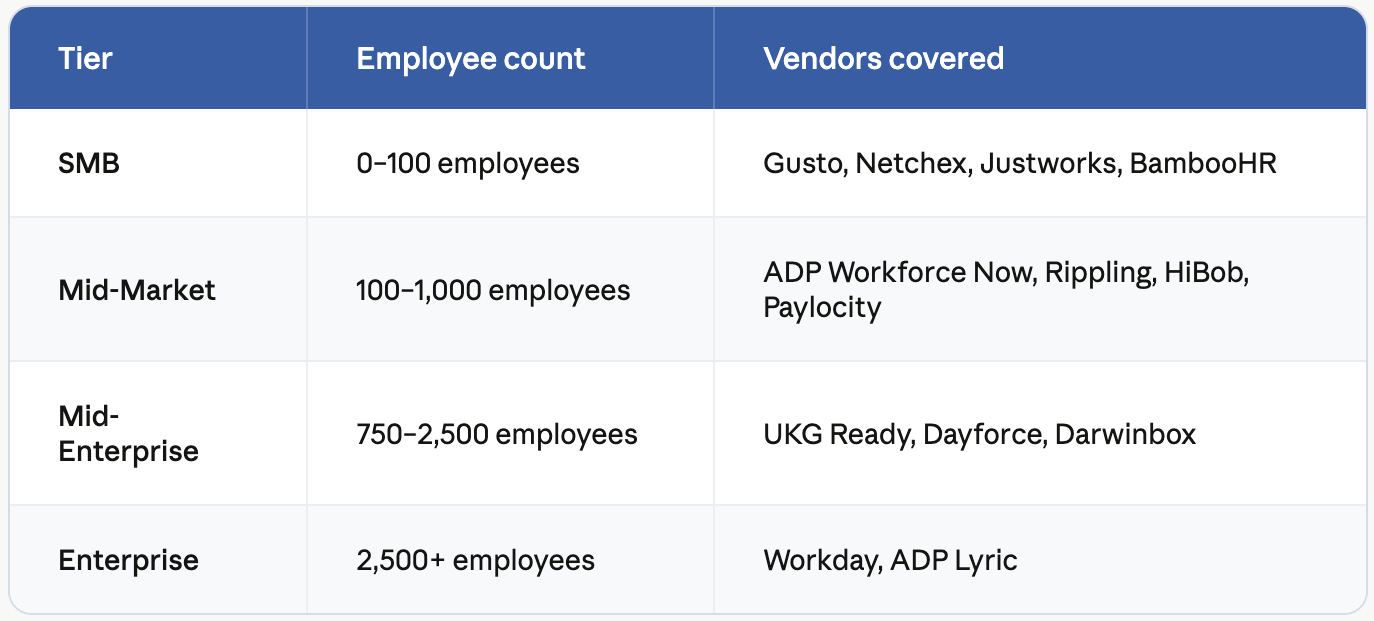
This guide organizes the 2026 HRIS landscape into four tiers based on company size, because that's the single biggest factor in determining which platforms belong on your shortlist. For each tier, we cover who the leading vendors are, what they cost, what they do well, and where they fall short.
If you want personalized recommendations based on your specific requirements, OutSail's HRIS Marketplace matches you with the right vendors for free — with pricing data, pros and cons, and advisory support throughout the process.
How to Use This Guide
We've organized vendors into four tiers based on ideal employee count. These ranges aren't hard boundaries — there's overlap, and vendors often serve companies slightly above or below their sweet spot. But they reflect where each platform delivers the best combination of fit, value, and support.
For each vendor, we cover pricing estimates, key strengths, primary limitations, and who it fits best. Pricing ranges reflect OutSail's advisory data and publicly available estimates — your actual quote will depend on modules, contract terms, and negotiation.
Tier 1: SMB (0–100 Employees)
Small businesses need an HRIS that's affordable, easy to implement, and doesn't require a dedicated HR technologist to manage. The platforms in this tier prioritize simplicity and speed over deep configurability.
Gusto
Estimated cost: $6–22 per employee per month (plus base platform fee of $49–$180/month depending on plan)
What it does well: Gusto has become the default payroll and HR platform for startups and small businesses, and for good reason. Setup takes days, not months. The interface is clean and intuitive — even non-HR founders can run payroll confidently. Gusto handles federal, state, and local tax filings automatically, offers built-in benefits administration (health, dental, vision, 401k), and provides solid onboarding workflows. The platform also supports contractor payments and has expanded into international payroll through an EOR offering.
Where it falls short: Gusto's simplicity becomes a limitation as companies grow past 75–100 employees. Reporting is basic. Performance management and talent features are minimal. And if you need deep workforce management tools like scheduling or labor costing, Gusto doesn't play in that space. Customer support has also received mixed reviews — the shift to primarily chat-based support frustrates some users who want phone access.
Best for: Startups, founder-led companies, and small businesses that want payroll and basic HR in one clean platform without paying enterprise prices.
Netchex
Estimated cost: $5–10 per employee per month (varies by modules)
What it does well: Netchex is an underrated option in the SMB space that punches above its weight in feature depth. It offers payroll, benefits administration, time and attendance (with geofencing and biometric options), recruiting, onboarding, performance management, and learning management — all in one platform. For small companies that want more than just payroll, Netchex provides a surprisingly complete suite at a competitive price. The platform also has strong tax compliance capabilities and dedicated implementation support.
Where it falls short: Netchex doesn't have the brand recognition of Gusto or BambooHR, which means fewer third-party integrations and a smaller community of users sharing best practices. The interface, while functional, isn't as polished as some competitors. And for companies with global employees, Netchex is primarily a domestic U.S. solution.
Best for: Small to mid-sized U.S. businesses (25–150 employees) that want a full-featured HRIS at a budget-friendly price point, especially those in industries like healthcare, manufacturing, or hospitality where time tracking and compliance are priorities.
Justworks
Estimated cost: $59/employee/month (Basic) or $109/employee/month (Plus, includes benefits)
What it does well: Justworks operates as a PEO (Professional Employer Organization), which means it bundles HR software with access to enterprise-level benefits, workers' compensation, and compliance management under a co-employment model. For small businesses that want someone else to handle the administrative complexity of benefits procurement, compliance, and payroll tax, Justworks provides a turnkey solution. The platform is clean, the pricing is transparent (rare for a PEO), and the benefits packages available through their group plans are genuinely competitive for small employers.
Where it falls short: The PEO model means you're in a co-employment arrangement, which isn't right for every company. Justworks' HR technology is functional but not deep — companies that want advanced talent management, performance tools, or robust reporting will outgrow it. And at $59–$109 per employee per month, the all-in cost is higher than standalone HRIS platforms, though you're paying for benefits access and compliance support that would otherwise require separate vendors.
Best for: Small businesses (10–100 employees) that want to outsource the complexity of benefits, compliance, and payroll under one PEO umbrella — especially those without a dedicated HR team.
BambooHR

Estimated cost: $10–33 per employee per month (depending on plan tier)
What it does well: BambooHR built its reputation on user experience, and it still delivers one of the cleanest, most intuitive interfaces in the HRIS market. The platform covers core HR, onboarding, time tracking, PTO management, basic performance reviews, and employee satisfaction surveys. BambooHR recently launched an Elite package pushing deeper into mid-market territory with advanced payroll, benefits administration, and workforce planning tools. For HR teams that value ease of adoption — getting employees and managers to actually use the system without extensive training — BambooHR consistently ranks near the top.
Where it falls short: BambooHR's reporting has historically been basic compared to mid-market competitors, though recent updates have improved this. Multi-country payroll requires add-ons or third-party integrations. And while the Elite tier adds more advanced features, companies with 200+ employees often find they need the configurability of a true mid-market platform. The recent pricing restructuring has also pushed costs higher for some customers.
Best for: Growing companies (25–250 employees) that prioritize a modern employee experience and ease of use over deep configurability — especially tech companies, professional services firms, and organizations that want quick deployment.
Tier 2: Mid-Market (100–1,000 Employees)
The mid-market is the most competitive tier in the HRIS space. Companies at this stage need a platform that can handle payroll at scale, support benefits administration, offer real talent management tools, and integrate with a broader tech stack. This is where most buyer decisions get made — and where OutSail spends the majority of its advisory work.
ADP Workforce Now

Estimated cost: $23–30 per employee per month (base); $30–50 PEPM with outsourced services
What it does well: ADP is the most trusted name in payroll — period. With over one million employers on its infrastructure, ADP Workforce Now delivers best-in-class tax compliance, payroll accuracy, and the option to outsource back-office functions through Comprehensive Services. The platform's compensation benchmarking tool (powered by 42+ million employee records) is a genuinely unique data asset. ADP has also invested heavily in its integration marketplace and revamped mobile app.
Where it falls short: Customer support is the most common complaint — long wait times and inconsistent resolution quality are well-documented. The platform can feel rigid, requiring companies to adapt their processes to ADP's way of working. And ADP's pricing structure can be opaque, with add-on fees and line items that aren't always prominent during the sales process.
Best for: Companies that prioritize payroll reliability and compliance above all else, organizations that want to outsource HR administration, and multi-state employers.
Rippling

Estimated cost: Starting at $8 per employee per month (base HR module); $35–55+ PEPM for full suite with payroll, benefits, IT
What it does well: Rippling is the platform that tech-forward companies gravitate toward. It unifies HR, IT, and finance operations in a way no other mid-market vendor does — onboarding a new employee can automatically provision their laptop, set up email accounts, enroll them in benefits, and start payroll, all from one workflow. Rippling's automation engine is extremely powerful, and the platform offers 600+ native integrations. For companies where HR and IT overlap heavily, Rippling's cross-functional approach is genuinely differentiated.
Where it falls short: Rippling's breadth can feel overwhelming for HR teams that just want straightforward payroll and benefits. The platform's ambition to be everything — HR, IT, finance, device management — means it can be more platform than some mid-market companies need. Global payroll is handled through integrations rather than natively in all countries. And Rippling's rapid growth and evolving product mean the experience can shift between updates.
Best for: Tech-forward companies (50–1,000 employees) that want tight HR-IT integration, heavy automation, and an extensive integration ecosystem — especially those with distributed or remote teams.
HiBob
Estimated cost: $16–25 per employee per month (varies by modules and region)
What it does well: HiBob (branded as "Bob") has built a passionate following among modern, culture-forward companies. The platform's strength is its employee engagement and people analytics layer — tools for org charts, workforce planning, compensation management, DEI tracking, and culture surveys that go beyond basic HRIS functionality. HiBob's interface is visually appealing and designed for engagement, not just administration. The company has also expanded aggressively into payroll, acquiring Pento and rolling out native payroll in the UK, Ireland, and Australia, with U.S. payroll on the roadmap.
Where it falls short: HiBob's payroll capabilities in the U.S. are still maturing — most American customers pair it with a third-party payroll provider, which adds integration complexity and cost. The platform is stronger on the people/culture side than on deep compliance and tax infrastructure. And for companies that need robust time and attendance or workforce management, HiBob's native tools are lighter than dedicated mid-market platforms.
Best for: Modern, globally distributed companies (100–1,500 employees) that prioritize employee experience, people analytics, and culture — especially those headquartered in Europe or with international teams.
Paylocity

Estimated cost: $18–28 per employee per month
What it does well: Paylocity has emerged as one of the most well-rounded mid-market HRIS platforms, combining solid payroll and core HR with genuinely innovative employee engagement features. The platform's Community tool (a social-media-style internal communication hub), on-demand payment options, and video-integrated learning modules set it apart from more traditional vendors. Paylocity is also known for a more modern, user-friendly interface than legacy competitors and a strong customer support experience.
Where it falls short: While Paylocity has improved significantly, some users report that the platform's reporting and analytics still lag behind more data-rich competitors like ADP or UKG. Advanced configurability for highly custom workflows can also be limited compared to enterprise-grade tools. And Paylocity's global capabilities are more limited than vendors with dedicated international payroll offerings.
Best for: Mid-market companies (100–1,000 employees) that want a modern, employee-friendly platform with solid payroll and benefits — especially those that value community features, engagement tools, and a vendor that innovates quickly.
Tier 3: Mid-Enterprise (750–2,500 Employees)
Companies in this range have outgrown basic mid-market platforms but may not need (or want to afford) a full enterprise suite. They typically need more advanced workforce management, deeper configurability, stronger analytics, and multi-location or multi-entity support.
UKG Ready

Estimated cost: $21–35 per employee per month
What it does well: UKG Ready (formerly Kronos) is purpose-built for organizations with complex workforce management needs — think shift scheduling, labor forecasting, advanced time and attendance, and compliance tracking for hourly and frontline workers. The platform combines core HR and payroll with the industry-leading workforce management tools that UKG is known for. For companies in retail, hospitality, healthcare, manufacturing, or any industry with large hourly populations, UKG Ready's scheduling and labor management features are among the best available.
Where it falls short: UKG Ready's interface and user experience trail behind more modern competitors. Implementation can be lengthy and resource-intensive compared to mid-market platforms. And the talent management modules (recruiting, performance, learning) are functional but not as polished as vendors that specialize in those areas. Companies that don't need deep workforce management may find UKG Ready more platform than they need.
Best for: Organizations (500–2,500 employees) with large hourly or shift-based workforces where scheduling, labor compliance, and workforce management are top priorities.
Dayforce (formerly Ceridian)
Estimated cost: $24–40 per employee per month
What it does well: Dayforce's standout feature is its continuous payroll calculation engine — the platform recalculates pay in real time as employees log hours, request time off, or receive benefits changes, rather than batch-processing at the end of a pay period. This gives payroll administrators a running view of payroll liability and dramatically reduces end-of-cycle surprises. Dayforce has also invested heavily in AI (Dayforce Co-Pilot), advanced analytics, and global payroll capabilities covering 200+ countries. The platform earned a "Leader" designation in Nucleus Research's 2026 Enterprise HCM Value Matrix.
Where it falls short: Dayforce implementations are among the most involved in the mid-enterprise space — expect 4–8+ months depending on scope. The platform's depth means there's a steeper learning curve for administrators. Pricing can escalate quickly as you add modules beyond core HR and payroll. And while Dayforce's continuous calculation engine is powerful, it also means the system requires clean, up-to-date data inputs to function correctly.
Best for: Mid-to-large enterprises (750–5,000+ employees) that need continuous payroll processing, strong workforce management, and global payroll — particularly in industries like financial services, healthcare, and manufacturing.
Darwinbox
Estimated cost: $3–8 per employee per month (varies significantly by region and configuration)
What it does well: Darwinbox has risen rapidly as a global HRIS challenger, particularly strong in Asia-Pacific and the Middle East. The platform offers a full HCM suite — core HR, payroll, time and attendance, talent management, performance, learning, and people analytics — at a price point that significantly undercuts Western enterprise vendors. Darwinbox's mobile-first design, AI-powered features, and voice-enabled assistant make it feel modern and accessible. The company recently secured a strategic partnership with Microsoft, signaling growing enterprise ambitions.
Where it falls short: Darwinbox's U.S. payroll and compliance infrastructure is less mature than domestic incumbents like ADP, UKG, or Dayforce. Companies with primarily U.S.-based workforces may find that the platform's strengths don't align with their compliance needs. Implementation support and customer success in North America are still scaling. And while the pricing is attractive, evaluating total cost of ownership requires accounting for any gaps that need third-party solutions to fill.
Best for: Global organizations (500–5,000+ employees) with substantial workforces in Asia-Pacific, India, or the Middle East — especially those looking for a modern, mobile-first platform at a lower price point than Western alternatives.
Tier 4: Enterprise (2,500+ Employees)
At the enterprise level, HRIS decisions are strategic, multi-year commitments involving extensive evaluation processes, dedicated implementation teams, and budgets that can reach seven figures. The vendors in this tier are built for global scale, deep configurability, and integration with broader ERP and financial systems.
Workday
Estimated cost: $50–100+ per employee per month (varies widely based on modules and organizational size)
What it does well: Workday is the gold standard for enterprise HCM — a cloud-native platform that combines HR, payroll, talent management, workforce planning, and financial management on a single architecture. For large organizations that want both HCM and financial planning in one system, Workday's unified data model is unmatched. The platform's analytics and reporting capabilities are among the deepest in the market, and Workday has invested aggressively in AI-powered skills intelligence, talent marketplace features, and agentic AI capabilities. Workday also has the most extensive partner ecosystem for enterprise implementation support.
Where it falls short: Workday is expensive — both the software itself and the implementation, which typically requires external consultants and can take 9–18+ months. The platform's power creates complexity; smaller HR teams can find it overwhelming. And while Workday has pushed into the mid-market with lighter deployment options, its sweet spot remains companies with 2,500+ employees and the budget and internal resources to support a full-scale implementation. According to Nucleus Research's 2026 Value Matrix, Workday remains a dominant force, though newer entrants are narrowing the gap on usability.
Best for: Large enterprises (2,500–100,000+ employees) that need a unified HCM and financial planning platform with global reach, deep analytics, and a commitment to long-term platform investment.
ADP Lyric
Estimated cost: Custom enterprise pricing (typically $30–60+ per employee per month depending on scope)
What it does well: ADP Lyric is ADP's next-generation enterprise HCM platform, launched in late 2024 and reaching full commercial stride in 2025–2026. Built from the ground up on a cloud-native, microservices architecture, Lyric was designed around modern work structures — dynamic teams, multiple worker types (full-time, part-time, contract, gig), and overlapping organizational hierarchies. It supports payroll in 75+ countries (expanding quarterly), features GenAI capabilities through ADP Assist, and integrates the WorkForce Suite for advanced scheduling and labor management. Lyric was named a Leader in Nucleus Research's 2026 Enterprise HCM Value Matrix alongside Dayforce, Oracle, and UKG Pro, and has landed some of the largest enterprise HCM deals in ADP's history — including companies with 20,000+ employees. As industry analyst Josh Bersin noted, Lyric is "architected for the dynamic nature of enterprises, designed around teams not hierarchies."
Where it falls short: Lyric is still relatively new. With 120+ large accounts as of early 2026, it doesn't have the decades-deep install base and partner ecosystem that Workday has built. Companies evaluating Lyric are still early adopters in some respects, which carries the typical risks of a platform still actively expanding its geographic footprint and feature set. The migration path from ADP Workforce Now to Lyric also requires careful planning.
Best for: Large enterprises (1,000–50,000+ employees) that want ADP's payroll and compliance expertise in a modern, AI-infused architecture — especially global organizations that need flexible team structures and multi-country payroll on a next-generation platform.
How to Choose the Right HRIS for Your Company
Beyond company size, several factors should shape your shortlist:
- Start with your non-negotiables. What are the three things your HRIS absolutely must do well? For some companies, it's payroll accuracy. For others, it's employee self-service, global support, or integration with specific tools. Anchor your evaluation around those priorities rather than trying to score every possible feature.
- Match the platform to your HR team's capacity. A powerful, configurable platform is only valuable if your team has the bandwidth to manage it. A 5-person HR team managing 800 employees probably doesn't need (or have time for) the same platform as a 30-person HR department.
- Model total cost of ownership, not just PEPM. Factor in implementation fees, add-on module costs, integration expenses, potential consulting needs, and annual renewal increases. A platform that's $5/month cheaper per employee but requires $50K more in implementation and consulting isn't actually saving you money.
- Check the vendor's service model. How does the vendor handle support? Dedicated reps, call queues, or ticketing? The answer matters more than most buyers realize — especially in the first year post-implementation.
- Negotiate before you sign. HRIS contracts are negotiable. Multi-year commitments, timing (vendors are often more flexible at quarter-end), and competitive quotes from other vendors all create leverage. Don't accept the first price you're given.
For a structured approach to vendor evaluation, OutSail's Requirements Builder can help you identify your must-haves and nice-to-haves before you start talking to sales teams.
Frequently Asked Questions
What is the best HRIS system for 2026?
There's no single "best" — it depends on your company size, priorities, and budget. For SMBs, Gusto and BambooHR lead on simplicity and value. In the mid-market, ADP Workforce Now, Rippling, and Paylocity are the most common shortlist contenders. For enterprise organizations, Workday and ADP Lyric represent the top tier. The right platform is the one that matches your requirements, team capacity, and growth trajectory.
How much does an HRIS cost in 2026?
Pricing varies widely by tier. SMB platforms typically run $6–33 per employee per month. Mid-market solutions range from $18–35 PEPM. Mid-enterprise platforms cost $21–40 PEPM. Enterprise systems start at $30 PEPM and can exceed $100 PEPM for full-suite deployments. Implementation fees add 10–35% of first-year costs across all tiers.
What's the difference between HRIS, HRMS, and HCM?
HRIS (Human Resources Information System) is the core system of record for employee data and workflows — payroll, benefits, time tracking, and compliance. HRMS (Human Resources Management System) typically includes everything in an HRIS plus deeper payroll and benefits integration. HCM (Human Capital Management) is the broadest term, adding talent management, performance, learning, workforce planning, and analytics. In practice, most modern platforms blur these lines, and the terms are often used interchangeably by vendors.
How long does it take to implement an HRIS?
SMB platforms like Gusto can be live in days to weeks. Mid-market platforms (ADP Workforce Now, Paylocity, Rippling) typically take 2–4 months. Mid-enterprise systems (UKG Ready, Dayforce) run 4–8 months. Enterprise deployments (Workday, ADP Lyric) can take 9–18+ months depending on scope and global reach.
Should I choose an all-in-one HRIS or best-in-class point solutions?
This is one of the most debated questions in HR technology. All-in-one platforms reduce integration headaches and data silos but may not excel in every category. Best-in-class stacks give you specialized tools but require more integrations and vendor management. Most mid-market companies are moving toward "core-plus" strategies — a strong all-in-one HRIS for payroll, benefits, and time, paired with one or two best-in-class tools for areas like recruiting or performance. For a deeper take, see our analysis of the all-in-one vs. best-in-class HRIS debate.
The Bottom Line
The HRIS market in 2026 is more competitive and more capable than ever. AI features are becoming standard. Employee self-service expectations are higher. And vendors at every tier are pushing to deliver more value per dollar.
But the fundamentals of a good HRIS decision haven't changed: know your requirements, match the platform to your size and capacity, model the real costs, and negotiate hard. The best HRIS for your company isn't the one with the most features — it's the one that fits how your team actually works.
If you want help cutting through the vendor noise, OutSail's advisory team works with hundreds of companies each year to match them with the right HRIS. Our service is completely free for buyers.
Looking for deeper dives on specific vendors? Browse the full OutSail Blog for individual vendor reviews, pricing guides, and head-to-head comparisons.
.png)
