BambooHR vs Rippling vs HiBob: Best HRIS for Companies With 50–300 Employees
Compare BambooHR, Rippling, and HiBob in 2026 for companies with 50–300 employees. See pricing, scalability, global capabilities, and which HRIS best fits your growing business needs.

Companies with 50–300 employees occupy a tricky middle ground when it comes to HR technology. You've outgrown basic payroll tools and spreadsheets, but you're not ready for (or interested in paying for) an enterprise platform. You need a system that handles core HR and payroll reliably today while scaling with you as headcount grows.
BambooHR, Rippling, and HiBob are the three vendors that land on shortlists most often in this range — and all three have evolved substantially heading into 2026. BambooHR launched a new Elite package aimed at the mid-market. HiBob acquired Mosaic (a financial planning platform) and launched native US payroll. Rippling continued expanding into finance and IT management, pushing further into spend management territory.
This guide compares all three across pricing, core features, global capabilities, integrations, service, and ideal fit so you can decide which one matches your organization's priorities.
If you want personalized vendor recommendations, OutSail's HRIS Marketplace can match you with the right platform for free.
The Quick Verdict
Company Snapshots
BambooHR
Founded in 2008 in Lindon, Utah, BambooHR built its reputation as the go-to HRIS for small businesses that wanted something better than spreadsheets without the weight of an enterprise system. The platform serves over 34,000 customers and has earned a loyal following for its clean interface, strong customer support, and approachable pricing.
In 2024, BambooHR restructured its pricing into three tiers — Core, Pro, and Elite — with the Elite package representing a deliberate push into the mid-market. Elite adds compensation management, custom analytics dashboards, HR benchmarking, 300+ compliance courses, and premium support — capabilities that were previously missing from BambooHR's offering.
BambooHR's sweet spot remains companies with 25–250 employees, though the Elite tier is designed to keep customers in the ecosystem as they grow past that range.
Rippling
Founded in 2016 by Parker Conrad (previously of Zenefits), Rippling has grown into one of the most ambitious platforms in the HR technology space. Valued at over $16 billion as of its May 2026 Series G round, Rippling's thesis is that HR, IT, and finance are fundamentally interconnected — and should run on one system.
Rippling isn't just an HRIS. It's a workforce operations platform that can onboard a new employee, provision their laptop and software accounts, enroll them in benefits, start payroll, and issue a corporate card — all from a single workflow. The 2024 Airbase-style spend management capabilities, global payroll in 100+ countries, and device management features put Rippling in a category of its own.
Rippling's ideal customer is a tech-forward company with 50–1,000 employees that values automation, integration breadth, and cross-functional reach.
HiBob
Founded in 2015 in Tel Aviv with headquarters in New York, HiBob (branded as "Bob") has built a passionate following among modern, globally distributed companies. The platform serves over 4,400 multinational businesses and is valued at approximately $3 billion.
HiBob's strength is the combination of an engaging employee experience layer with people analytics, workforce planning, and global HR capabilities. In 2025, HiBob acquired Mosaic (a $35 million deal for a financial planning and analysis platform), launched Bob Finance for integrated headcount planning and budgeting, introduced Bob Hiring (native ATS) and Bob Learning, and rolled out native US payroll powered by Gusto's engine with general availability in January 2026.
HiBob's sweet spot is globally distributed companies with 100–1,500 employees that prioritize employee engagement, people analytics, and culture — especially those with European or international headquarters.
Pricing Comparison
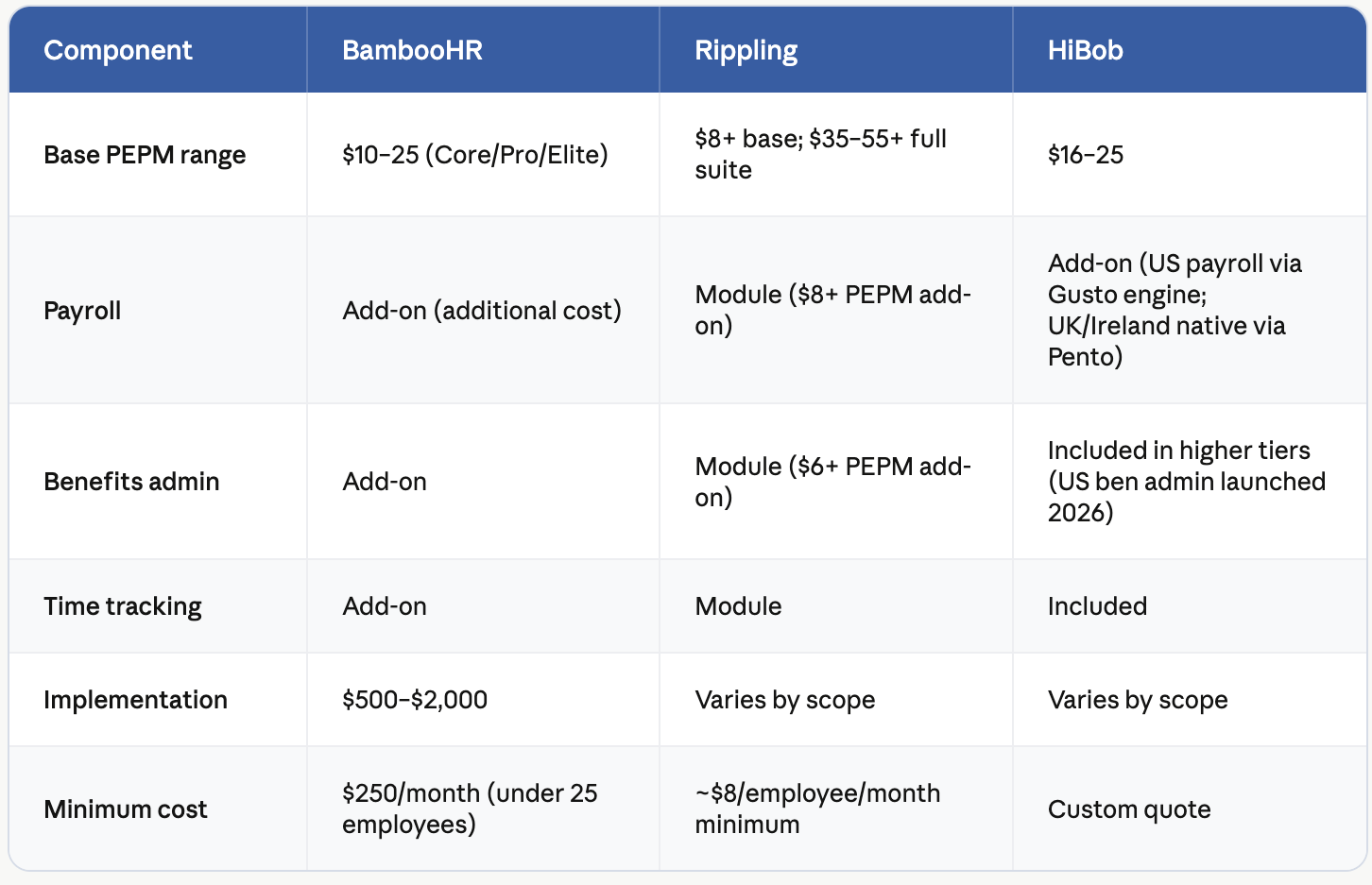
BambooHR is the most affordable at the base level, especially on Core ($10 PEPM) and Pro ($17 PEPM). But keep in mind that payroll, benefits administration, and time tracking are all paid add-ons — so the sticker price can understate the real cost by 30–50% once you add the modules most companies actually need. Even with add-ons, BambooHR typically lands as the least expensive of the three for comparable functionality.
Rippling starts low at $8 per employee per month for the base HR module, but every capability beyond core HR — payroll, benefits, IT management, device management, spend management — is an additional module. A fully loaded Rippling deployment with payroll, benefits, time, and IT management can reach $35–55+ PEPM, making it the most expensive of the three when all modules are stacked.
HiBob falls in the middle at $16–25 PEPM, with more features included in the base subscription than BambooHR (time tracking, org charts, workforce planning, engagement surveys) but without the IT and finance layers that Rippling offers. Payroll is an add-on, with US payroll now available natively (powered by Gusto) alongside existing UK and Ireland payroll via the Pento acquisition.
Core HR and Payroll
BambooHR
BambooHR's core HR module is clean, intuitive, and well-suited for companies transitioning from spreadsheets or basic tools. Employee records, org charts, time-off management, workflows, and basic reporting are all handled well. The platform earns consistently high marks for ease of use — both for HR administrators and for employees doing self-service tasks.
Payroll is available as an add-on and handles US payroll processing, tax filing, and direct deposit. It's reliable for standard domestic payroll but doesn't support international payroll natively. For global teams, BambooHR partners with Remote (available through the BambooHR marketplace as an EOR add-on).
The Elite tier adds compensation management and benchmarking — a meaningful upgrade for companies that previously had to manage comp planning in spreadsheets alongside BambooHR.
Rippling
Rippling's payroll module is robust and natively built, supporting payroll in the US and 100+ countries through a combination of native processing and global payroll partnerships. The platform automatically calculates taxes, handles deductions, and files returns across federal, state, and local jurisdictions. Rippling also offers an EOR (Employer of Record) service for companies hiring in countries where they don't have entities.
What distinguishes Rippling's payroll is the automation layer. Because HR, payroll, IT, and finance all run on the same system, changes anywhere automatically propagate everywhere. An employee's address change updates tax withholding, updates their office assignment in IT, and adjusts their benefits eligibility — without anyone re-keying data.
HiBob
HiBob's payroll story has evolved rapidly. The 2024 acquisition of Pento gave HiBob native payroll in the UK and Ireland. In September 2025, HiBob launched native US payroll powered by Gusto's engine, with general availability from January 2026. This means HiBob now offers payroll in three of its largest markets natively, with additional countries supported through payroll integrations and partners.
HiBob's core HR module excels at engagement and people operations — org charts, headcount planning, workforce analytics, DEI tracking, and employee lifecycle management. The interface is visually modern and designed for daily engagement, not just administrative use.
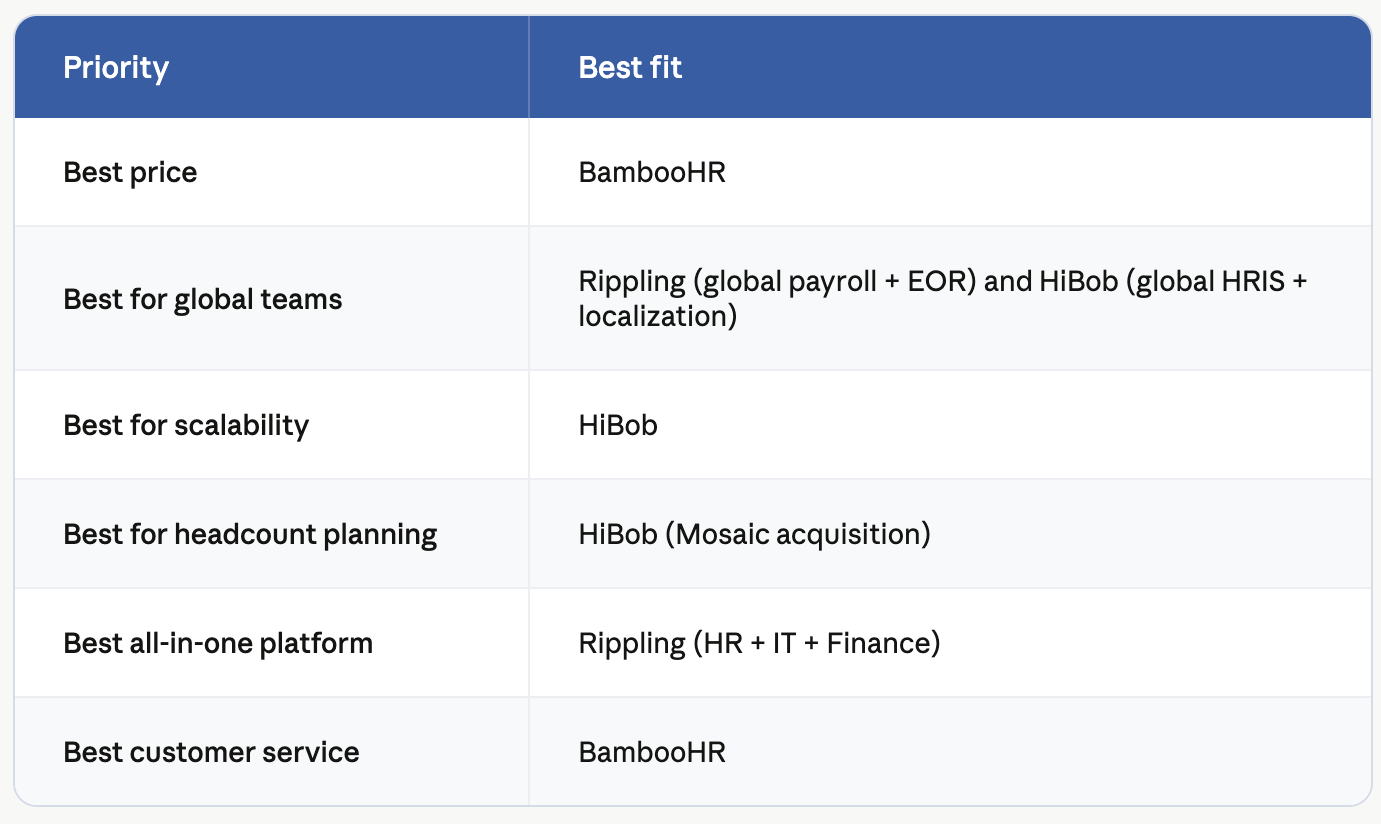
Edge: Rippling for the most powerful payroll automation and global payroll depth. BambooHR for simplicity and ease of use. HiBob for the strongest people analytics and engagement features layered on top of solid core HR.
Global Capabilities
This is where the three platforms diverge most sharply.
BambooHR
BambooHR is primarily a US-focused platform. It supports employee records and basic HR for international teams (it operates in 190+ countries for core HR and supports eight languages), but there's no native global payroll. Companies with international employees typically pair BambooHR with an EOR partner like Remote (available through the marketplace) or a separate global payroll provider.
For companies where 80%+ of the workforce is in the US and international employees are a small minority, BambooHR can work. But it's not a global system of record in the way HiBob or Rippling are.
Rippling
Rippling supports global payroll in 100+ countries and offers an EOR service for companies hiring in countries without entities. The platform handles multi-currency payroll, international tax compliance, and cross-border benefits administration. Rippling's global capabilities are strong and getting stronger — but the platform's roots are in the US market, and the depth of localization varies by country.
HiBob
HiBob was built with global companies in mind from the start. The platform supports localized HR workflows, multi-language interfaces, country-specific compliance, and localized payroll in the UK, Ireland, and US (with additional countries through integrations). HiBob serves over 4,400 multinational companies and has deep localization for European, APAC, and Middle Eastern markets.
For companies with distributed teams across multiple countries, HiBob's global HRIS capabilities and localization depth are among the best in the mid-market. The platform feels natively global rather than US-first-with-international-bolted-on.
Edge: HiBob for the strongest global HRIS and localization. Rippling for global payroll breadth and EOR services. BambooHR for US-centric organizations with minimal international needs.
Headcount Planning and Financial Integration
This is a newer battleground — and one where HiBob has made the boldest move.
HiBob
HiBob's acquisition of Mosaic ($35 million, closed April 2025) gave it a full financial planning and analysis (FP&A) platform. The resulting product, Bob Finance, integrates headcount planning, budget forecasting, scenario modeling, and workforce cost analysis directly into the HRIS. CFOs and HR leaders can see how hiring decisions, compensation changes, and turnover impact financial performance — in real time, in one system.
This is a genuine differentiator for growing companies where people costs represent 60–70% of operating expenses. Instead of reconciling data between separate HR and finance tools (or managing it all in spreadsheets), Bob Finance brings both into a single platform. No other vendor in this comparison offers anything comparable.
Rippling
Rippling's Airbase-style spend management capabilities cover expense management, corporate cards, bill pay, and procurement — but this is more CFO-facing finance tooling than HR-driven headcount planning. Rippling doesn't offer FP&A or workforce planning at the level HiBob now does with Mosaic.
BambooHR
BambooHR's Elite tier adds compensation management and benchmarking but doesn't include financial planning, headcount forecasting, or budget modeling. Companies on BambooHR that need this level of planning typically use separate tools.
Edge: HiBob, by a wide margin, for headcount planning and HR-finance integration.
IT and Cross-Functional Reach
Rippling
This is Rippling's single biggest differentiator. No other HRIS in the mid-market offers native IT device management, software provisioning, identity management, and access control alongside HR and payroll. Rippling can provision a laptop, set up email and Slack accounts, assign security roles, enroll the employee in benefits, and start payroll — all triggered from one onboarding workflow.
For companies where HR and IT responsibilities overlap (which is increasingly common in tech-forward organizations with remote teams), Rippling eliminates an entire category of manual handoffs between departments.
Rippling also offers spend management (corporate cards, expense reports, bill pay) through its finance module, making it the broadest cross-functional platform of the three.
HiBob and BambooHR
Neither HiBob nor BambooHR offers IT management, device provisioning, or identity management. Both integrate with IT tools through their respective marketplaces, but the integration is directional — HR data flowing to IT systems — rather than the unified approach Rippling provides.
Edge: Rippling, definitively, for companies that want HR + IT + Finance on one platform.
Integrations
Rippling leads with 600+ native integrations spanning HR, IT, finance, and productivity tools. The platform's automation engine can trigger cross-system workflows (e.g., when an employee is promoted, automatically update their access permissions in Okta, adjust their comp in payroll, and notify their manager in Slack).
BambooHR offers 150+ integrations through its marketplace, including popular connections with Greenhouse, Slack, Lattice, Deel, and accounting platforms. The API is well-documented and open. For a platform focused on core HR, the integration ecosystem is solid.
HiBob has a growing integration marketplace with connections to popular ATS, payroll, learning, and productivity tools. It's more curated than Rippling's but covers the most common use cases. HiBob's recent product launches (Bob Hiring, Bob Learning, Bob Finance) also reduce the need for third-party integrations in several categories.
Edge: Rippling for integration breadth and cross-system automation. BambooHR for a well-curated, easy-to-use integration marketplace.
Customer Service
BambooHR is consistently praised for customer support quality. The company offers phone, email, and chat support, and users frequently cite helpful, responsive interactions. Support is limited to US business hours, which can be a limitation for global teams. The new Elite tier includes premium support with dedicated resources for larger customers.
HiBob provides account management with dedicated customer success managers, which users generally rate positively. The support model is designed for ongoing relationship management rather than transactional issue resolution. For global companies, HiBob's support team covers multiple time zones.
Rippling has invested in scaling its support as the company has grown rapidly, but user reviews are more mixed. Some users report responsive, helpful interactions; others cite longer wait times and less personalized service compared to smaller vendors. Rippling's self-service help documentation is thorough, but companies that value high-touch support may find it less personal than BambooHR or HiBob.
Edge: BambooHR for the most consistently positive support experience.
Who Each Platform Fits Best
Choose BambooHR if:
- Budget is a top priority and you want the lowest total cost for solid core HR, payroll, and talent tools
- You value simplicity and ease of use above all — you want a platform that HR administrators and employees will adopt with minimal training
- Your workforce is primarily US-based and you don't need deep global capabilities
- Customer support quality matters and you want a vendor known for responsive, helpful service
- You're a growing company (25–250 employees) that wants to get off spreadsheets and onto a proper HRIS quickly, with the option to scale into the mid-market via the Elite tier
Choose Rippling if:
- You want HR, IT, and finance on one platform — device management, software provisioning, corporate cards, expense management, and HRIS in a unified system
- Automation is a priority — you want employee lifecycle events to trigger workflows across every system in your stack without manual handoffs
- You need deep integration breadth — Rippling's 600+ integrations and automation engine are the most extensive in this tier
- You're a tech-forward company (50–1,000 employees) with distributed teams where HR-IT coordination is a daily pain point
- Global payroll with EOR is on the roadmap and you want one vendor to cover domestic and international
Choose HiBob if:
- You're a globally distributed company that needs localized HR workflows, multi-language support, and a platform that feels natively global
- People analytics and headcount planning are priorities — HiBob's analytics depth and the Mosaic-powered Bob Finance suite are best-in-class for the mid-market
- Scalability matters — HiBob serves companies from 100 to 1,500+ employees and is designed to grow with you without requiring a re-implementation
- Employee engagement and culture are core to your HR strategy — HiBob's interface is built for daily employee interaction, not just back-office administration
- Your CFO needs workforce planning tools — Bob Finance integrates headcount planning, budget forecasting, and financial analytics directly into the HRIS
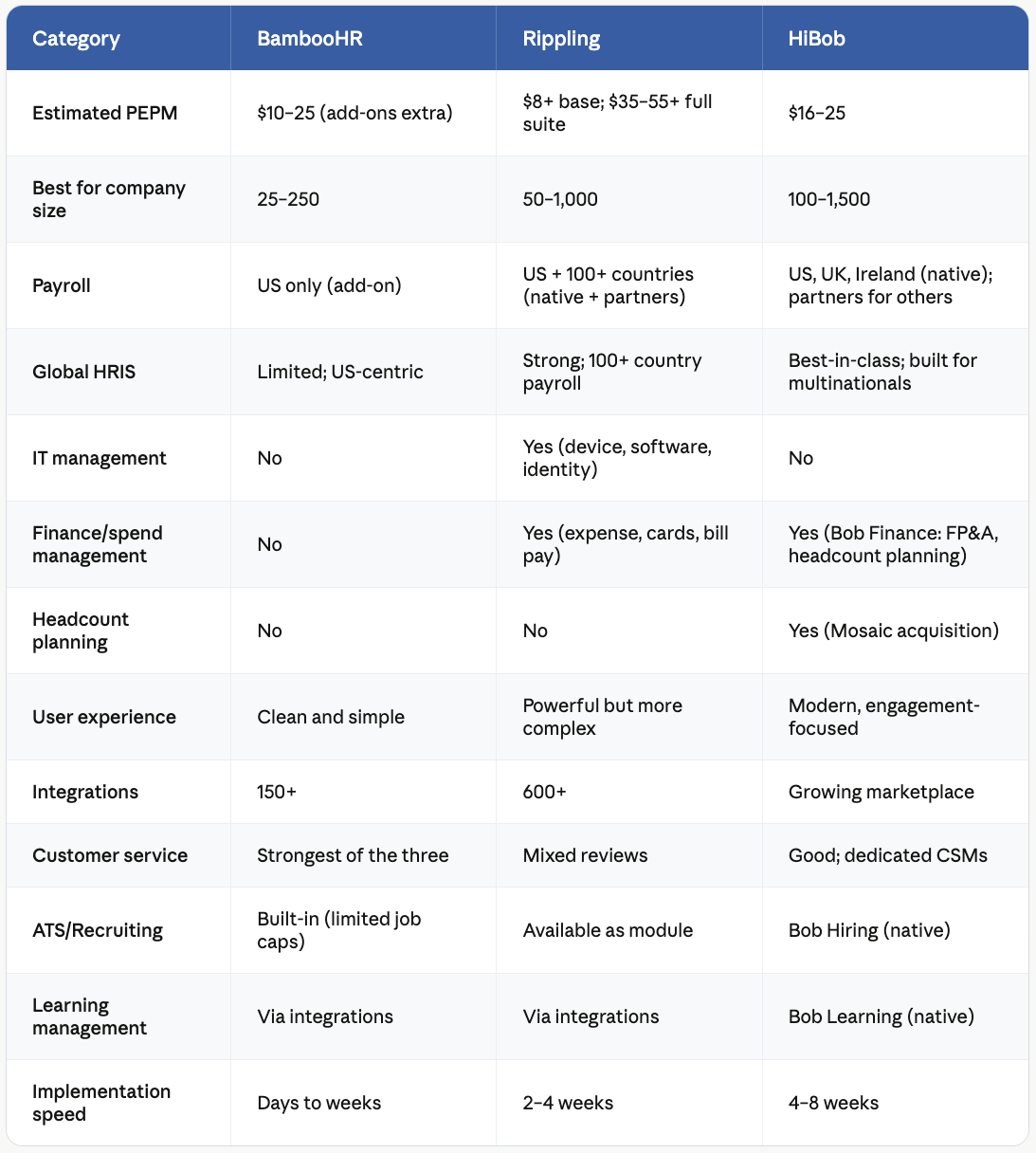
Side-by-Side Comparison Table
Frequently Asked Questions
Which is the most affordable: BambooHR, Rippling, or HiBob?
BambooHR is the least expensive at the base level ($10–25 PEPM depending on tier), even after accounting for payroll and time tracking add-ons. Rippling starts at $8 PEPM but quickly becomes the most expensive when you add payroll, benefits, IT, and finance modules. HiBob falls in the middle at $16–25 PEPM with more features included in the base subscription.
Can BambooHR handle international employees?
BambooHR supports employee records in 190+ countries and eight languages, but it doesn't offer native global payroll. For international payroll, you'll need to pair BambooHR with an EOR partner like Remote (available through the marketplace) or a separate global payroll provider. If global HR is a primary requirement, HiBob or Rippling are stronger options.
What is Bob Finance and how does it compare to Rippling's finance tools?
Bob Finance is HiBob's integrated financial planning and analysis suite, built on the Mosaic acquisition ($35 million, 2025). It focuses on headcount planning, workforce cost forecasting, budget modeling, and connecting HR data to financial outcomes — serving CFOs alongside HR leaders. Rippling's finance tools focus on operational spend management: corporate cards, expense reports, bill pay, and procurement automation. They solve different problems. Bob Finance is for strategic workforce planning; Rippling's finance suite is for day-to-day spend operations.
Is Rippling too complex for a 50-person company?
Not necessarily, but it depends on what you need. If you only need basic HR and payroll, Rippling can feel like more platform than required — and the modular pricing means you'd be paying for breadth you're not using. Where Rippling shines for smaller companies is when HR and IT responsibilities are intertwined (common in tech startups with remote teams). If provisioning laptops, managing software licenses, and onboarding employees are all currently separate processes handled by the same 2–3 people, Rippling's unified approach saves real time.
Does HiBob offer US payroll now?
Yes. HiBob launched native US payroll (powered by Gusto's engine) in September 2025, with general availability from January 2026. This is a meaningful upgrade — previously, US-based HiBob customers needed a separate payroll provider. The native integration means payroll data now flows directly within the Bob platform. HiBob also offers native payroll in the UK and Ireland through its Pento acquisition.
The Bottom Line
BambooHR, Rippling, and HiBob are all strong platforms — but they're built for different types of companies with different priorities.
BambooHR is the best choice when you want an affordable, user-friendly HRIS with excellent customer support and a clean employee experience. It's ideal for US-centric companies that value simplicity and don't need deep global capabilities or cross-functional IT/finance features.
Rippling is the best choice when you want one platform to handle HR, IT, and finance operations with deep automation and integration capabilities. It's ideal for tech-forward companies that want to eliminate manual handoffs between departments and need global payroll alongside device and software management.
HiBob is the best choice when you're a globally distributed company that needs a platform built for international teams, with strong people analytics, headcount planning, and an engagement-focused employee experience. The Mosaic acquisition makes it uniquely powerful for companies where CFOs and HR leaders need to collaborate on workforce strategy.
If you're comparing all three — or trying to decide which vendors should make your shortlist — OutSail can help. Our advisory team works with hundreds of growing companies each year and our service is completely free for buyers.
.png)
