Workday vs Rippling: A 2026 Comparison for Mid-Market and Enterprise Buyers
Workday and Rippling are converging on the 500–2,000 employee market. This 2026 comparison covers pricing, AI, global payroll, ERP breadth, IT management, and who each platform truly fits.


Two years ago, Workday and Rippling occupied reasonably distinct market positions. Workday served enterprises — large, complex organizations where the CFO and CHRO co-owned a multi-year infrastructure decision. Rippling served the modern mid-market — fast-growing technology and professional services companies that needed a clean, automated workforce platform without Workday's implementation overhead.
In 2026, that distinction has blurred substantially, and the blurring is intentional on both sides.
Workday has aggressively pursued the mid-market through its Workday Launch program, targeting organizations of 500–3,500 employees with faster implementations, more standardized configurations, and pricing structures that have come down meaningfully from where they stood two years ago. Workday is now directly competing for buyers who would previously have looked only at Dayforce, Paylocity, or mid-market HCM platforms.
Rippling, meanwhile, has moved upmarket with equal ambition. Its $450 million Series G in May 2025 valued the company at $16.8 billion and funded product expansion into enterprise-grade HR, finance, and IT capabilities. Rippling crossed $1 billion in annualized revenue in 2025, launched native global payroll in five major markets, and introduced Rippling AI in early 2026 — a natural-language interface for executing workflows across HR, IT, and finance simultaneously. The company's NPS of approximately 90 on G2 reflects a user satisfaction story that most enterprise platforms would envy.
The result is a genuine collision in the 500–2,000 employee segment — a buyer tier that can now credibly choose either platform, and that faces a more consequential decision because the platforms diverge sharply on several dimensions despite converging on price.
This comparison is written for the buyer sitting at that crossover point: large enough that Workday's mid-market offering makes sense, tech-forward enough that Rippling's architecture is compelling, and clear-eyed enough to know that the right answer depends on which differences actually matter for their organization.
The Honest Summary Before You Read Further
Both platforms are genuinely strong. Neither is the universal answer.
Choose Workday if: Finance-HR integration is a board-level priority; your organization is in enterprise territory (1,000+ employees) or growing toward it; you have complex payroll requirements and want maximum flexibility to choose payroll providers; your implementation team has the internal capacity for a thorough rollout; or your CFO has already identified Workday Financial Management as part of the technology strategy.
Choose Rippling if: You need native global payroll and EOR in a single platform without a separate vendor; IT device management and app provisioning are operational challenges you want solved alongside HR and payroll; your organization values speed of implementation and ease of use; you are tech-forward and want the platform with the most ambitious AI roadmap; or you are in the 200–1,500 employee range where Rippling's operational efficiency advantages are most pronounced.
Explore OutSail's Workday and Rippling Evaluation Tools
OutSail's platform gives HR and finance teams a structured way to evaluate both Workday and Rippling against each other and against your organization's specific requirements — at no cost.
Start your vendor evaluation on OutSail →
Pricing: The Gap Has Narrowed Significantly
Pricing is the most common starting point in this comparison — and the most frequently misrepresented one. A few years ago, the pricing gap between Workday and Rippling was a meaningful differentiator. In 2026, it is less so, and buyers should not anchor their decision on price alone.
Workday Pricing in 2026
Workday does not publish pricing, and all contracts are custom-quoted. Based on third-party buyer reports, OutSail's advisor data, and market benchmarks, Workday HCM typically runs $24–$36 per employee per month (PEPM) for mid-market deployments through Workday Launch. This represents a meaningful reduction from the $45–$65+ PEPM that characterized Workday's traditional enterprise pricing just two years ago.
The Workday Launch program — targeting 500–3,500 employees — uses preconfigured deployment templates and standardized configurations to reduce both the license cost and the implementation overhead. Implementation timelines through Launch are typically 3–4 months, compared to 6–12+ months for traditional Workday enterprise deployments.
First-year total cost of ownership still runs substantially higher than the license fee. Implementation costs for Workday traditionally represent 100–150% of the annual subscription. Through Launch, this multiplier is lower — but buyers should still expect meaningful first-year professional services costs beyond the PEPM rate.
What drives Workday's price: The modular structure means organizations pay for the specific combination of HCM, payroll, talent, and analytics modules they deploy. Adding Workday Financial Management (the ERP) substantially increases the total investment but creates the finance-HR integration story that drives Workday's most loyal enterprise customers.
For a detailed Workday cost breakdown, see OutSail's Workday pricing guide.
Rippling Pricing in 2026
Rippling's pricing model is modular and additive. The base Unity platform starts at approximately $8 per employee per month — but that is not a complete cost picture for most buyers. A full-suite Rippling deployment covering HR, payroll, benefits, and IT typically runs $25–$40+ PEPM when all relevant modules are included, a range that has moved upward as Rippling has added capabilities.
The modular structure creates genuine flexibility: organizations can start with core HR and payroll and add IT management, spend management, global payroll, or EOR services as needed. But it also makes total cost modeling more complex than Rippling's published starting price suggests. Implementation fees of 5–15% of annual contract value apply and are not disclosed upfront.
The pricing convergence: At the mid-market crossover point — 500–1,500 employees, moderate configuration complexity — Workday and Rippling can reach comparable all-in PEPM rates for comparable functionality. This convergence is one reason the decision has become more genuinely competitive in this segment.
For Rippling's modular pricing structure in detail, see OutSail's Rippling pricing guide.
Platform Architecture: Two Fundamentally Different Bets
Before getting into individual feature comparisons, it helps to understand what each platform was architecturally designed to do — because the differences here explain most of the downstream feature divergences.
Workday: HR and Finance as One System
Workday's founding thesis was that HR and Finance belong on the same data model. Its platform unifies human capital management, financial management, and planning on a single cloud architecture — meaning workforce decisions and financial decisions draw from the same data without integration middleware.
This is not an integration story. It is a native architecture story. When Workday calculates headcount costs, those figures flow directly into financial planning models. When Finance runs a scenario analysis on a new business unit, headcount assumptions draw directly from the workforce data. The CFO and CHRO are not reconciling two systems' outputs — they are working in the same system.
This architecture explains why Workday has become the standard for organizations where Finance and HR are strategic partners rather than separate operational silos, and why Workday's enterprise customer base skews toward finance-sophisticated buyers.
Rippling: HR, IT, and Finance as One System
Rippling's founding thesis — driven by Parker Conrad's frustration with his Zenefits experience — was that HR, IT, and Finance belong on the same data model. When an employee is hired, their payroll, app access, device provisioning, and benefits enrollment should all trigger from a single action. When an employee is terminated, their system access should be revoked, their device wiped, and their final paycheck calculated simultaneously.
Rippling Unity is the data layer that makes this work. Every module — HR, payroll, IT, benefits, spend — reads from and writes to the same employee record. The argument is that the manual handoffs between HR, IT, and Finance that plague most organizations aren't a management problem; they're an architecture problem that only a unified data model can solve.
This architecture explains why Rippling resonates most strongly with technology companies, distributed organizations, and companies where IT provisioning is a recurring operational bottleneck — and why Rippling's user satisfaction scores consistently outperform legacy platforms that require multiple system handoffs to accomplish the same outcomes.
The architecture implication for buyers: If your primary strategic need is Finance-HR integration — unified planning, consolidated reporting, a shared data model for workforce and financial decisions — Workday's architecture serves that need better than any alternative. If your primary operational need is HR-IT-Finance integration — eliminating the manual steps between hiring, access provisioning, payroll, and spend management — Rippling's architecture serves that need better than any alternative.
Head-to-Head: 8 Dimensions That Matter at the Crossover
1. Enterprise Track Record and Organizational Complexity
Workday's advantage is substantial here. Workday serves more than 65% of the Fortune 500, with 11,000+ organizations globally. Its security model, organizational structure support (complex hierarchies, matrix organizations, shared services centers), and audit-grade compliance infrastructure have been stress-tested at organizational scales and complexity levels that Rippling has not yet matched.
For organizations with 2,000+ employees, complex approval workflows, sophisticated talent management needs, or significant financial management requirements alongside HR, Workday's depth of enterprise functionality — built over two decades of serving large, complex customers — is a genuine differentiator.
Rippling has served enterprise-scale customers, but its primary user base is mid-market (62% of G2 reviews come from mid-market buyers, versus 75% enterprise for Workday HCM). Rippling's enterprise maturity is growing rapidly, but buyers evaluating Rippling for 2,000+ employee deployments should seek references at that scale specifically.
2. Global Workforce Support
This is one of the most important dimensions, and the two platforms have taken opposite approaches.
Workday offers global HCM and supports international HR operations across 175+ countries. For global payroll, Workday takes a flexible, partner-first approach — working with a network of certified global payroll providers (ADP, SD Worx, NGA, and others) that integrate with Workday's core HCM rather than running payroll natively. This gives organizations significant flexibility to choose the payroll provider that best fits each country, but it requires integrating and managing multiple provider relationships.
Rippling runs native payroll in the US, UK, Canada, Australia, and India, and offers EOR services in 80+ countries with contractor payments in 185+ countries. For organizations hiring internationally who want a single vendor to manage both the HR system and payroll processing (including EOR legal infrastructure where they don't have local entities), Rippling's native global approach is operationally simpler.
The trade-off: Workday's partner-based model gives sophisticated buyers maximum flexibility to optimize payroll provider selection by country. Rippling's native model gives less complex international buyers a single-vendor relationship that reduces the integration and management overhead of a multi-provider global payroll strategy.
Organizations with established global payroll operations and existing provider relationships may prefer Workday's openness. Organizations building a global workforce from scratch who want to avoid a multi-vendor management overhead may prefer Rippling's native coverage.
3. ERP and Finance Integration
Workday's defining advantage. No mid-market or enterprise HRIS platform matches the depth of Workday's HR-Finance integration for organizations that deploy both Workday HCM and Workday Financial Management.
The unified Workday data model means workforce planning, headcount costing, labor cost analytics, and financial close are all operating on the same underlying record. Finance teams can run real-time scenario models that account for both financial assumptions and workforce variables simultaneously. This is the capability that makes Workday a CFO co-buy rather than just an HR system — and it is why Workday's enterprise retention rates are among the highest in the HCM market.
Rippling offers spend management (corporate cards, expense reimbursement, bill pay) through Rippling Spend, but this is not an ERP in the Workday sense. Rippling's finance capabilities are designed to eliminate friction between HR and Finance in mid-market operational workflows — not to replace a general ledger or serve as the financial system of record for a complex organization.
For buyers whose CFO is part of the evaluation: If the CFO wants the HRIS to feed directly into financial planning and reporting, Workday's value proposition is materially stronger. If the CFO primarily wants better visibility into workforce costs and less manual data transfer between HR and Finance, Rippling's approach may be sufficient.
4. IT Management and Workforce Automation
Rippling's defining advantage. No mainstream HCM platform comes close to Rippling's IT capabilities. Rippling IT includes device management (MDM), app access management (SSO and identity), software procurement tracking, and device provisioning — including the ability to ship a pre-configured laptop to a new employee in 30+ countries before their first day.
When combined with Rippling's HR and payroll platform, this creates genuinely automated onboarding-to-offboarding workflows: a new hire triggers payroll setup, benefits enrollment, app access provisioning, and laptop shipment simultaneously. A termination triggers access revocation, device wipe preparation, and final paycheck calculation simultaneously. These are not integrations between systems — they are single-system actions.
Workday has no equivalent IT management capability. Organizations using Workday alongside IT management tools (Okta, Jamf, ServiceNow) manage these as separate systems with integration middleware, which creates exactly the manual handoff problem that Rippling's architecture eliminates.
For buyers where IT management is a genuine operational pain point: If your IT team spends meaningful time on app access management, device provisioning, and offboarding access revocation, Rippling's IT platform is a standalone value proposition beyond the HR and payroll argument.
5. AI Strategy — Illuminate vs. Rippling AI
Both platforms have invested aggressively in AI, and both have announced genuinely ambitious AI capabilities. The approaches differ in important ways.
Workday Illuminate was announced at Workday Rising 2025 and includes AI agents purpose-built for HR and Finance: a Business Process Copilot Agent that automates configuration, a Case Agent that handles HR service delivery, a Document Intelligence agent for contingent labor, and an Employee Sentiment Agent. Illuminate agents are embedded in Workday's HR and Finance data — meaning they operate with the context of Workday's complete employee and financial dataset, which spans 11,000+ organizations and decades of workforce data.
Workday's AI advantage is data depth. Because Workday serves a large percentage of the Fortune 500, its AI models are trained on workforce data that reflects organizational complexity at a scale few platforms can match. The tradeoff is that Workday's AI rollout has been deliberate and methodical — new Illuminate agents began rolling out in 2026, with the full suite still materializing.
Rippling AI, launched in March 2026, takes a different architectural approach. It translates natural language into actions that execute across Rippling's connected HR, IT, and finance data simultaneously. Because Rippling's Unity platform has a single data model spanning HR, IT, and finance, a single AI query can surface information and trigger actions across all three simultaneously — something that is architecturally impossible for systems that maintain separate data stores.
OutSail's interview with Rippling's leadership on this architecture — covered in detail in Why Rippling Was Built for the AI Moment — makes a compelling case that the unified data layer is not just an operational advantage but an AI advantage: agents that operate on integrated data can do things that siloed-data AI cannot.
The AI verdict: Workday's AI has the advantage of depth — trained on richer, more complex organizational data from a longer track record at enterprise scale. Rippling's AI has the advantage of breadth — able to act across HR, IT, and finance simultaneously from a single data layer. For mid-market organizations where the HR-IT-Finance integration story is the primary value driver, Rippling's AI architecture may produce more immediately useful automation. For enterprises where sophisticated workforce planning and financial modeling are the priority, Workday's AI depth may produce more strategic value.
6. Implementation Speed and Complexity
Rippling wins clearly on implementation speed. For most mid-market deployments, Rippling implements in 4–8 weeks. The unified architecture means there is no integration middleware to configure between HR, payroll, and IT modules — they share a data layer from the outset.
Workday Launch has meaningfully reduced implementation timelines for mid-market buyers, targeting 3–4 months for organizations using the preconfigured deployment track. This is substantially faster than traditional Workday implementations (6–12+ months), but still roughly double Rippling's typical mid-market timeline.
For organizations with a hard go-live date driven by a PEO exit, a system failure, or an M&A integration, Rippling's faster timeline is operationally meaningful. For organizations with the runway to execute a thorough Workday Launch deployment, the 3–4 month timeline is often acceptable.
The complexity trade-off: Faster implementation with Rippling typically means accepting Rippling's standardized workflow architecture rather than configuring custom processes. Workday's longer implementation process accommodates more organizational complexity and custom configuration. Organizations with genuinely complex approval hierarchies, unusual talent management processes, or significant financial integration requirements may find that Workday's implementation time reflects real organizational complexity that Rippling's faster track does not accommodate.
7. User Experience and Adoption
Rippling has a clear advantage in user-facing experience scores. Rippling's G2 rating is 4.8/5 across 11,000+ reviews; Workday HCM's is 4.1/5 across 1,461 reviews. The gap reflects both the different buyer populations (Workday's enterprise customers have more complex implementations that create more friction) and genuine design differences.
Rippling's UI is built around the assumption that employees and managers will use it independently. The mobile experience is strong, onboarding is fast, and the workflow automation means employees encounter fewer manual steps. Workday's interface is functional and powerful, but its depth creates navigation complexity that enterprise HR teams manage — while frontline managers and employees sometimes find it less intuitive.
For organizations where employee self-service adoption is a priority, and where the HR team cannot afford significant training investment to drive system usage, Rippling's user experience advantage translates to real operational outcomes.
8. Payroll Flexibility
Workday offers greater payroll flexibility; Rippling offers greater payroll simplicity.
Workday's partner-agnostic approach means organizations can choose from a wide range of certified payroll providers and connect them to Workday HCM. For global organizations with existing payroll provider relationships, or for organizations with complex payroll requirements that benefit from a specialized provider in a specific market, this flexibility is genuinely valuable.
Rippling's native payroll model — running payroll directly in the US, UK, Canada, Australia, and India — simplifies vendor management but locks organizations into Rippling's payroll engine for those markets. Organizations with highly specialized payroll requirements (complex union agreements, international executive compensation structures) may find Rippling's native payroll less configurable than a best-in-class specialized payroll provider.
Side-by-Side Summary
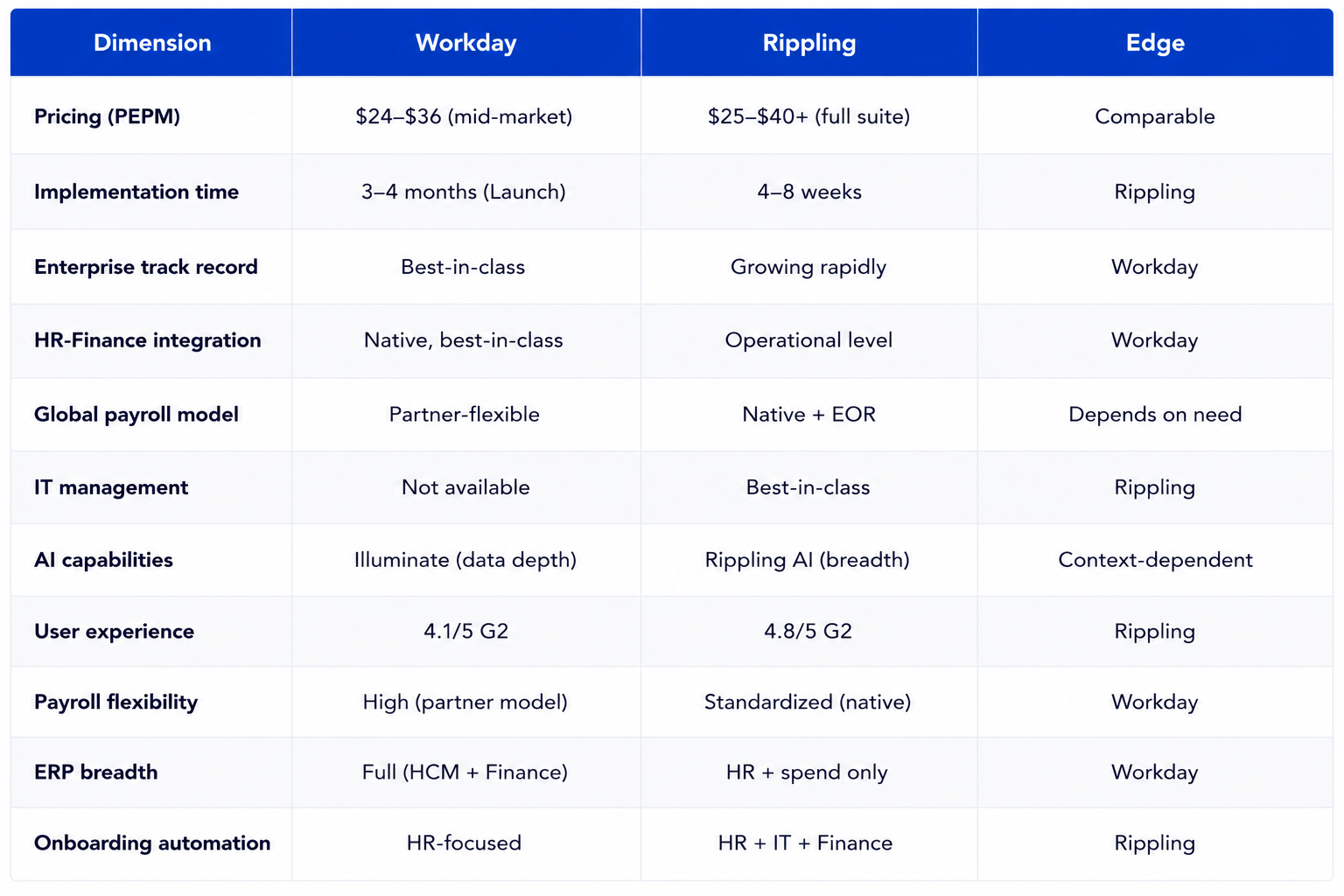
Who Should Choose Workday
Workday is the right platform for your organization when:
Finance-HR integration is a strategic priority. If your CFO wants workforce planning and financial planning on the same data model — where headcount decisions and financial model assumptions are genuinely synchronized — Workday Financial Management alongside Workday HCM delivers this natively. No mid-market competitor matches it.
Your organization is in enterprise territory or clearly growing toward it. Workday's governance model, security architecture, organizational structure support, and partner ecosystem are built for 2,000+ employee organizations with genuine complexity. If you're at 700 employees today and your five-year plan targets 5,000, Workday's ceiling is appropriate.
You have existing global payroll relationships you want to maintain. Workday's partner model allows you to maintain established relationships with preferred payroll providers in complex markets while centralizing HR on Workday. This is the right approach for organizations with mature global operations.
Your industry has specific Workday investment. Healthcare, higher education, financial services, and the public sector have significant Workday-specific implementation expertise in the partner ecosystem. The availability of specialized implementation resources in your vertical is a real consideration.
Your CFO is a co-buyer. Workday's CFO value proposition — unified financial and workforce data, planning integration, audit-grade financial controls — is genuinely differentiated. If Finance is driving or co-driving the HCM evaluation, Workday's story resonates in ways Rippling's does not.
Who Should Choose Rippling
Rippling is the right platform for your organization when:
IT management is a genuine operational challenge. If your IT team spends significant time on app provisioning, device management, and offboarding workflows — and you want those processes automated alongside HR and payroll rather than managed in separate systems — Rippling's unified HR-IT platform eliminates an entire category of operational friction.
Global hiring is part of your growth story. If you are actively hiring internationally and want a single platform to manage payroll, EOR services, and global HR without a separate multi-vendor management structure, Rippling's native global approach is operationally compelling.
Speed of implementation matters more than configuration depth. Organizations with hard go-live dates, lean HR teams, or a clear preference for configuration-light deployment will find Rippling's 4–8 week timeline and standardized workflow architecture meaningfully advantageous.
You are tech-forward and want the most ambitious AI roadmap. Rippling's unified data architecture — where HR, IT, and finance share a single employee record — positions it as a uniquely strong substrate for AI workflows that span all three domains simultaneously. The March 2026 Rippling AI launch demonstrated this capability in production. For organizations that want their HRIS to be the foundation of an AI-first operating model, Rippling's architecture is a structural advantage.
Employee experience and adoption are operational priorities. If your HR team cannot invest heavily in training and change management, and if self-service adoption by employees and managers is critical to the system's success, Rippling's 4.8/5 user experience scores reflect a genuine design investment that delivers measurable adoption outcomes.
You are in the 200–1,500 employee range. This is Rippling's strongest market — the size where its operational automation produces the highest ratio of value to investment, and where the absence of Workday's enterprise complexity features is least constraining.
The Evaluation Questions That Clarify the Decision
If you are genuinely between these two platforms, these questions tend to clarify the right direction:
"Does our CFO see this as a Finance technology decision or an HR technology decision?" If Finance — and specifically CFO-level engagement with financial planning and workforce cost management — is in the room, Workday's story is compelling in ways Rippling's is not. If the evaluation is primarily HR-driven with Finance as a sign-off stakeholder, the calculus is different.
"What happens on an employee's first day that currently requires manual work?" Walk through the end-to-end new hire workflow: payroll setup, benefits enrollment, app access provisioning, device delivery, onboarding checklist completion. Count the number of systems involved and manual handoffs. If the number is high and IT is in the critical path, Rippling's architecture directly addresses this. If the primary friction is in HR process management rather than system handoffs, Workday's strength is more relevant.
"Where will we be in three years, and what does that organization need from its HR system?" Workday's ceiling — particularly with Financial Management — is higher for enterprises targeting 5,000+ employees or global complexity. Rippling's ceiling is growing rapidly, but its primary strength remains the 200–2,000 employee range where its operational automation is most differentiated.
"How much implementation capacity do we have, and what is our go-live timeline?" If the answer is limited internal capacity and a date-driven go-live, Rippling's faster implementation track is a meaningful operational advantage. If the organization has the internal project resources and timeline flexibility for a thorough Workday Launch deployment, the implementation difference is manageable.
For a structured framework to work through these questions as a team, OutSail's vendor scorecard approach gives buyers a quantitative way to weight these criteria against their specific organizational priorities.
Conclusion
Workday and Rippling are not fighting for the same customer anymore — they are both fighting for a broader set of customers than they used to serve, and they are increasingly encountering each other in the same deal cycles.
That convergence makes the comparison more interesting and the decision more consequential. Both platforms are genuinely excellent. Both have invested seriously in AI, global workforce support, and mid-market accessibility. The question is not which is better in the abstract; it is which architecture, which depth of finance integration, and which set of operational tradeoffs best match the specific organization doing the evaluation.
Workday is the right answer when Finance-HR integration at enterprise depth is the strategic priority. Rippling is the right answer when HR-IT operational automation, native global hiring, and deployment speed are the primary drivers.
Both are multi-year infrastructure decisions. Getting the architecture match right from the outset — rather than discovering two years into a contract that the platform's strengths don't align with your organization's actual priorities — is what a rigorous evaluation delivers.
Compare Workday and Rippling With OutSail
OutSail gives HR and finance teams a structured, vendor-agnostic way to evaluate Workday and Rippling side by side — with current pricing benchmarks, scorecard tools, and advisor support from people who have seen both platforms deployed at your scale.
Start your free evaluation with OutSail →
Frequently Asked Questions
Is Workday or Rippling better for mid-market companies in 2026?
The answer depends on what "better" means for your organization. Rippling is better if operational automation across HR, IT, and payroll is the primary goal — it implements faster, has higher user satisfaction scores, and its unified data model eliminates the manual handoffs between HR and IT that mid-market companies struggle with. Workday is better if Finance-HR integration depth, enterprise governance, or complex global payroll flexibility are the priority. Workday's Launch program has made it genuinely competitive in the 500–2,000 employee range with faster implementations and lower pricing than traditional Workday deployments, but Rippling still leads on ease of use and deployment speed.
How does Workday vs Rippling pricing compare in 2026?
The pricing gap between the platforms has narrowed significantly. Workday HCM through the Launch program typically runs $24–$36 PEPM for mid-market deployments. Rippling's full-suite pricing — including HR, payroll, and IT management — typically reaches $25–$40+ PEPM once all relevant modules are included. Both platforms use custom pricing, and first-year total cost of ownership (including implementation) adds meaningfully to the subscription cost for both. The key pricing consideration is that Rippling's modular model can appear cheaper at the starting price ($8/user/month for the base platform) but scales upward as modules are added, while Workday's implementation costs remain a significant first-year investment even at mid-market scale.
Does Rippling replace Workday for enterprise companies?
Not yet at the largest enterprise scales, though the gap is narrowing. Workday serves more than 65% of the Fortune 500, and its enterprise governance model, security architecture, and Finance Management depth reflect decades of enterprise-grade investment. Rippling has grown rapidly into enterprise territory and has customers at 2,000+ employees, but its primary market strength remains in the mid-market. Organizations at 2,000–10,000+ employees with complex approval workflows, significant financial management requirements, or established global payroll operations are more likely to find Workday's depth necessary. Organizations at 500–2,000 employees can now genuinely evaluate both platforms as viable alternatives.
What is Workday Illuminate and how does it compare to Rippling AI?
Workday Illuminate is Workday's family of AI agents, announced at Workday Rising 2025 and rolling out through 2026. Illuminate agents are purpose-built for HR and Finance workflows: the Business Process Copilot automates configuration, the Case Agent handles HR service delivery automation, the Employee Sentiment Agent surfaces engagement trends, and additional agents address performance management, workforce planning, and financial close. Rippling AI, launched in March 2026, allows users to execute natural-language queries and workflow triggers across Rippling's connected HR, IT, and finance data simultaneously. The key architectural difference: Workday Illuminate operates on a rich dataset of HR and finance data trained across 11,000+ organizations; Rippling AI operates across a unified data model that spans HR, IT, and finance simultaneously, enabling cross-domain actions that siloed systems cannot perform.
Should I choose Workday or Rippling if I need global payroll?
This depends on your global payroll strategy. If you want native global payroll in a single platform with EOR services for countries where you don't have local entities, Rippling's native coverage (US, UK, Canada, Australia, India) and EOR network (80+ countries) provides a single-vendor global solution. If you have established global payroll provider relationships you want to maintain, or if your global complexity requires best-in-class specialized providers in specific markets, Workday's partner-flexible model allows you to connect preferred payroll providers to Workday's core HCM. Neither approach is universally better — the right choice depends on the maturity of your global operations and whether you prioritize vendor simplicity or payroll provider flexibility.
.png)
