Paychex vs ADP vs Paylocity: Which Mid-Market Payroll Platform Wins in 2026?
Compare Paychex, ADP, and Paylocity in 2026 on pricing, technology, service, and best fit, including how the Paychex-Paycor merger reshapes the mid-market payroll market.

The mid-market payroll space has never been more competitive — or more confusing. Paychex completed its $4.1 billion acquisition of Paycor in April 2025, creating a combined entity that now serves over 790,000 clients. ADP continues to dominate with more than one million employers on its infrastructure. And Paylocity has quietly built one of the most modern and employee-friendly platforms in the market, serving nearly 40,000 mid-market organizations.
Each vendor has earned its reputation. But they've earned it for different reasons — and those differences matter enormously when you're choosing where to run payroll, manage benefits, and build your HR tech foundation.
This guide breaks down the three platforms across pricing, core technology, customer service, global capabilities, and ideal fit. No vendor wins across every category, so the goal isn't to crown a single champion — it's to help you identify which one matches your specific priorities.
If you want personalized shortlist recommendations based on your requirements, OutSail's HRIS Marketplace can match you with the right vendors for free.
The Quick Verdict
If you're short on time, here's where each vendor leads:
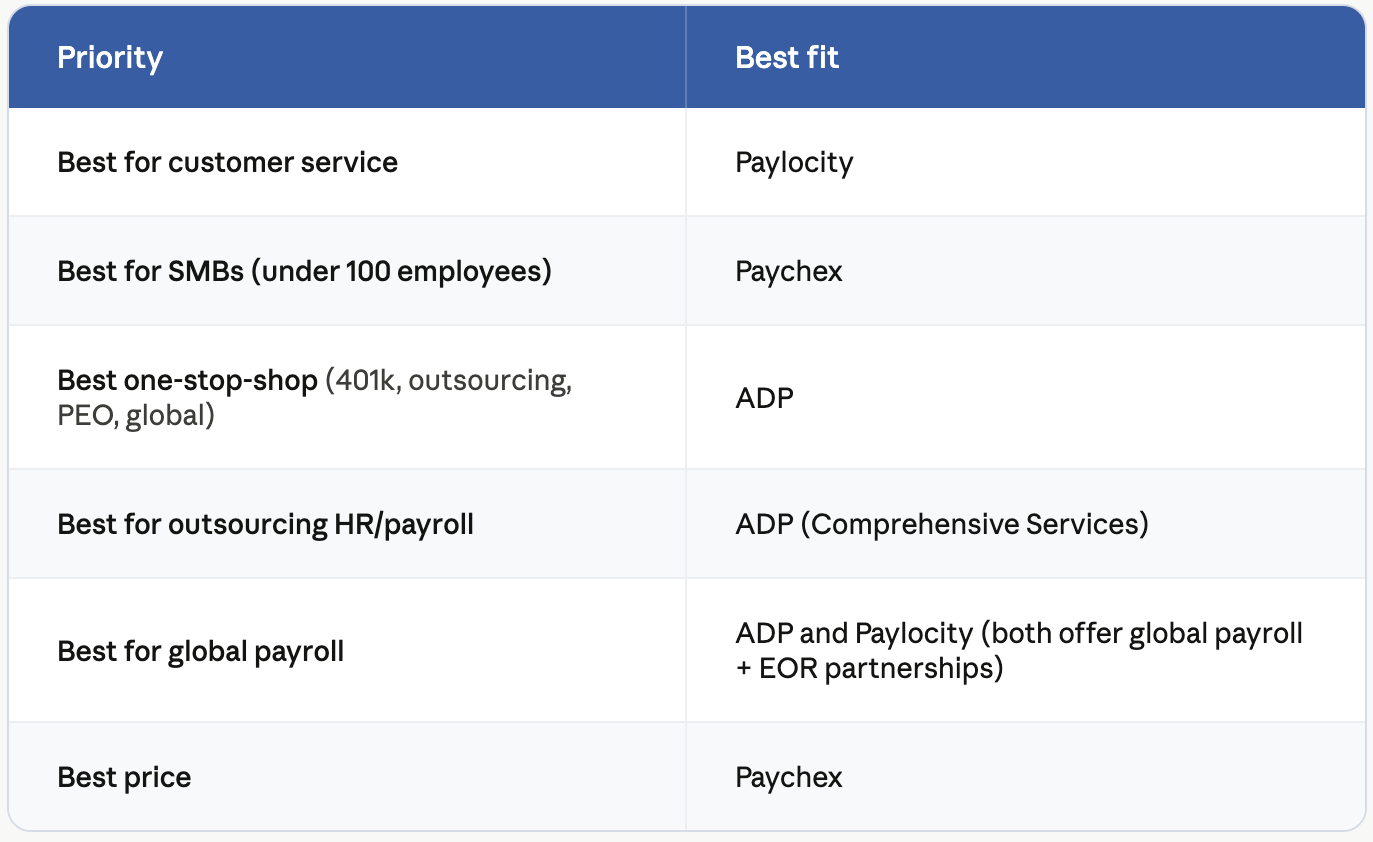
Now let's unpack the details.
Company Overview: Where Each Vendor Stands in 2026
Paychex
Paychex has been in the payroll business since 1971 and serves over 745,000 clients in the U.S. and Europe. For most of its history, Paychex has been known primarily as a small-business payroll provider — and that remains its center of gravity. The typical Paychex client has fewer than 100 employees.
That positioning changed meaningfully in April 2025 when Paychex completed its acquisition of Paycor for $4.1 billion. Paycor brought approximately 49,000 clients and a modern, mid-market-focused HCM platform with strong talent management tools. The deal was designed to push Paychex upmarket, giving it credible technology for organizations with 100–2,000+ employees.
As of 2026, Paychex and Paycor customers remain on their respective platforms with existing service teams, and the combined product roadmap is still taking shape. The full integration will play out over the next 1–2 years, but the strategic direction is clear: Paychex is building toward a comprehensive HCM portfolio that spans from 1-employee startups to mid-enterprise organizations.
Paychex also operates one of the largest PEO businesses in the country, offering co-employment services for companies that want to fully outsource HR, benefits, and compliance.
ADP
ADP needs little introduction. Founded in 1949, it's the largest HR technology company in the world and processes payroll for roughly one in six American private-sector employees. ADP serves over one million employers globally and posted more than $19 billion in revenue in fiscal 2025.
ADP's mid-market offering, Workforce Now, covers payroll, benefits administration, time and attendance, talent management, and analytics for companies with 50–1,000+ employees. What makes ADP distinctive is the breadth of services surrounding the software: outsourced payroll processing (Comprehensive Services), a full PEO offering (TotalSource), 401(k) administration, business insurance, global payroll through Celergo (140+ countries), and compensation benchmarking powered by 42+ million employee records.
ADP also launched ADP Lyric in late 2024, its next-generation enterprise platform for companies with 1,000+ employees — but Workforce Now remains the primary mid-market product.
Paylocity
Paylocity is the youngest of the three, founded in 1997, and has grown into one of the most respected mid-market HRIS platforms in the United States. The company serves nearly 40,000 clients and is publicly traded (NASDAQ: PCTY).
Paylocity's strength is a modern, employee-centric platform that combines solid payroll with genuinely innovative engagement and community features. Its 2024 acquisition of Airbase ($325 million) added a full finance and spend management suite, expanding the platform beyond HCM and into the CFO's office. Paylocity has also partnered with Vestwell for 401(k) administration and Blue Marble for global payroll processing.
Paylocity's sweet spot is companies with 50–750 employees, though they increasingly serve organizations above that range.
Pricing Comparison
None of these vendors publish pricing publicly. All three provide custom quotes. But based on OutSail's advisory data, here's what most mid-market buyers can expect in 2026:
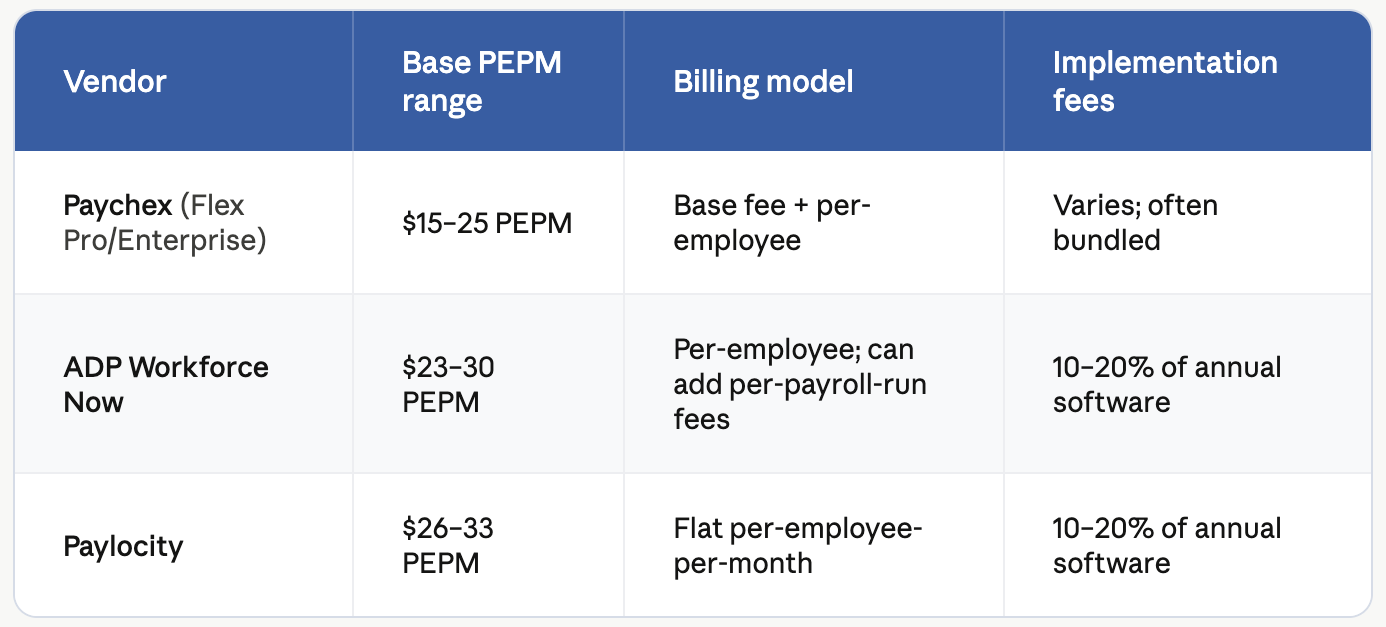
Paychex is typically the least expensive option for mid-market buyers, especially those with under 100 employees. Paychex's tiered Flex plans (Essentials, Select, Pro, Enterprise) allow smaller companies to start with basic payroll at $39/month + $5/employee and scale up as needed. For mid-market organizations, the Flex Pro and Enterprise tiers are more directly comparable to ADP and Paylocity, but still tend to come in at the lower end of the pricing spectrum.
ADP Workforce Now falls in the middle on base pricing but offers the widest range of add-on services — Comprehensive Services (outsourced payroll/HR), 401(k), global payroll, PEO. These layers can push total costs to $30–50+ PEPM, but they also replace services you'd otherwise source separately.
Paylocity uses a flat PEPM model that's more transparent and predictable than either competitor. No per-paycheck charges, no base platform fees on top of per-employee costs. What you see in the quote is close to what you'll pay. The trade-off is that Paylocity's base rate is often the highest of the three for comparable core functionality.
Core Technology and Platform
Payroll Processing
All three vendors handle core payroll well — it's table stakes at this level. But the approaches differ:
ADP has the deepest payroll and tax compliance engine in the industry. With 75+ years of payroll processing at massive scale, ADP's tax filing infrastructure, error detection, and compliance automation are unmatched. ADP recently introduced AI-powered payroll anomaly detection and is migrating Workforce Now customers to a new NextGen payroll engine that promises greater flexibility.
Paylocity processes payroll reliably with strong automation and a clean interface. Paylocity's payroll engine integrates tightly with its time tracking and benefits modules, and the company supports payroll in 100+ countries through Blue Marble. Paylocity has also added managed payroll services for companies that want to outsource processing.
Paychex has been running payroll since 1971 and handles it for over 745,000 clients. The Paychex Flex platform automates tax administration (Taxpay®), supports multiple pay delivery methods, and connects directly to accounting software. With the Paycor acquisition, Paychex now also has access to Paycor's more modern payroll engine for mid-market customers — though integration timelines are still developing.
Edge: ADP for pure payroll depth and compliance. All three are reliable for standard payroll processing.
User Experience and Interface
Paylocity leads here. The platform has a modern, clean interface that's consistently praised in user reviews. Paylocity's Community feature — an internal social-media-style communication hub — is genuinely unique in the mid-market. Employees can post updates, give peer recognition, share surveys, and stay connected in ways that go far beyond traditional HRIS functionality.
ADP Workforce Now has improved its UX in recent years, particularly with a revamped mobile app. But the desktop interface still feels more utilitarian than modern, and users report that finding specific reports or settings can require more clicks than necessary.
Paychex Flex is functional and the mobile app rates well (4.8/5 on app stores), but the desktop experience reveals its age in places — some modules feel more modern than others, a common side effect of a platform that's evolved over decades.
Edge: Paylocity for overall UX and employee engagement features.
Talent Management
Paylocity offers recruiting/ATS, onboarding, performance reviews, compensation management, and learning — all built natively. The onboarding module gets particularly strong reviews.
ADP Workforce Now provides add-on modules for recruiting, performance, learning, and compensation management. ADP's compensation benchmarking (via DataCloud) is a standout, leveraging 42+ million employee records. However, talent modules are add-on costs, not included in the base.
Paychex has historically had lighter talent management tools, but the Paycor acquisition brings Paycor's well-regarded talent suite (recruiting, onboarding, performance, learning, compensation) into the Paychex portfolio. How quickly these capabilities become available to Paychex customers is still unfolding.
Edge: Paylocity for a natively built, fully integrated talent suite available today. ADP wins on compensation benchmarking.
Integrations and Ecosystem
ADP has the most extensive integration ecosystem. The ADP Marketplace offers pre-built connectors with hundreds of third-party tools, and ADP API Central supports custom integrations. Due to ADP's market weight, virtually every leading HR tool has some level of ADP integration.
Paylocity has invested heavily in its integration marketplace and supports 350+ integrations. The Airbase acquisition also adds finance tool integrations (QuickBooks, NetSuite, Xero). Paylocity's integration capabilities are strong and improving.
Paychex offers integrations through its API library and developer resources, connecting with accounting platforms (QuickBooks, Sage, Xero) and various HR tools. The integration ecosystem is adequate but not as deep or open as ADP's or Paylocity's.
Edge: ADP for integration breadth. Paylocity is a strong second.
Customer Service
This is where the three vendors diverge most sharply — and where the decision often gets made.
Paylocity
Paylocity has rebuilt its customer service reputation over the past two years. After a challenging period in early 2023, the company overhauled its service organization and things have trended back up. Paylocity offers multi-channel support (phone, email, chat) and assigns dedicated client service representatives. Users generally report responsive support with knowledgeable reps.
ADP
ADP's customer service is its most frequently cited weakness. Users on standard Workforce Now plans (Select, Plus, Premium) commonly report long hold times, transfers between departments, and inconsistent resolution quality. The experience improves considerably for customers on Comprehensive Services or TotalSource (PEO), where you get more dedicated support structures. But for standard mid-market clients, support can be frustrating.
Paychex
Paychex has historically offered 24/7 phone support — a differentiator in the industry. However, as of early 2026, support hours have been reduced to 8 AM–8 PM ET for most clients, with round-the-clock access only in select areas. Paychex also provides dedicated payroll specialists on higher-tier plans. Reviews are mixed: some users praise the reliability, while others cite slow responses and less-than-helpful interactions.
Edge: Paylocity offers the most consistently positive service experience in recent reviews across the three vendors.
Outsourcing and PEO Options
If you want to offload HR and payroll operations rather than just buying software, this category matters.
ADP
ADP offers the widest range of outsourcing options in the market. Comprehensive Services provides outsourced payroll processing, benefits administration, and compliance management layered on top of Workforce Now. ADP TotalSource is a full PEO offering with co-employment, group benefits, workers' comp, and dedicated HR support. No other vendor in this comparison matches ADP's depth of outsourcing at scale.
Paychex
Paychex runs one of the largest PEO businesses in the country. Their PEO offering includes co-employment, group health benefits, workers' comp, and compliance management — well-suited for small to mid-sized businesses that want to fully outsource HR. Paychex also offers ASO (Administrative Services Organization) for companies that want outsourcing without co-employment.
Paylocity
Paylocity has recently introduced managed payroll services but does not offer a PEO or full outsourcing solution comparable to ADP or Paychex. Companies that want genuine HR outsourcing will need to look beyond Paylocity.
Edge: ADP for the most flexible and scalable outsourcing options. Paychex is strong for SMB PEO needs.
Global Capabilities
ADP
ADP supports global payroll in 140+ countries through Celergo, its global payroll aggregator. ADP also launched Lyric HCM with payroll support in 75+ countries and expanding quarterly. For companies with substantial international workforces, ADP offers the most established global infrastructure of the three.
Paylocity
Paylocity supports payroll in 100+ countries through its partnership with Blue Marble Payroll. The platform itself remains U.S.-centric, but the Blue Marble relationship provides a viable global payroll path for companies with international employees. Paylocity also works with EOR (Employer of Record) partners for companies hiring in countries where they don't have entities.
Paychex
Paychex operates in the U.S. and parts of Europe (including Germany and Denmark), but its global payroll capabilities are more limited than ADP's or Paylocity's. The Paycor acquisition doesn't meaningfully change the global picture.
Edge: ADP for the deepest global reach. Paylocity is a solid second through Blue Marble.
The Paychex-Paycor Merger: What Buyers Should Know
The $4.1 billion acquisition closed in April 2025 and is one of the most impactful consolidation events in the mid-market HRIS space in recent years. Here's what matters for buyers evaluating Paychex in 2026:
Existing customers stay on their current platforms. Paychex and Paycor customers remain on their respective systems with their existing service teams. There are no forced migrations happening in 2026.
The combined product roadmap is still forming. Paychex now has access to Paycor's modern mid-market HCM platform, including its talent management suite, analytics, and AI capabilities. But it's unclear when (or how) these capabilities will be unified into a single offering. Expect clarity to emerge over the next 12–18 months.
Paychex's upmarket push is real. The acquisition was explicitly designed to strengthen Paychex's position with companies that have 100–2,000+ employees. If you're in that range, Paychex now has more to offer than it did pre-acquisition — but the full value will take time to materialize.
Watch the integration closely. Mergers of this scale always carry execution risk. Product overlap, service disruption, and organizational restructuring are real possibilities. If you're evaluating Paychex today, ask direct questions about the integration timeline and what it means for the specific product line you'd be buying.
For more on this story, read: Paycor and Paychex Start 2025 Off with a Bang
Who Each Vendor Fits Best
Choose Paychex if:
- You're a small business with under 100 employees that wants affordable, reliable payroll with the option to add HR services as you grow
- You want PEO services and prefer a well-established provider with transparent per-employee pricing
- Price is a top-three decision factor and you need core payroll and HR at the lowest cost among major vendors
- You're watching the Paycor integration and believe the combined product roadmap will deliver mid-market value in the near future
- You want a vendor with 50+ years of payroll experience and a massive installed base
Choose ADP if:
- You need a one-stop-shop that covers payroll, benefits, 401(k), outsourcing, PEO, global payroll, and compensation benchmarking under one vendor relationship
- Outsourcing is a priority — you want to hand off payroll processing, benefits administration, or compliance to a vendor rather than managing it in-house (Comprehensive Services)
- You have multi-state or global payroll needs and want the most established tax compliance and international payroll infrastructure in the market
- You're a company leaving a PEO and want similar service layers without co-employment
- Integration breadth matters — you need your HRIS to connect with a wide ecosystem of third-party tools
Choose Paylocity if:
- Customer service quality is a top priority and you want a vendor with a strong recent track record on support
- You value a modern, employee-friendly platform with engagement features (Community, surveys, peer recognition) that go beyond basic HR administration
- You want transparent, predictable pricing with a flat PEPM model and no per-paycheck billing surprises
- You need solid mid-market payroll + HCM in a single platform with strong integration capabilities and room to grow into finance tools (Airbase)
- You're looking for a platform that's innovating quickly — Paylocity's pace of feature development (Community, Airbase, managed payroll, Blue Marble global) is among the fastest in the mid-market
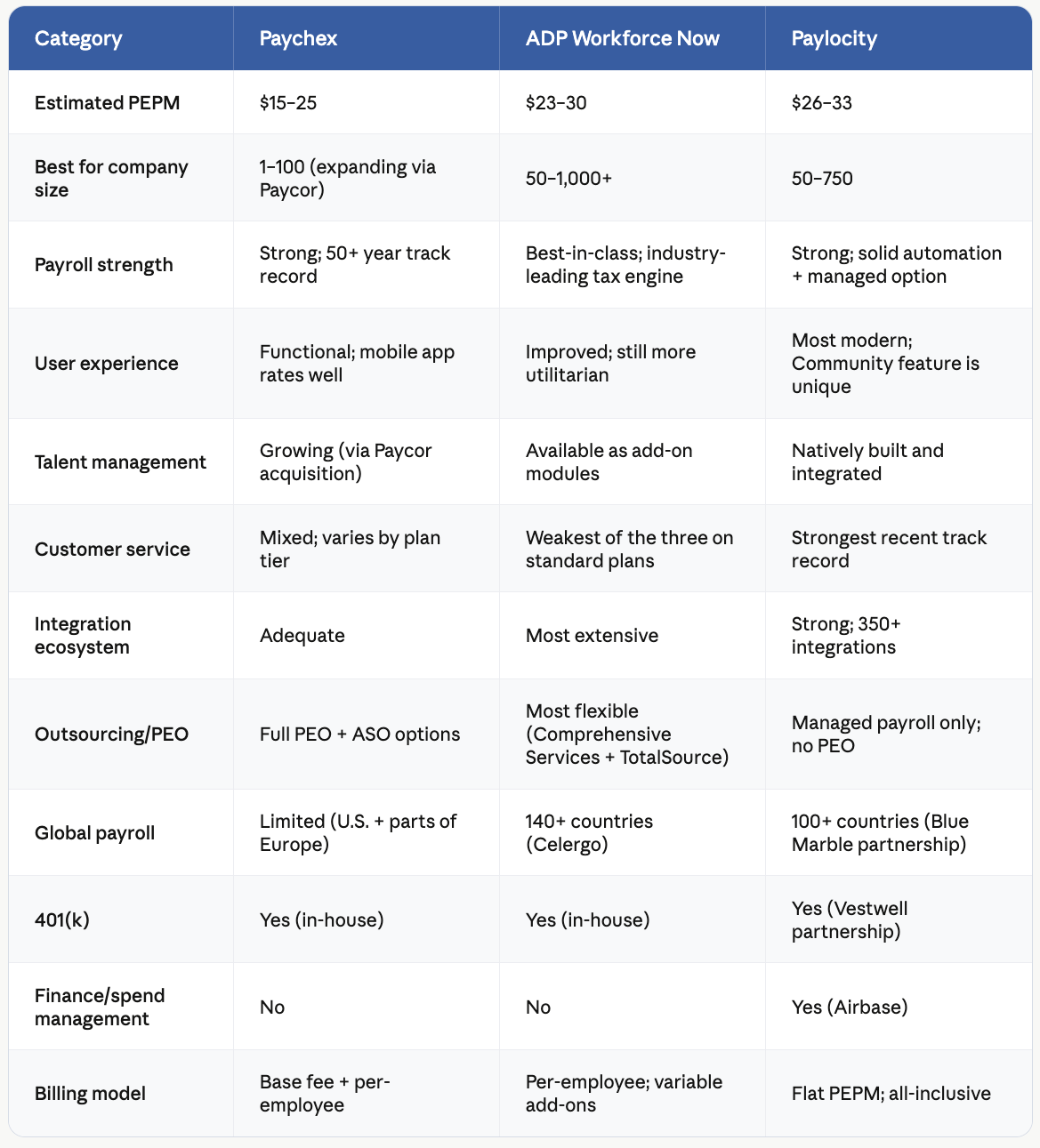
Side-by-Side Comparison Table
Frequently Asked Questions
Which is cheaper: Paychex, ADP, or Paylocity?
Paychex is generally the most affordable of the three, particularly for small businesses. ADP Workforce Now falls in the middle ($23–30 PEPM), while Paylocity is typically the highest ($26–33 PEPM) but with a more transparent billing model. Keep in mind that total cost depends on modules, services, and contract terms — a cheaper base rate doesn't always mean a lower total cost of ownership.
Is Paychex still a good option after the Paycor acquisition?
Yes, but with caveats. Existing Paychex and Paycor customers continue on their current platforms with no disruption. The acquisition gives Paychex access to Paycor's modern mid-market technology, which should strengthen its upmarket capabilities over time. However, the integration is still early, and the full combined product offering hasn't materialized yet. If you're buying today, evaluate what's available now — not what's promised.
How does ADP's customer support compare to Paylocity's?
Paylocity has a stronger recent track record on customer support. ADP's support quality varies heavily based on your service tier — customers on Comprehensive Services or TotalSource generally have a better experience than those on standard Workforce Now plans. If support quality is a top priority and you're not investing in ADP's outsourced tiers, Paylocity is the safer bet.
Can any of these vendors handle global payroll?
ADP and Paylocity both offer global payroll capabilities. ADP supports 140+ countries through Celergo and is expanding rapidly through Lyric. Paylocity covers 100+ countries through Blue Marble Payroll. Paychex's international reach is more limited. For companies with heavy global needs, also consider dedicated global payroll providers like Deel or Remote.
Which platform is best for a company with 200–500 employees?
This is the sweet spot where all three compete. ADP is strongest if you want outsourcing options or global payroll. Paylocity wins if you value a modern employee experience and strong customer service. Paychex (via its Paycor offering) is worth evaluating if budget is tight and you want solid core HR and talent tools at a lower price point.
The Bottom Line
There's no universal winner here — there's only the right fit for your organization's priorities.
Paychex offers the best value for small businesses and is building toward mid-market relevance through the Paycor acquisition. If you're under 100 employees and want reliable, affordable payroll with room to grow, Paychex is hard to beat on price.
ADP is the one-stop-shop. If you want payroll, outsourcing, PEO, 401(k), global payroll, and compensation benchmarking all under one roof, no other vendor matches ADP's breadth. You'll pay more, and the support experience on standard plans isn't great — but the infrastructure is unrivaled.
Paylocity delivers the most modern platform experience with the best customer service of the three. Its transparent pricing, employee engagement features, and fast innovation pace make it a compelling choice for mid-market companies that want a platform employees will actually enjoy using.
If you're evaluating all three — or trying to decide which vendors should make your shortlist — OutSail can help. Our advisory team works with hundreds of mid-market companies each year and our service is completely free for buyers.
.png)
