Lattice vs 15Five vs Culture Amp: Performance Management Showdown
Lattice vs 15Five vs Culture Amp: which performance management software fits your company? Compare features, pricing, and ideal use cases in our detailed 2026 showdown.

When companies outgrow spreadsheet-based performance reviews, three names dominate the conversation: Lattice, 15Five, and Culture Amp. They're all modern, well-designed platforms that promise to transform how you manage performance and engage employees.
But they're not interchangeable. Each platform was built with a different philosophy, serves different organizational priorities, and works best for different types of companies.
This comparison breaks down what each platform does best, where they fall short, and how to decide which one fits your organization.
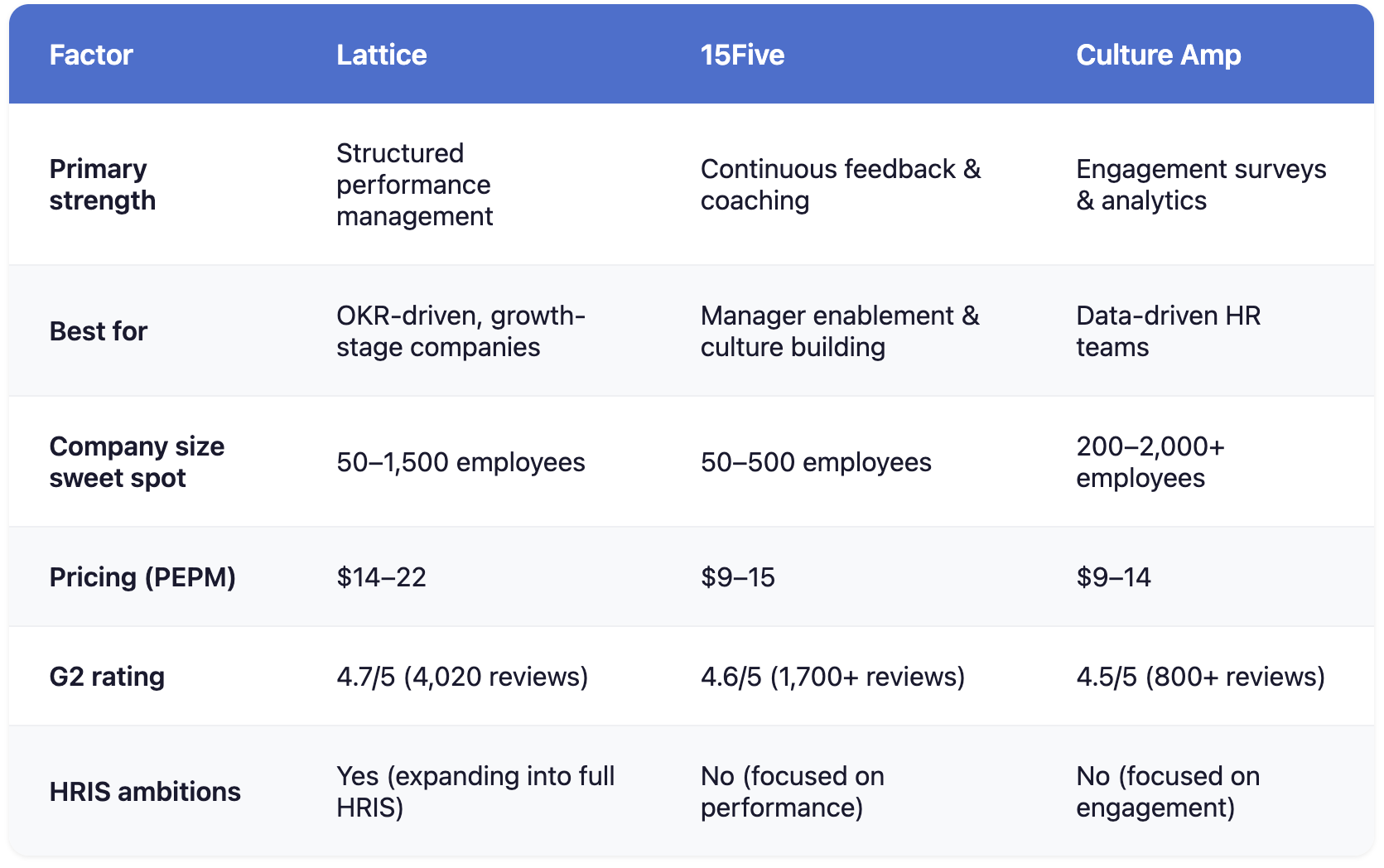
The Quick Take
Lattice: The Performance-First Platform
Lattice has become the default choice for growth-stage companies that take performance management seriously. The platform combines goals, reviews, feedback, compensation, and—increasingly—core HR functions into a unified experience.
What Makes Lattice Different
Lattice was built around structured performance cycles. If your organization runs on OKRs, conducts regular review cycles, and wants performance data to inform compensation decisions, Lattice delivers.
Core capabilities:
- Goal and OKR management with cascading objectives
- Flexible performance review cycles (quarterly, annual, or custom)
- 360-degree feedback and peer reviews
- 1:1 meeting workflows with agenda templates
- Compensation management and benchmarking
- Career pathing and competency frameworks
- Engagement surveys and pulse checks
- Recognition via "high-fives"
Recent expansion: Lattice has been aggressively moving into HRIS territory, adding:
- HR management and employee records
- Onboarding workflows
- Time-off tracking
- Custom reporting and analytics
- Native payroll (launched early 2025)
Where Lattice Excels
- User experience: Lattice consistently earns praise for its inviting, intuitive interface. Employees actually use it—which is half the battle with performance software.
- Workflow integration: Lattice prompts employees for feedback and reviews directly via Slack, Teams, Gmail, and Outlook. This reduces friction and improves completion rates.
- Performance-compensation connection: If you want performance ratings to directly inform compensation decisions, Lattice makes this seamless. The compensation module pulls review data automatically.
- 1:1 workflows: Lattice's 1:1 tools help managers and employees set tasks, track progress, and maintain continuity across conversations. This turns ad-hoc check-ins into structured development.
- Financial backing: Lattice has raised significant venture capital and has strong market position. They're a safe bet for companies worried about vendor longevity.
Where Lattice Falls Short
- Can feel repetitive: Users report that Lattice's automated questionnaires can become stale over time. The same prompts appearing week after week lose their impact.
- Complexity for smaller teams: Companies under 50 employees may find Lattice's depth overwhelming—and may not receive direct account support.
- HRIS gaps: As Lattice expands into HR, they're still missing capabilities that established HRIS vendors offer: time and attendance, benefits administration, and applicant tracking are notable gaps.
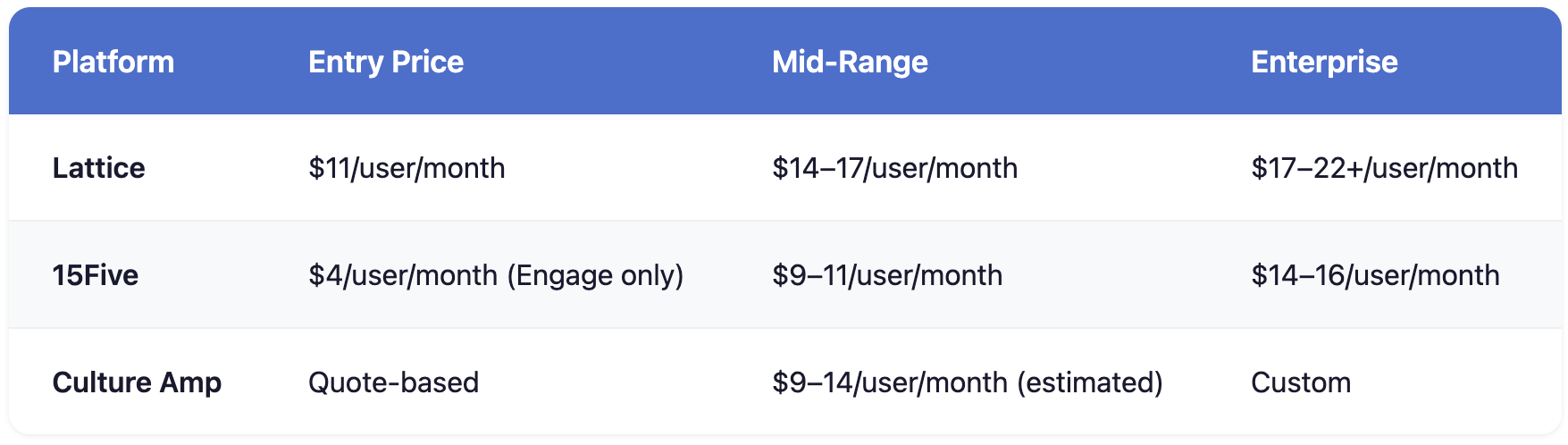
- Premium pricing: At $14–22 PEPM, Lattice is the most expensive option in this comparison. For smaller companies, that premium adds up.
Ideal Lattice Customer
- Growth-stage companies (50–1,500 employees) using OKRs
- Organizations that want performance, goals, and compensation in one system
- Companies willing to pay premium for polished UX and robust features
- HR teams considering Lattice as their HRIS (and willing to accept current limitations)
For a detailed assessment, read our complete Lattice review.
15Five: The Continuous Feedback Champion
15Five takes a fundamentally different approach. Rather than building around quarterly or annual review cycles, 15Five is built around weekly check-ins and continuous dialogue. The name itself—15 minutes to write, 5 minutes for a manager to read—reflects this philosophy.
What Makes 15Five Different
15Five believes great performance emerges from consistent, lightweight touchpoints rather than periodic formal reviews. The platform emphasizes manager effectiveness and positive psychology principles.
Core capabilities:
- Weekly check-ins (the signature feature)
- OKR and goal tracking
- 1:1 meeting agendas and notes
- Performance reviews (flexible cycles)
- High Fives peer recognition
- Engagement surveys and pulse checks
- Manager coaching and development tools
- Career development and growth plans
Where 15Five Excels
- Continuous feedback rhythm: The weekly check-in creates a drumbeat that keeps performance conversations current. Managers see what's happening before issues escalate.
- Manager enablement: 15Five invests heavily in helping managers become better coaches. The platform includes coaching features, manager training resources, and tools that support development conversations.
- Smart, simple design: 15Five is praised for being highly engaging for both users and admins. The interface is clean and approachable—it doesn't feel like enterprise software.
- Recognition culture: High Fives make peer recognition easy and visible. For companies wanting to build appreciation into their culture, this feature delivers.
- Implementation and support: 15Five gets strong reviews for customer support and implementation. The onboarding process is smooth, and support teams are knowledgeable and responsive.
- Pricing: At $9–15 PEPM, 15Five is the most affordable option for full performance management capabilities.
Where 15Five Falls Short
- Weekly check-ins can feel like homework: The same feature that makes 15Five powerful can also cause fatigue. Some employees view mandatory weekly updates as administrative burden rather than valuable practice. (Note: weekly check-ins are no longer mandatory.)
- Less robust for complex organizations: Large enterprises with intricate structures, multiple review types, or sophisticated calibration needs may find 15Five too lightweight.
- Engagement features still maturing: 15Five acquired an employee engagement platform, but these capabilities are still developing compared to Culture Amp's depth.
- Narrower scope: 15Five stays focused on performance and engagement. If you want compensation management, career pathing, or HRIS features, you'll need additional tools.
Ideal 15Five Customer
- Mid-sized companies (50–500 employees) wanting continuous feedback culture
- Organizations prioritizing manager development and coaching
- Companies that want performance management without complexity
- Budget-conscious teams seeking strong value
For a detailed assessment, read our complete 15Five review.
Culture Amp: The Analytics Powerhouse
Culture Amp came to market as the leader in engagement surveys and people analytics. They've since expanded into performance management, but their DNA remains research-driven, data-centric, and focused on organizational health.
What Makes Culture Amp Different
Culture Amp was founded by organizational psychologists, and it shows. The platform emphasizes science-backed surveys, detailed analytics, and connecting employee sentiment to business outcomes.
Core capabilities:
- Employee engagement surveys (the flagship feature)
- Pulse surveys and continuous listening
- Performance reviews and feedback cycles
- Goal tracking and OKRs
- 1:1 meeting support
- 360-degree feedback
- Manager effectiveness insights
- Detailed people analytics and reporting
- Shoutouts for recognition
Recent additions:
- Acquired Orgnostic for position management and workforce planning
- Enhanced turnover modeling and end-of-year budgeting capabilities
Where Culture Amp Excels
- Engagement surveys: This is Culture Amp's superpower. Their surveys are research-backed, benchmarked against extensive data, and designed to surface actionable insights—not just satisfaction scores.
- People analytics: Culture Amp allows HR leaders to slice data by department, location, manager, tenure, and more. Dashboards are easy to export for executive presentations.
- Templates and guidance: Culture Amp provides HR leaders with templates, training, and in-context guidance to not only gather data but act on it effectively.
- Science-backed approach: For organizations that want their people programs grounded in research rather than intuition, Culture Amp's psychology-driven methodology resonates.
- Enterprise scale: Culture Amp serves over 6,500 companies, including Canva, McDonald's, and Etsy. They can handle organizational complexity that smaller platforms can't.
Where Culture Amp Falls Short
- Support varies by tier: Culture Amp has many enterprise clients, and smaller customers report that support isn't always responsive. Basic packages don't include live support or HRIS integrations.
- HRIS integrations came late: Culture Amp was slower than competitors to build HRIS integrations. They're catching up, but the integration marketplace isn't as mature as Lattice's.
- Growth by acquisition: Culture Amp has added features through acquisitions, which can lead to a less cohesive experience. Some modules feel bolted on rather than natively integrated.
- Engagement-first, performance-second: While Culture Amp offers performance management, it's not their core strength. Organizations whose primary need is structured performance reviews may find Lattice more purpose-built.
- Pricing opacity: Culture Amp uses quote-based pricing, making it harder to budget without engaging sales.
Ideal Culture Amp Customer
- Mid-to-large companies (200–2,000+ employees) prioritizing engagement measurement
- Data-driven HR teams that want sophisticated analytics
- Organizations with I/O psychology mindset toward people programs
- Companies where engagement surveys are the primary use case (with performance as secondary)
For a detailed assessment, read our complete Culture Amp review.
Head-to-Head Comparison
Performance Management
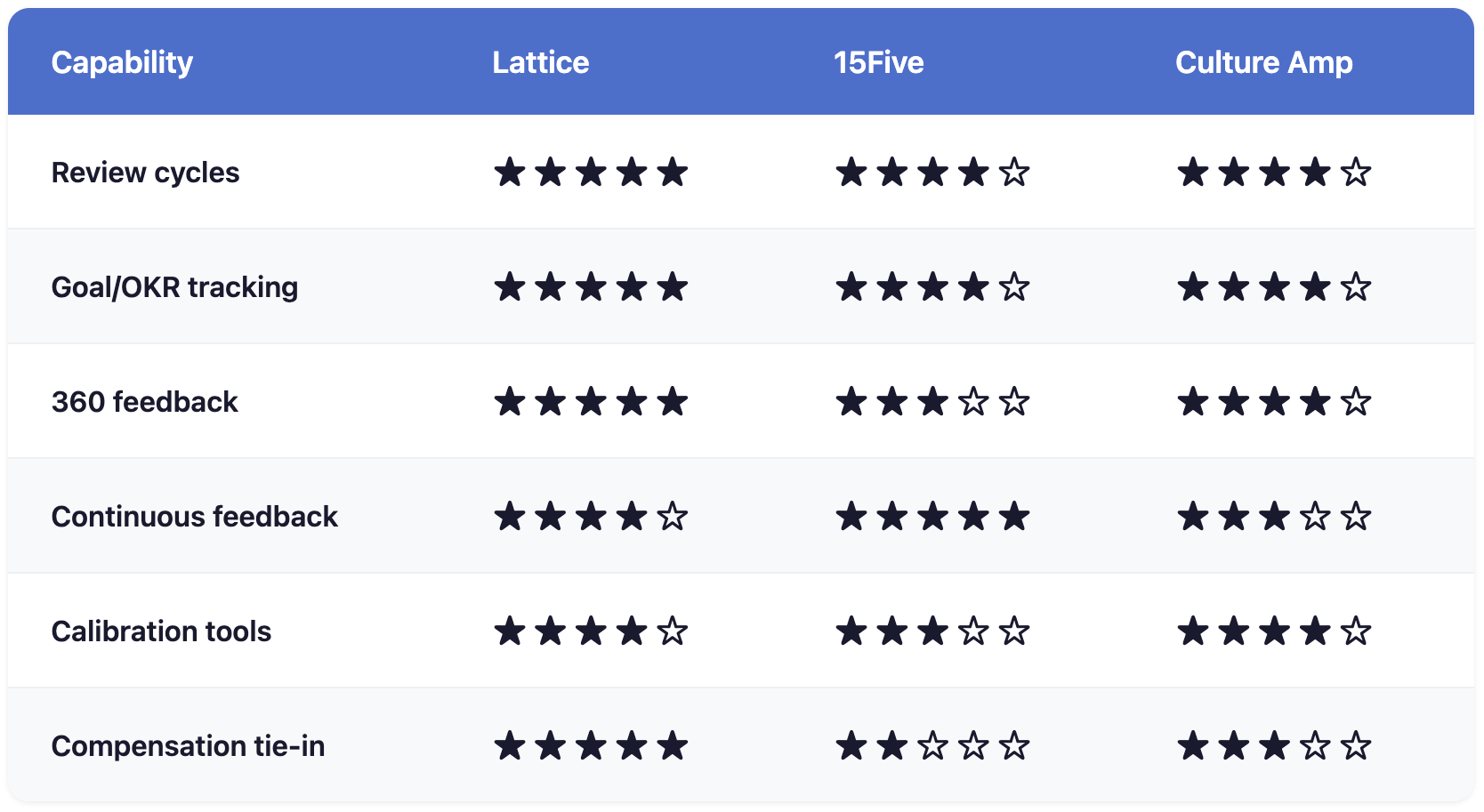
Verdict: Lattice wins for structured performance management with compensation integration. 15Five wins for continuous feedback and coaching-oriented reviews. Culture Amp is solid but performance isn't their primary strength.
Employee Engagement
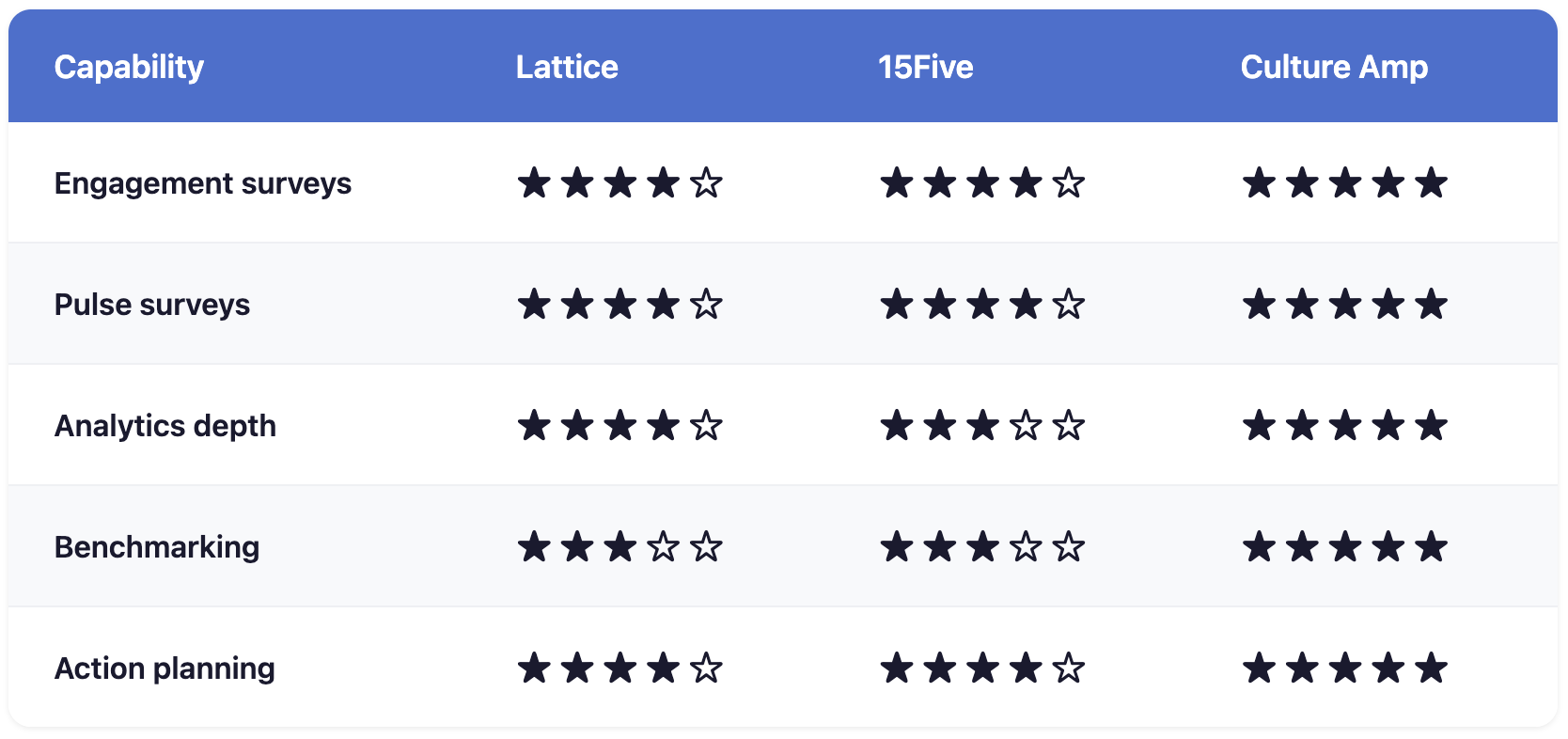
Verdict: Culture Amp dominates engagement surveys and analytics. It's their core competency. Lattice and 15Five offer good engagement features, but they're not the primary focus.
Manager Enablement
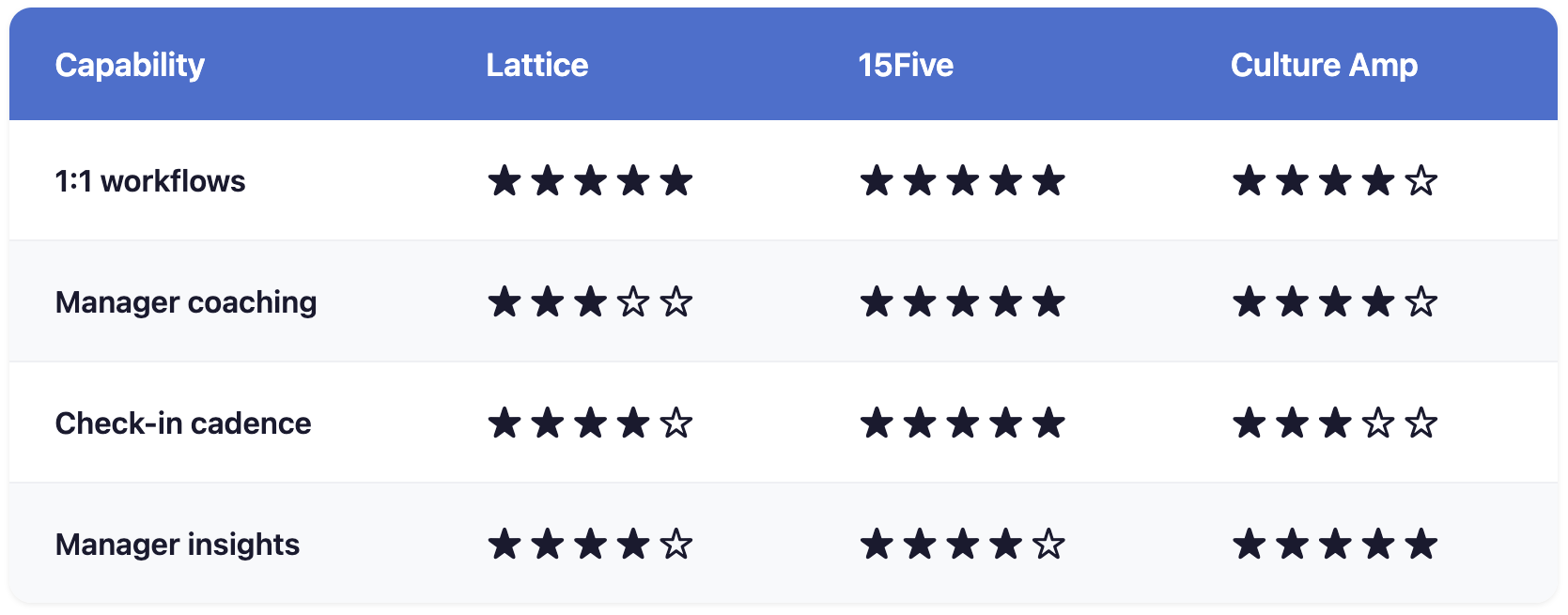
Verdict: 15Five wins for manager enablement and coaching. Their entire platform is designed to make managers more effective. Lattice provides strong 1:1 workflows. Culture Amp provides excellent manager-level analytics.
Recognition
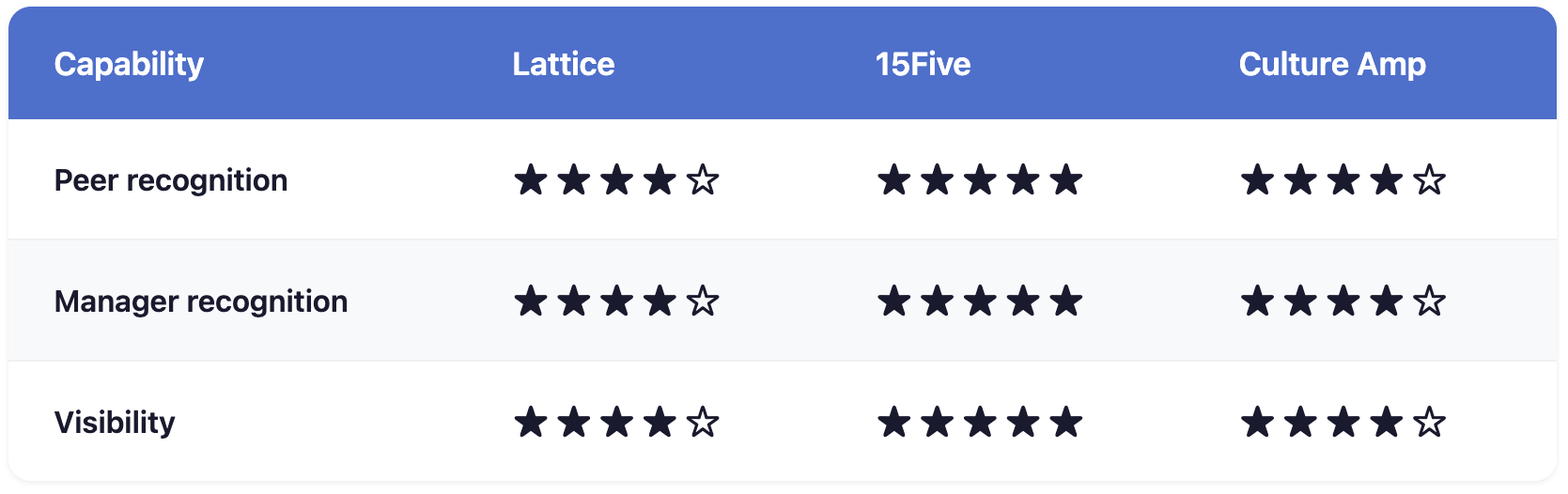
Verdict: 15Five's High Fives feature is the most developed recognition system. Lattice and Culture Amp offer recognition (shoutouts), but it's not their differentiator.
Integration Ecosystem
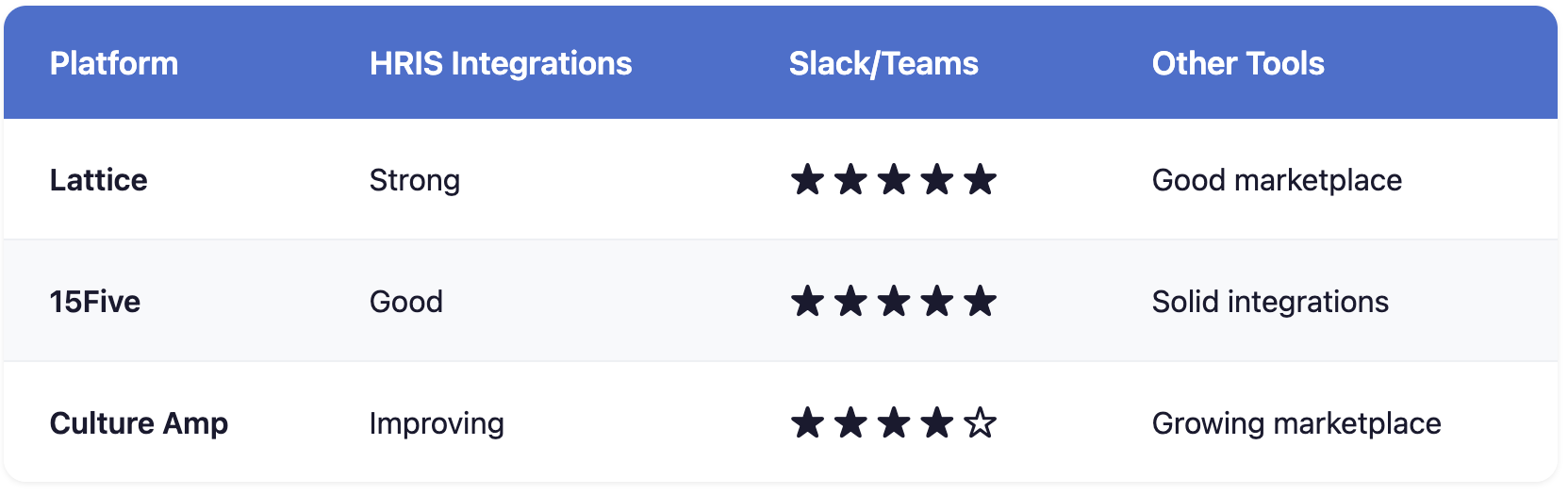
Verdict: Lattice has the most mature integration ecosystem. Culture Amp was late to HRIS integrations but is catching up.
Pricing
Notes:
- Lattice has a $4,000 annual minimum
- 15Five is most transparent about pricing
- Culture Amp requires contacting sales for quotes
Verdict: 15Five offers the best value at the entry and mid-range levels. Lattice commands a premium for its breadth. Culture Amp pricing is opaque but generally competitive.
Decision Framework: Which Platform Fits You?
Choose Lattice If:
- Performance management is your primary goal – You want structured reviews, goal tracking, and calibration
- You're OKR-driven – Lattice's goal management is built for cascading objectives
- You want performance to inform compensation – The connection is seamless
- You're considering an eventual HRIS transition – Lattice is expanding in this direction
- You have 50–1,500 employees – Lattice's sweet spot
- Budget isn't the primary constraint – You're willing to pay premium for polish
Choose 15Five If:
- Continuous feedback matters most – Weekly check-ins are your preferred cadence
- You want to develop better managers – 15Five's coaching orientation fits
- You value simplicity – Clean interface, straightforward setup
- Budget matters – 15Five offers strong value at lower price points
- You have 50–500 employees – 15Five's sweet spot
- Recognition culture is a priority – High Fives delivers
Choose Culture Amp If:
- Engagement surveys are your primary need – Nobody does this better
- You're data-driven – You want sophisticated analytics and benchmarking
- You have I/O psychology orientation – Research-backed approaches resonate
- You're larger (200+ employees) – Culture Amp scales well
- You want to connect engagement to business outcomes – Their analytics enable this
- Performance management is secondary – You'll use it, but surveys are the priority
The Hybrid Approach
Some organizations use multiple platforms:
- Culture Amp for engagement surveys + Lattice for performance – Best-in-class at both
- HRIS-native performance + Culture Amp for engagement – If your HRIS (like HiBob, Rippling, or BambooHR) has decent performance tools
This adds complexity and cost but delivers specialized capabilities in each area.
What About Other Options?
The performance management market has additional players worth considering:
- Leapsome ($9–15 PEPM): Offers the widest breadth of functionality—performance, surveys, recognition, goals/OKRs, onboarding, and learning—in one platform. Based in Berlin with growing US presence. More configurable than peers. Good option for companies wanting everything in one place.
- ChartHop ($8–20 PEPM): Best-in-class for org design and workforce planning. Recently added performance and engagement tools, but they're newer. Choose ChartHop if headcount planning and org visualization are primary needs.
- Confirm ($8–14 PEPM): Radically different approach—gathers organization-wide feedback on who's most impactful, knowledgeable, and helpful. Great for companies that want to break from traditional annual reviews. Narrow scope (performance only) and higher price for a single module.
For companies using full-suite HRIS platforms (Workday, Dayforce, UKG, Paylocity), the native performance modules may be sufficient—especially if avoiding additional point solutions is a priority.
HRIS Integration Considerations
All three platforms integrate with major HRIS vendors, but compatibility varies:
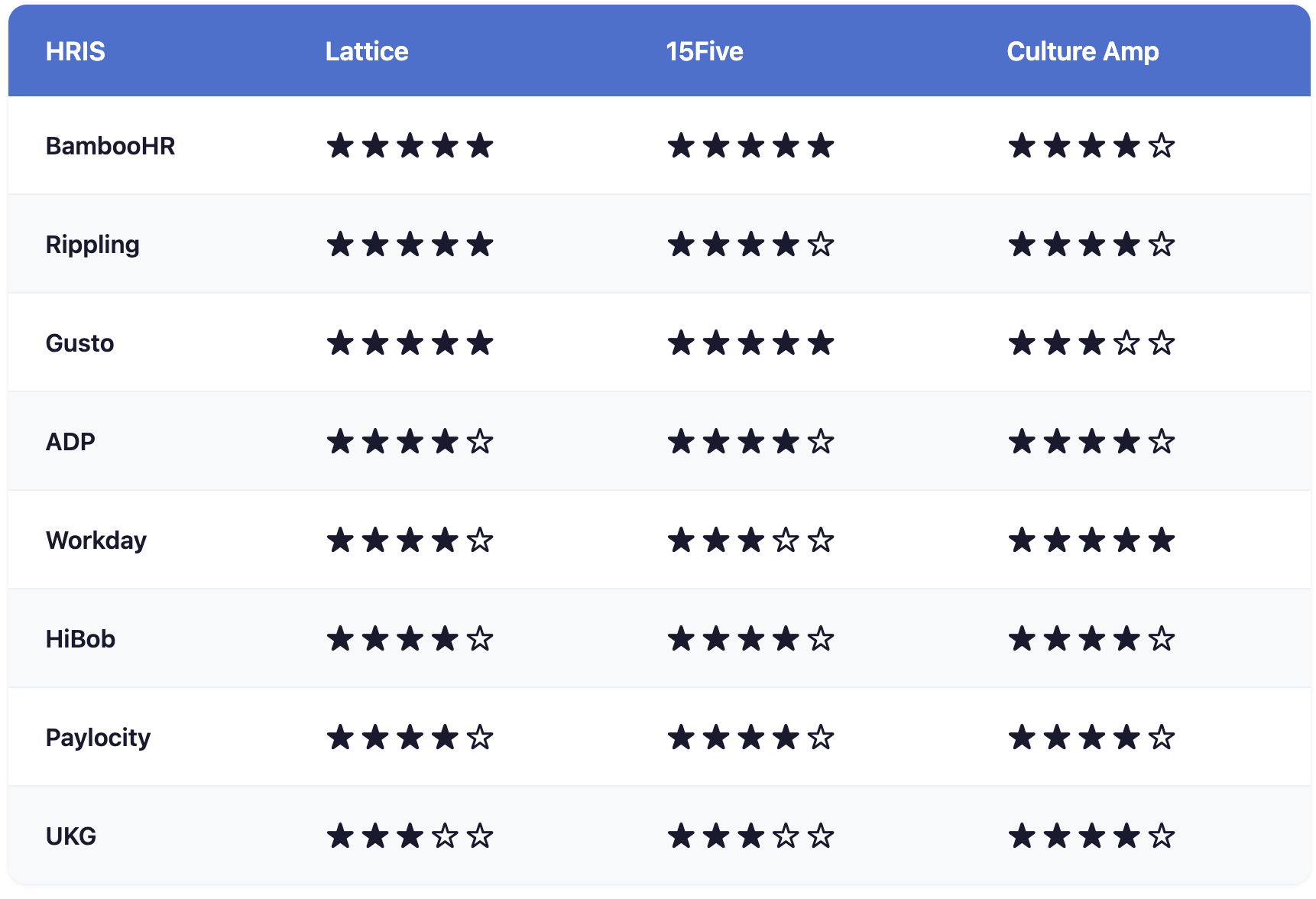
Before selecting a performance platform, verify:
- Does a pre-built integration exist with your HRIS?
- What data syncs automatically (employees, managers, departments)?
- Is the integration bi-directional or one-way?
- Are there additional costs for integration?
Making Your Decision
The Lattice vs 15Five vs Culture Amp decision ultimately comes down to your primary use case:
- If performance management drives your decision: Lattice offers the most comprehensive, structured approach with compensation integration.
- If continuous feedback and manager development drive your decision: 15Five's weekly rhythm and coaching orientation deliver.
- If engagement measurement and analytics drive your decision: Culture Amp's survey expertise and benchmarking are unmatched.
All three are solid platforms with thousands of happy customers. The "best" choice depends entirely on what matters most to your organization.
Need help deciding? OutSail advises companies on HR technology selection, including performance management platforms. We can help you evaluate options and find the right fit.
.png)
