The 3 Ways to Implement an HRIS: DIY, Outsourced Partner, or Supervised Support
Learn the three ways to implement an HRIS—DIY, outsourced implementation, or supervised support—and compare the cost, risk, control, and resources required for each approach.

Key Takeaways
- There are three ways to implement an HRIS: do it yourself with the vendor, hand it to an outsourced partner, or run it with supervised support. They differ mostly in cost and risk.
- DIY is the cheapest, costing only your team's time, but it is the riskiest, because the biggest failure points (data, process, and timeline) sit entirely on you.
- A fully outsourced implementation is the safest, but for a 250 to 400 employee company it typically runs $40,000 to $60,000.
- Supervised support is the middle path: an expert covers the biggest risk factors while your team does the hands-on work, landing at roughly 85% of the safety of outsourcing for about 20% of the cost, often $7,500 to $10,000.
- For most mid-market rollouts, supervised support is the balance point. OutSail can run it, or help you decide which path fits.
Once you have chosen an HRIS, one question decides how the rollout goes: how much of the work will you own, and how much will you hand off?
There are three answers, and they trade cost against risk in very different ways.
You can do it yourself with the vendor, pay a firm to do it for you, or run it yourself with an expert watching the risky parts.
Most buyers only hear about the first two, so they end up choosing between a cheap, risky rollout and an expensive, safe one.
The third option, supervised support, is the one that fits the most mid-market projects, and this guide shows why.
How Should You Implement an HRIS?
Implement an HRIS one of three ways: do it yourself with the vendor, outsource it to a third-party firm, or run it yourself with supervised expert support.
DIY costs the least and risks the most.
Outsourcing costs the most and risks the least.
Supervised support sits between them, and it is the option most mid-market teams should look at first.
By OutSail's estimate, supervised support covers the biggest risk factors of a rollout, landing at about 85% of the safety of a fully outsourced implementation for roughly 20% of the cost.
That combination, most of the safety at a fraction of the price, is why the middle path fits so many projects.
The Three Ways to Implement an HRIS
Every HRIS implementation falls into one of three models, separated mainly by who does the work and who carries the risk.
The table below shows the trade-offs at a glance.
Option 1: DIY Implementation
A DIY implementation means your team runs the project with only the vendor's standard help.
The vendor configures the system to the choices you give it, but you own the data, the process decisions, the timeline, and the testing.
The appeal is cost: beyond your team's time, there is little to pay, since basic vendor setup is usually included in the software.
The risk is that every failure point sits on you.
If your data is messy, your processes are unclear, or your team is stretched, a DIY rollout is where timelines slip and go-lives go sideways.
DIY works when your data is clean, your processes are documented, and your team has real hours to give the project.
For everyone else, the savings can cost more than they save.
Option 2: The Outsourced Partner
An outsourced implementation hands the whole project to a third-party firm that runs it hands-on.
This is the safest path, because experienced people own the data migration, the configuration, the testing, and the timeline.
It is also the most expensive.
For a mid-market company of roughly 250 to 400 employees, a fully outsourced implementation typically runs $40,000 to $60,000, on top of the software.
There is a quieter trade-off too: when a firm does everything, your team learns less and ends up dependent on the firm for future changes.
Outsourcing is the right call when the project is high-stakes, the timeline is tight, or your team simply cannot spare the hours.
For a routine mid-market rollout, it is often more cost, and more hand-off, than the job needs.
Option 3: Supervised Support
Supervised support is the middle path: your team does the hands-on work, while an expert supervises the parts most likely to go wrong.
Instead of doing everything or nothing, an advisor leads the data-migration strategy, helps you lock in processes before they are built, keeps the project on schedule, and reviews testing before go-live.
Your team stays in control and builds capability, but never faces the riskiest decisions alone.
The cost reflects the lighter footprint.
For that same 250 to 400 employee company, supervised support often runs $7,500 to $10,000, roughly a fifth of a fully outsourced engagement.
And because it targets the biggest failure points, it captures most of the safety of outsourcing, about 85% by OutSail's estimate, at around 20% of the cost.
For most mid-market rollouts, that is the balance point between price and peace of mind.
How Do the Costs Compare?
Cost tracks how much of the work you hand off, from near-zero for DIY to the highest for a fully outsourced partner.
DIY costs only your team's time, since standard vendor setup is bundled with the software.
Supervised support, for a 250 to 400 employee company, typically runs $7,500 to $10,000.
A fully outsourced implementation for the same company typically runs $40,000 to $60,000, roughly five times the supervised option.
Keep all of these separate from the price of the platform itself, which is a different line item.
The real comparison is not the sticker price but the cost of a failed rollout, and that is where the cheapest option can turn out to be the most expensive.
How Do the Risks Compare?
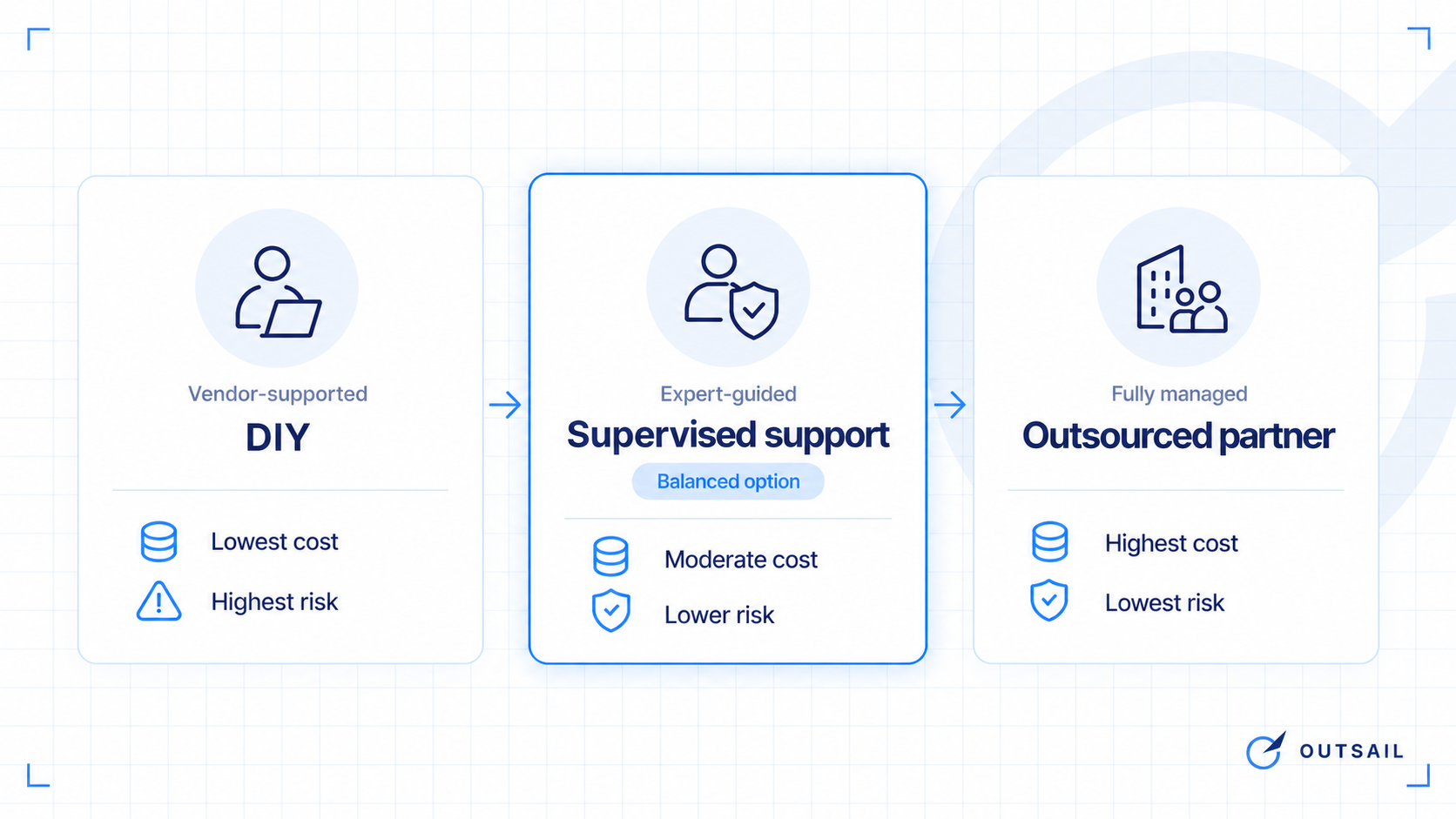
DIY carries the most risk, a fully outsourced partner the least, and supervised support removes the biggest risks for a fraction of the outsourced price.
The risk in any implementation clusters around three things: your data, your processes, and your timeline.
Data is the largest.
Up to 60% of data migration projects run late or over budget (OutSail), and vendors expect you to hand over clean records rather than clean them for you.
Process is next: a system can be configured many ways, and a team that cannot decide how it wants to work stalls the build.
Timeline is the third: a mid-market rollout typically runs three to six months (Paycom), and a stretched team tends to fall behind.
DIY leaves all three on your desk.
A fully outsourced partner takes all three off it.
Supervised support targets exactly these failure points, letting your team do the routine work while an expert owns the risky parts, which is why it lands close to outsourcing on safety without the outsourcing price.
Which Should You Choose?
Match the implementation model to your data, your processes, and your bandwidth.
Choose DIY when:
- Your employee data is clean and lives in one place.
- Your processes are documented and agreed on.
- Your team has real hours to give the project for months.
Choose supervised support when:
- You want to stay in control and build in-house capability.
- Your data or processes need work, but you can do the hands-on tasks.
- You want most of the safety of a partner without the full cost.
Choose a fully outsourced partner when:
- The project is high-stakes, global, or on a tight deadline.
- Your team has no bandwidth to take part.
- The budget can absorb a $40,000 to $60,000 engagement.
For most mid-market companies, supervised support is the honest first choice: it removes the biggest risks, keeps your team in the driver's seat, and costs a fraction of full outsourcing.
The next step is simply deciding how much support you want.
How Can OutSail Help With Your HRIS Implementation?
OutSail is an independent HR technology advisory firm built to help mid-market companies select, implement, and get real value from the systems that run HR.
Brett Ungashick and the OutSail team specialize in HR technology advisory, HRIS selection, and consultant matching – working alongside your team so a rollout lands on time and gets adopted, not just switched on.
OutSail does not try to be a generalist HR firm, and that focus is the point.
From choosing the right platform to supervising the rollout or matching a specialist for a fix, OutSail focuses on outcomes at every stage of an HR technology project.
HR and finance leaders get clear visibility into what a system will cost, what it takes to implement, and where the risks sit.
The guidance is independent by design.
OutSail pioneered the HR software broker approach, partnering with 220+ vendors that each pay a similar commission when a client buys.
The advice never bends toward whoever is paying, and roughly 90% of clients never pay a cent for the core selection service.
That independence shows up in outcomes like Olo saving $300K on its HRIS, Gentherm cutting payroll-vendor evaluation time by roughly 75%, and VetnCare selecting a new system in 30 days.
Every shortlist and pricing benchmark behind those wins draws on first-party data, not vendor marketing.
We know that a blown timeline or a system your people avoid is real money lost.
Every recommendation we make is built around one outcome – an implementation that goes live cleanly and earns its keep.
Meet the Founder of OutSail
Meet the founder and CEO of OutSail – Brett Ungashick:
- As founder and CEO of OutSail, Brett brings years of hands-on experience in HR technology selection, negotiation, and implementation, drawn from advising 1,500+ organizations on their HR systems.
- Brett began his career selling HR technology at LinkedIn, where he saw how hard it was for buyers to compare an increasingly crowded market, and founded OutSail in 2018 to put independent, buyer-side expertise into the process.
- OutSail's data-driven approach has supported more than $100M in HR software purchases, saved clients 100,000+ hours of work, and earned an 83 NPS, working with companies such as DoorDash, Salesloft, Olo, Houzz, and AuditBoard.
What Does Working With OutSail Look Like?
OutSail operates as a dedicated extension of your team – not a vendor that disappears after a kickoff call.
Every engagement includes direct access to advisors, transparent guidance tied to real project outcomes, and a plan built around your platform, data, and internal bandwidth.
It runs from a tech stack audit through selection and negotiation, and on to a vetted, platform-specific consultant or implementation support when the work moves to a rollout or a fix.
Whether you want to run the rollout yourself with a safety net, hand it off entirely, or simply get a straight read on which path fits, OutSail builds the plan and does the work alongside you.
OutSail helps mid-market companies run HR technology projects that land on time and get used – not just go live on paper.
Frequently Asked Questions
What are the three ways to implement an HRIS?
The three ways are DIY, where your team runs the rollout with the vendor; outsourced, where a third-party firm runs it for you; and supervised support, where your team does the work while an expert covers the biggest risks.
They differ mainly in cost and risk.
Most mid-market teams find supervised support the best balance of the two.
How much does HRIS implementation cost?
For a mid-market company of roughly 250 to 400 employees, a fully outsourced implementation typically runs $40,000 to $60,000, while supervised support often runs $7,500 to $10,000.
DIY costs only your team's time, since basic vendor setup is included with the software.
All of these are separate from the price of the platform itself.
Is DIY HRIS implementation a bad idea?
Not always. DIY works well when your data is clean, your processes are documented, and your team has the hours to run the project.
It becomes risky when any of those is missing, because the biggest failure points, data, process, and timeline, sit entirely on your team.
What is supervised HRIS implementation support?
Supervised support is a middle path where your team does the hands-on implementation while an expert leads the risky parts: data migration strategy, process decisions, project oversight, and testing.
It keeps your team in control and builds in-house capability, while removing the failure points most likely to derail a rollout.
It typically costs about a fifth of a fully outsourced engagement.
How risky is implementing an HRIS yourself?
The main risks are messy data, unclear processes, and a slipping timeline, and DIY puts all three on your team.
Data is the biggest: up to 60% of data migration projects run late or over budget, and vendors expect clean records from you.
Clean data, clear processes, and real bandwidth lower the risk; missing any of them raises it.
Can OutSail run my HRIS implementation for me?
OutSail can supervise your rollout, matching you with a vetted specialist to lead the risky parts while your team does the hands-on work, or connect you with a partner for a fully outsourced project if that fits better.
Because vendors fund the core service, you can get a straight recommendation on which path suits your team before you spend anything.



.png)
