How Much Does Paylocity Cost in 2026? Pricing Breakdown & Hidden Fees
Paylocity pricing for 2026: $26–33 per employee per month for the full HCM suite. Module-level cost breakdowns, hidden fee analysis, competitor pricing, and negotiation tips.

Paylocity's HRIS costs typically range from $26–33 per employee per month depending on modules selected, with a flat-fee billing model that's more transparent than most mid-market competitors. Here's what you'll actually pay — and where additional costs can show up.
Paylocity has grown into one of the most popular mid-market HRIS platforms in the United States, serving nearly 40,000 clients. But like most HCM vendors, Paylocity doesn't publish pricing on its website. Every quote is custom, which makes it hard to know whether the number you're looking at is fair before you've invested time in demos and sales conversations.
This guide gives you the pricing benchmarks, module-level cost breakdowns, and negotiation context you need to evaluate a Paylocity quote — whether you're buying for the first time or coming up on a contract renewal.
Paylocity's Pricing Model: How It Works
Paylocity charges on a flat per-employee-per-month (PEPM) basis. Unlike some competitors that bill per paycheck (which means weekly payroll costs more than biweekly), Paylocity's model is based on actual headcount. This makes budgeting more predictable and is one of the platform's underrated strengths.
Your PEPM rate is determined by three main factors:
1. Employee count. Larger organizations generally negotiate lower per-employee rates. The sweet spot for Paylocity is companies with 50–750 employees, though they serve organizations above and below that range.
2. Modules selected. Paylocity's platform is modular — you select which capabilities you need, and each module contributes to your total PEPM. More modules mean a higher rate, but Paylocity typically bundles them into an all-inclusive monthly price rather than itemizing each one separately on your invoice.
3. Contract terms. Multi-year agreements (typically 2–3 years) can unlock better pricing. Timing also matters — like most SaaS vendors, Paylocity's sales team has more flexibility near quarter-end and fiscal year-end.
What Paylocity Costs in 2026: The Numbers
Based on OutSail's advisory data across hundreds of mid-market HRIS evaluations, here's what most companies should expect:
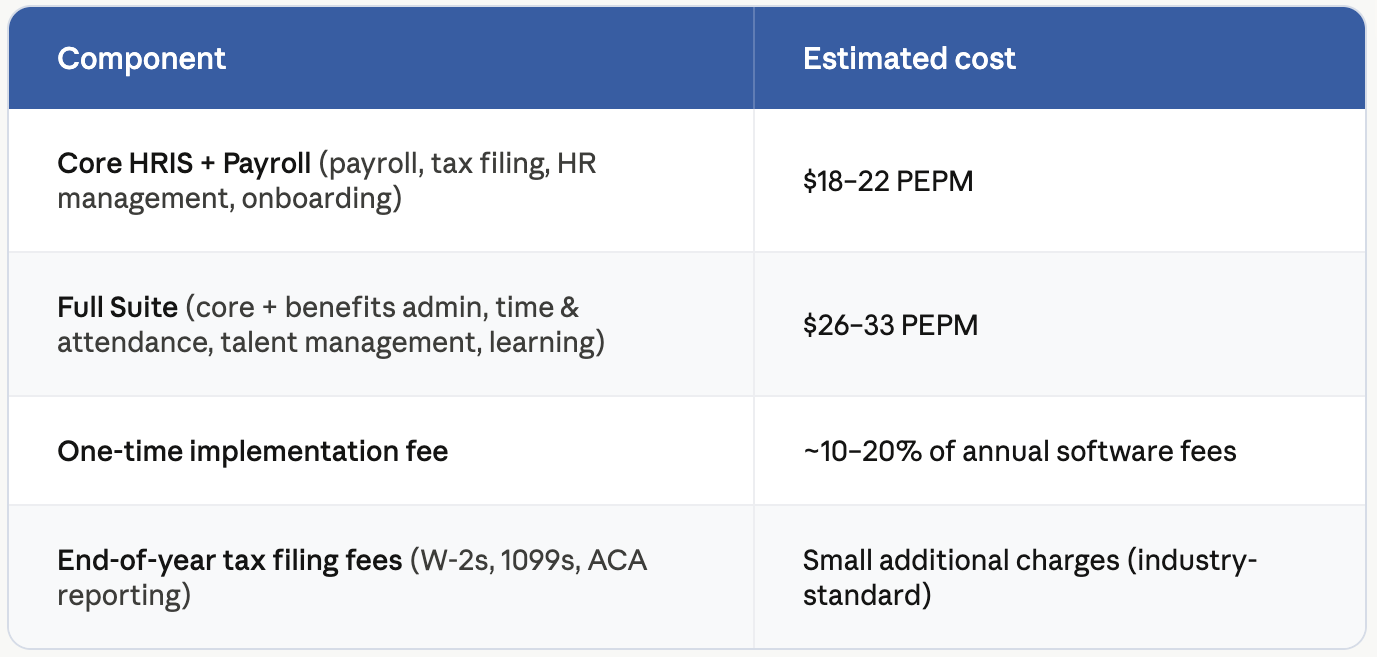
Example: 200-employee company on the full suite
At $26–33 PEPM, your annual software cost would run approximately $62,400–$79,200. Add a one-time implementation fee of roughly $6,000–$16,000 (10–20% of annual spend), and your first-year total lands in the range of $68,000–$95,000. Year-two costs drop to just the software subscription, assuming stable headcount.
Example: 500-employee company on the full suite
At the same PEPM range, annual software costs would be approximately $156,000–$198,000. Larger organizations typically negotiate toward the lower end of the range, so a 500-employee company is more likely to land around $26–28 PEPM rather than $33. Implementation fees at this scale might run $15,000–$40,000 depending on scope.
What's Included in Each Module
Paylocity organizes its platform into functional categories. Here's what each area covers and how it contributes to your total cost:
Payroll & Tax The foundation of every Paylocity deployment. Includes automated payroll processing, federal/state/local tax filing, direct deposit, garnishment management, and general ledger integration. Paylocity supports payroll in 100+ countries through its partnership with Blue Marble Payroll for international processing.
HR Management Employee records, compliance dashboards, document management, templated workflows, and reporting. This is typically bundled with payroll as part of the base HRIS package.
Benefits Administration Benefits enrollment, carrier connections, ACA compliance, life event management, and benefits-specific reporting. Paylocity has developed its own native benefits tools, moving away from earlier third-party partnerships.
Time & Attendance Time tracking, scheduling, PTO management, geofenced clock-in/out, and labor cost allocation. This module is particularly valued by companies with hourly or shift-based workforces.
Talent Management Recruiting/ATS, onboarding workflows, performance reviews, compensation management, and succession planning. Paylocity's recruiting and onboarding modules get consistently strong reviews.
Employee Experience Paylocity's Community feature (an internal social-media-style communication hub), surveys, peer recognition, and engagement analytics. This is one of Paylocity's most distinctive offerings — few mid-market competitors have anything comparable.
Learning Management Training content creation, compliance course tracking, and video-integrated learning modules. This is a lighter LMS compared to dedicated learning platforms, but sufficient for most mid-market needs.
Where Additional Costs Can Show Up
One of Paylocity's strengths is that their quoting process is relatively clean. They use a flat PEPM model that's all-inclusive for the modules you've selected, which means you won't typically see a separate line item for every feature within a module. That said, there are a few areas where costs can extend beyond the base quote:
End-of-Year Tax Filings
Small fees for W-2 preparation, 1099 generation, and ACA reporting (1094-C/1095-C) are common. These are standard across the payroll industry — virtually every vendor charges something similar. Paylocity's fees here are in line with market norms, but they're worth confirming during the sales process so they don't surprise you in January.
Finance Suite (Airbase)
In 2024, Paylocity acquired Airbase for $325 million, adding a full spend management platform to its offerings. The Airbase integration — now being branded as Paylocity's finance suite — includes bill pay and accounts payable automation, expense management, corporate cards, and procurement workflow automation.
This is a separate product line from the core HRIS. If you add spend management capabilities, expect your total cost to increase beyond the $26–33 PEPM range. Pricing for the finance suite is quoted separately based on transaction volume and functionality needed. It's a compelling add-on for companies that want to manage both labor and non-labor spend on one platform, but it's not included in the standard HCM pricing.
401(k) and Retirement Plans
Paylocity offers white-labeled retirement plan administration through a partnership with Vestwell, a leading workplace savings platform. This gives Paylocity clients access to 401(k) plans, employer matching, and retirement savings tools integrated directly into the payroll workflow.
Like the finance suite, retirement plan administration carries its own pricing structure separate from the HRIS subscription. Costs will depend on plan design, participant count, and asset levels. If you're evaluating Paylocity's 401(k) offering, compare it against standalone retirement plan providers to ensure competitive fees.
Managed Payroll Services
For companies that want to outsource payroll processing rather than managing it in-house, Paylocity now offers managed payroll services. This is a newer offering aimed at organizations with lean HR teams or those accustomed to PEO-style service models.
Managed services carry a premium above the standard software PEPM — typically adding $5–15+ per employee per month depending on the scope of outsourcing. This is worth exploring if your team doesn't have the bandwidth to own payroll processing, but it's a separate cost layer.
Premium Support or Additional Training
Standard customer support is included in Paylocity's PEPM pricing. However, if you need dedicated account management, priority response times, or extended training sessions beyond the initial implementation, those may come at additional cost. Ask about support tier options during the sales process.
How Paylocity's Pricing Compares to Competitors
One of the most common questions buyers ask is how Paylocity stacks up on price against other mid-market HRIS platforms. Here's where it sits:
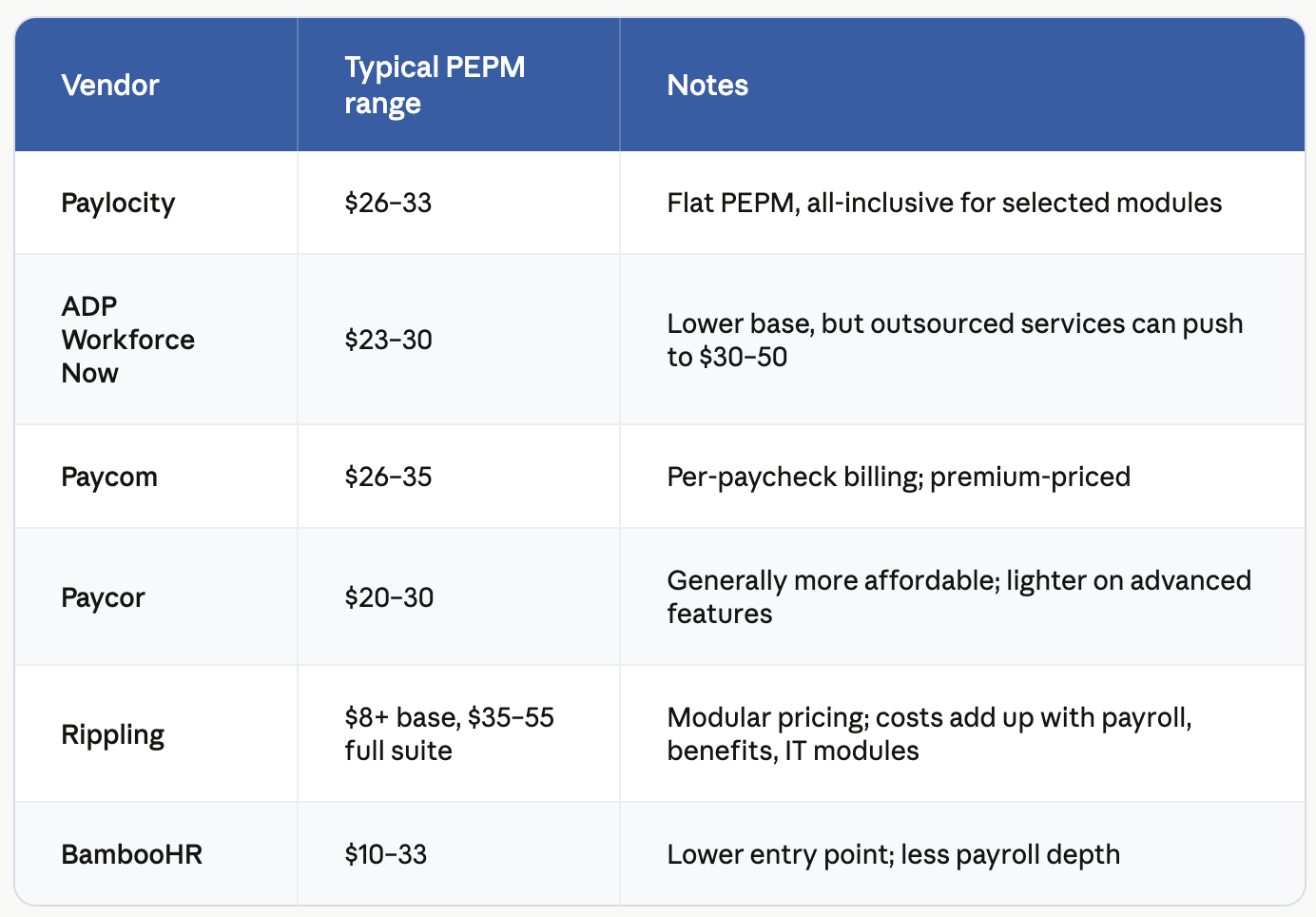
Paylocity sits squarely in the middle of the mid-market pack — not the cheapest, not the most expensive. It's typically priced close to ADP Workforce Now for comparable module configurations, but with a more predictable billing model. It's noticeably less expensive than Paycom for most buyers, while offering a similar breadth of functionality.
For a detailed head-to-head breakdown, see our comparisons: ADP vs. Paylocity and Paylocity vs. Rippling.
Negotiation Tips for Paylocity Buyers
Paylocity's pricing is negotiable. Here are the levers that give you the most leverage:
- Get competing quotes. Nothing moves a Paylocity sales rep faster than a competitive proposal from ADP, Paycom, or Paycor sitting on the table. Even if Paylocity is your top choice, having alternatives gives you pricing benchmarks and negotiation leverage.
- Commit to a multi-year term. A 2–3 year agreement often unlocks a lower PEPM rate. Just make sure the contract includes reasonable termination provisions and caps on annual renewal increases. For guidance on what to look for, see our HRIS contract negotiation guide.
- Buy at the right time. Paylocity's fiscal year ends in June, so Q3 and Q4 (January–June) are when the sales team is pushing hardest to close deals. End-of-quarter timing (March, June, September, December) also tends to create urgency that benefits buyers.
- Negotiate implementation fees. The one-time implementation fee is often the most negotiable part of the deal. Some buyers get it reduced by 50% or waived entirely in exchange for a longer contract commitment.
- Ask about promotional bundles. Paylocity occasionally offers promotional pricing when you add newer modules (like the finance suite or managed payroll) alongside the core HCM package. Ask your rep what's available — bundling can reduce the effective PEPM.
- Cap renewal increases. This is easy to overlook and painful to miss. Make sure your contract specifies a maximum annual price increase (3–5% is standard) so you're not surprised by a 15% jump at renewal.
Frequently Asked Questions
How much does Paylocity cost per employee?
Most mid-market companies pay between $26 and $33 per employee per month for the full HCM suite (payroll, benefits, time, talent, and learning). Core payroll and HR alone typically runs $18–22 PEPM. Implementation fees add approximately 10–20% of your first-year software costs. For a full Paylocity review including features and user feedback, see our in-depth write-up.
Does Paylocity have hidden fees?
Paylocity is more transparent than most mid-market vendors. Their flat PEPM model means you're paying one all-inclusive rate for the modules you've selected — no per-paycheck charges, no separate line items for individual features within a module. The main areas where additional costs can appear are end-of-year tax filings (W-2s, 1099s), the newer finance suite (Airbase), retirement plan administration (Vestwell), and managed payroll services. None of these are "hidden" per se, but they're quoted separately from the core HRIS.
How does Paylocity compare to Paycom on pricing?
Paylocity is typically 10–20% less expensive than Paycom for comparable functionality. Paycom also bills per paycheck rather than per month, which makes costs less predictable for companies running weekly payroll. The trade-off is that Paycom offers a single-database architecture and Beti employee-driven payroll, while Paylocity provides stronger integration capabilities and employee engagement features. See our full Paycom vs. Paycor vs. Paylocity comparison.
Is Paylocity worth the cost for a mid-sized company?
For companies with 50–750 employees that want a well-rounded, modern HRIS with solid payroll, benefits, time tracking, and employee engagement features, Paylocity offers strong value for the price. It's particularly well-suited for organizations that value community features, employee self-service, and a platform that integrates well with third-party tools. Where Paylocity may not justify the cost is for very small companies (under 50 employees) with basic needs — where Gusto or BambooHR would be more appropriate — or very large enterprises that need the configurability of UKG or Workday.
What is Paylocity's implementation fee?
Typically 10–20% of your annual software subscription. For a $100,000 annual deal, that's $10,000–$20,000 as a one-time charge. Implementation usually takes 2–3 months and covers system configuration, data migration, training, and parallel payroll testing. This fee is often negotiable, especially if you're committing to a multi-year contract.
Does Paylocity support international payroll?
Paylocity supports payroll in 100+ countries through its partnership with Blue Marble Payroll. However, the platform itself is still very U.S.-centric — it wouldn't serve as a true global system of record for companies with heavy international operations. For global needs, consider Deel or ADP's global offerings alongside or instead of Paylocity.
The Bottom Line on Paylocity Pricing
Paylocity earns credit for doing something that's surprisingly rare in the mid-market HRIS space: pricing that's relatively straightforward. The flat PEPM model, all-inclusive module bundling, and predictable billing structure mean that what you see in the quote is close to what you'll actually pay — with no per-paycheck surprises or obscure line items inflating your monthly invoice.
The base HRIS costs of $26–33 PEPM are competitive for the breadth of functionality Paylocity delivers. Where your total spend can climb is if you layer on the newer offerings — the Airbase-powered finance suite, Vestwell 401(k) plans, or managed payroll services. These are valuable add-ons, but they're priced separately and should be evaluated on their own merits.
If you're comparing Paylocity quotes against other mid-market platforms, OutSail can help. Our advisory team reviews hundreds of HRIS proposals each year and can tell you whether your quote is competitive — for free.
Need expert help with your HR implementation? Explore our HR Service Partner Finder to connect with the best HR consultants in the industry.
.png)
