How Much Does an HR Technology Consultant Cost?
See what HR technology consultants charge by provider type and engagement model, including hourly rates, implementation costs, hidden expenses, and ways to control your total budget.

Key Takeaways
- HR technology consultant cost depends on two things: how the work is priced (the engagement model) and who you hire (the provider tier).
- Hourly rates typically range from $150 to $400: about $300 to $400 for a large consultancy or certified enterprise partner, $250 to $275 for a boutique mid-market firm, and $150 to $175 for generalist support.
- Most work is priced one of four ways: a fixed project fee, a monthly advisory retainer, a managed hands-on engagement, or an hourly rate for smaller tasks.
- A full mid-market implementation commonly runs from about $7,500 to $10,000 with supervised support up to $40,000 to $60,000 fully outsourced, separate from the software itself.
- The rate on the quote is rarely the whole cost. Data cleanup, integrations, change management, and your own team's time all add up, and a low hourly rate can hide a higher total.
- OutSail's core selection service is free because vendors pay a commission, and its matching service negotiates below-market rates, so you often pay less than a cold quote, or nothing at all.
"How much does an HR technology consultant cost?" has no single answer, because two different things drive the number.
The first is how the work is priced: by the hour, by the project, or by the month.
The second is who you hire: a generalist, a mid-market specialist, or a top-tier enterprise partner.
The gap between the cheapest and most expensive version of the same project can be five times or more, and most of that gap is a choice rather than a fixed cost.
Get clear on both drivers, and a vague "it depends" turns into a range you can budget against and negotiate on.
This guide breaks down the rates, the pricing models, the costs that never make it onto the quote, and the ways to pay less for the same outcome.
What HR Technology Consultants Actually Charge
An HR technology consultant costs between $150 and $400 an hour, depending on the provider tier, or a fixed project fee that scales with scope and platform.
Generalist support runs about $150 to $175 an hour.
A boutique mid-market firm runs about $250 to $275.
A large consultancy or certified enterprise partner runs about $300 to $400.
On a project basis, a full mid-market implementation commonly ranges from roughly $7,500 to $10,000 with supervised support up to $40,000 to $60,000 fully outsourced.
The right number is the one that matches your platform, your scope, and how much of the work you hand off, not the highest rate you can find.
The rest of this guide explains how each of those figures is set, and where the real total often hides.
What Drives HR Technology Consultant Cost?
Six things move the price more than anything else: the provider tier, the platform, the scope, the state of your data, the length of the project, and where the work happens.
- Provider tier: a generalist costs less than a mid-market specialist, who costs less than a certified enterprise partner. This is usually the single biggest lever on the rate.
- Platform: deep expertise in enterprise systems like Workday and SAP SuccessFactors commands a premium over mid-market platforms like Dayforce, UKG, or Paylocity, because that skill is scarcer and the systems are more demanding to configure.
- Scope: a short optimization on a live system costs a fraction of a full selection-to-go-live implementation, because scope decides how many hours the work takes.
- Data condition: messy data adds cleanup hours, and cleanup is slow, detailed work a consultant often has to lead rather than hand back to your team.
- Length: a rollout that stretches over more months carries more hours, more meetings, and more coordination, all of which land on the invoice.
- Geography: a multi-country project adds local compliance, language, and payroll rules, each of which adds specialist time.
Two projects on the same platform can differ in cost by a wide margin once these stack up, which is why a quote means little without a clear scope behind it.
How Do HR Technology Consultants Price Their Work?
Most HR technology consultants price their work one of four ways, and the model shapes the total as much as the rate does.
- Hourly: best for small, scoped tasks and one-off questions, usually $150 to $400 depending on the provider. Simple to start, but risky on a fuzzy scope, since the meter keeps running.
- Fixed project: one price for a defined outcome like a data migration or a go-live, best when the scope is clear. It moves the overrun risk onto the consultant, which is why they price it carefully.
- Advisory retainer: a monthly fee for ongoing guidance while your team does the hands-on work. It fits a long project where you want an expert on call rather than in the weeds.
- Managed engagement: the consultant runs the project hands-on, the highest cost but the least lift for your team.
The cheapest model on paper is not always the cheapest in practice.
An hourly arrangement on an unclear scope can quietly run well past what a fixed price would have been, because every clarification and rework is billable.
When the scope is clear, a fixed project fee is usually the safer way to control the total.
How Much Do HR Technology Consultants Charge Per Hour?
Hourly rates fall into three broad tiers, set mostly by the provider's size and platform depth.
Here is what each tier actually buys.
At the top, a Workday- or SAP-certified specialist sits at $300 to $400 because that skill is scarce and those systems are demanding to configure.
You are paying for someone who has done your exact build many times, which is worth the premium on a large, enterprise-platform program where a mistake is costly.
In the middle, a boutique mid-market firm runs $250 to $275 because it pairs real platform depth on systems like Dayforce and UKG with far lower overhead than a global firm.
For most mid-market selections and rollouts, this is the tier that fits.
At the entry level, generalist or independent support runs $150 to $175.
A generalist can be a fine choice for a simple, well-scoped task, but they are often less fluent in the enterprise systems, so the low rate can quietly cost more hours as they learn on your project.
The lowest rate is only a bargain if the person can actually do your job, on your platform, without ramp-up time you end up paying for.
What Does a Full HR Technology Project Cost?
On a project basis, cost tracks the phase of work and how much you hand off.
A short optimization or a focused fix on a system you already run is the least, often a few thousand dollars.
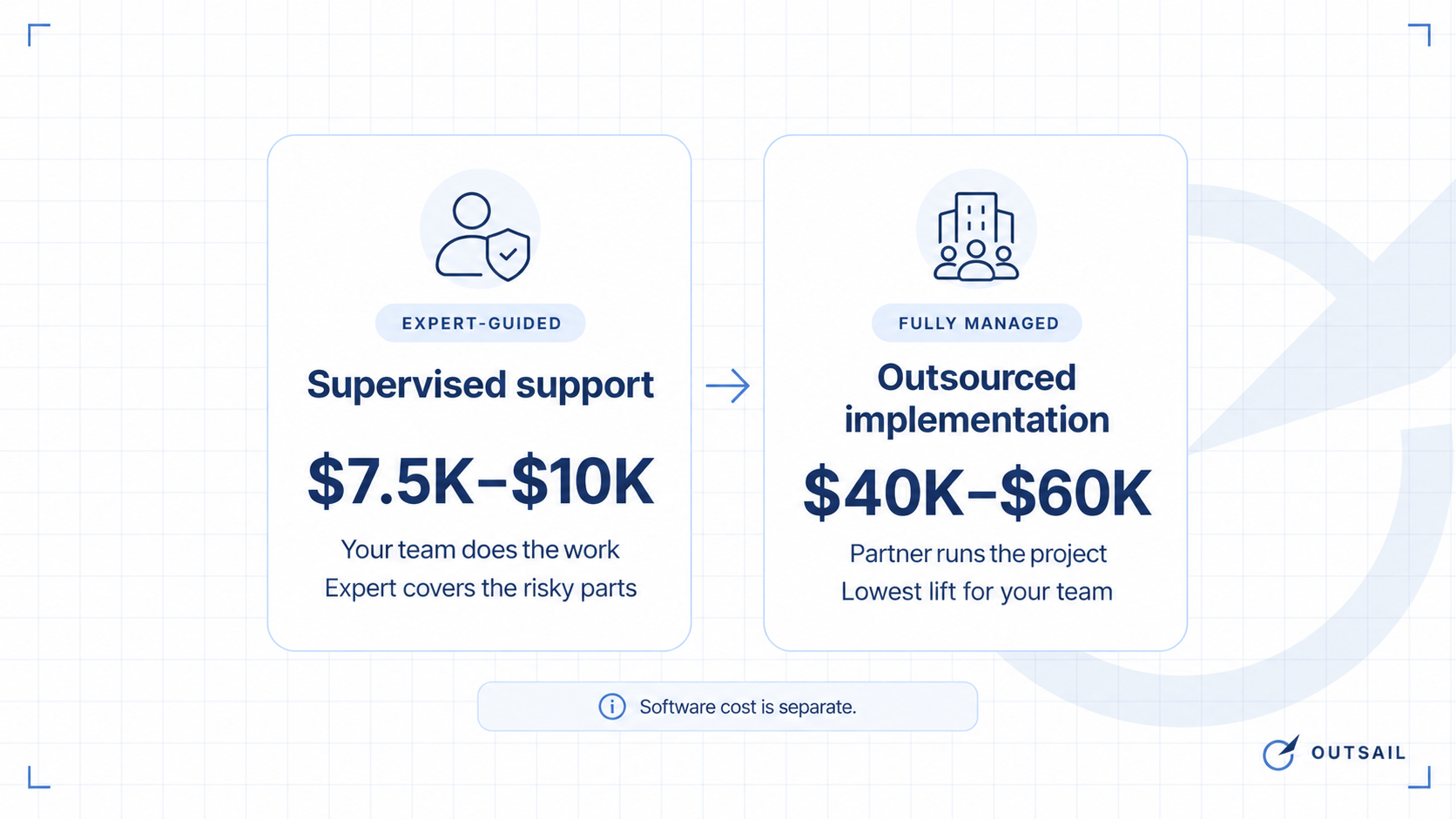
A full mid-market implementation commonly runs from roughly $7,500 to $10,000 with supervised support, where your team does the work and an expert covers the risky parts, up to $40,000 to $60,000 for a fully outsourced firm that runs the whole thing.
A selection, choosing the right platform in the first place, can be free through a broker-funded service or a paid advisory tier for heavier requirements.
An integration project, connecting the HRIS to payroll, benefits, or identity systems, is usually priced per connection and can add several thousand dollars each.
Timelines feed the total: a mid-market rollout typically runs three to six months (Paycom), and more months mean more hours.
A Worked Example: A 300-Person Company Moving to UKG
Say a 300-person company is moving to UKG, a mid-market platform.
A boutique firm certified on UKG might bill around $250 to $275 an hour, which is the right tier for this platform and company size.
If that firm runs the whole implementation hands-on, the engagement could land in the $40,000 to $60,000 range.
With supervised support instead, where the company's own HR team does the hands-on work and an advisor leads the data migration, the process decisions, and the testing, the same rollout often runs $7,500 to $10,000.
Choosing UKG in the first place could be free through a broker-funded selection service.
So the spread on the same move runs from under $10,000 to $60,000 or more, and most of that difference is a decision about how much the company hands off, not a difference in the platform or the outcome.
What Costs Get Left Out of the Quote?
The rate on the quote is rarely the whole cost, and the gaps are where budgets get blown.
- Your team's time: the largest hidden cost. Implementation is a second job on top of everyone's first one, and those hours are real even when no one invoices for them.
- Data cleanup: vendors and many consultants expect clean records handed to them. Reconciling duplicates and filling gaps is slow work, and it is often yours or billed as extra hours.
- Integrations: each connection to payroll, benefits, an ATS, or an identity system can add hours that a headline implementation price does not include.
- Change management: training, communication, and adoption decide whether the system gets used, and they are frequently scoped out of the base quote.
- Post-go-live support: the weeks of stabilization after launch, when issues surface, can carry their own fee or eat into a retainer.
Before you compare two quotes, ask each provider what is and is not included on this list.
A higher quote that covers data and change management can be cheaper than a lower one that leaves both on your desk.
Consultant Cost vs Software Cost
Keep consultant cost separate from software cost, because the two are often confused and the consulting line can rival the license.
The software cost is what you pay the vendor for the platform, usually a per-employee subscription.
The consultant cost is what you pay a person or firm to help you choose, deploy, or fix it.
Enterprise platforms like Workday and SAP SuccessFactors frequently require a third-party implementation partner, so the consulting line is a large, separate budget item on top of the subscription.
Budget for both from the start, so the implementation cost does not surprise you after you have already signed for the software.
How Do You Pay Less for the Same Outcome?
The biggest savings come from matching the provider tier to the job, buying through a network rather than a cold inquiry, and keeping the scope tight.
Overpaying usually comes from hiring a bigger, more certified firm than the task needs, so a right-sized specialist is often the real saving.
A generalist on a demanding enterprise build is a false economy, and a top-tier enterprise partner on a routine mid-market rollout is simply overkill.
Buying through an established network helps too, because matched engagements are often priced below what a firm quotes a cold prospect.
A tight, written scope is its own discount, since it removes the billable back-and-forth that inflates hourly work.
And the selection stage itself can cost nothing.
OutSail's core HR software selection service is free, because vendors pay a commission when you buy, and roughly 90% of clients never pay a cent for it.
When you do need hands-on help, OutSail matches you to a vetted specialist at the right tier and negotiates below-market rates through its network.
How Can OutSail Help With Your HR Technology Project?
OutSail is an independent HR technology advisory firm built to help mid-market companies select, implement, and get real value from the systems that run HR.
Brett Ungashick and the OutSail team specialize in HR technology advisory, HRIS selection, and consultant matching – working alongside your team to build an HR technology decision you can defend, not just a signed contract.
OutSail does not try to be a generalist HR firm, and that focus is the point.
From choosing the right platform to matching the right-sized specialist for a rollout or a fix, OutSail focuses on outcomes at every stage of an HR technology project.
HR and finance leaders get clear visibility into what a system will cost, what the market actually offers, and where the risks sit.
The guidance is independent by design.
OutSail pioneered the HR software broker approach, partnering with 220+ vendors that each pay a similar commission when a client buys.
The advice never bends toward whoever is paying, and roughly 90% of clients never pay a cent for the core selection service.
That independence shows up in outcomes like Olo saving $300K on its HRIS, Gentherm cutting payroll-vendor evaluation time by roughly 75%, and VetnCare selecting a new system in 30 days.
Every shortlist and pricing benchmark behind those wins draws on first-party data, not vendor marketing.
We know that a wrong system or overpaying for one is real money lost.
Every recommendation we make is built around one outcome – an HR technology decision that fits your business and gets adopted by your people.
Meet the Founder of OutSail
Meet the founder and CEO of OutSail – Brett Ungashick:
- As founder and CEO of OutSail, Brett brings years of hands-on experience in HR technology selection, negotiation, and implementation, drawn from advising 1,500+ organizations on their HR systems.
- Brett began his career selling HR technology at LinkedIn, where he saw how hard it was for buyers to compare an increasingly crowded market, and founded OutSail in 2018 to put independent, buyer-side expertise into the process.
- OutSail's data-driven approach has supported more than $100M in HR software purchases, saved clients 100,000+ hours of work, and earned an 83 NPS, working with companies such as DoorDash, Salesloft, Olo, Houzz, and AuditBoard.
What Does Working With OutSail Look Like?
OutSail operates as a dedicated extension of your team – not a vendor that disappears after a kickoff call.
Every engagement includes direct access to advisors, transparent guidance tied to real project outcomes, and a plan built around your systems, budget, and internal bandwidth.
It runs from a tech stack audit through selection and negotiation, and on to a vetted, platform-specific consultant or implementation support when the work moves to a rollout or a fix.
Whether you need a single specialist, a full implementation team, or a straight read on what a fair price looks like, OutSail builds the plan and does the work alongside you.
OutSail helps mid-market companies make HR technology decisions they can defend to their CFO – not just buy software.
Frequently Asked Questions
How much does an HR technology consultant cost per hour?
Hourly rates typically range from $150 to $400.
Generalist or independent support runs about $150 to $175, a boutique mid-market firm about $250 to $275, and a large consultancy or certified enterprise partner about $300 to $400.
The tier you need depends on your platform and how deep the work goes.
How much does a full HRIS implementation cost?
For a mid-market company, a full implementation commonly runs from about $7,500 to $10,000 with supervised support up to $40,000 to $60,000 fully outsourced.
A short optimization on a live system costs far less, often a few thousand dollars.
All of these are separate from the price of the software itself.
Why are Workday and SAP consultants more expensive?
Enterprise platforms like Workday and SAP SuccessFactors are demanding to configure, and certified specialists in them are scarce.
That scarcity and depth push their rates to the top of the range, roughly $300 to $400 an hour.
For a mid-market platform like Dayforce or UKG, a specialist typically costs less.
What's the difference in cost between a big consultancy and a boutique firm?
A large consultancy or certified enterprise partner usually charges about $300 to $400 an hour, while a boutique mid-market firm charges about $250 to $275.
The boutique tier pairs real platform depth with lower overhead, which is why it fits most mid-market projects.
The bigger firm is worth the premium mainly for large, enterprise-scale programs.
What costs are usually left out of an implementation quote?
The common gaps are your team's time, data cleanup, integrations, change management, and post-go-live support.
Any of these can add materially to the total, and a lower quote that excludes them can end up costing more than a higher one that includes them.
Ask each provider exactly what is and is not in scope before you compare prices.
Is it cheaper to hire a generalist?
The hourly rate is lower, but the total is not always.
A generalist who is less fluent in your platform can take more hours to reach the same result, and those extra hours can erase the saving.
A generalist fits a simple, well-scoped task; a demanding enterprise build usually calls for a specialist.
How can I lower my HR technology consultant cost?
The biggest savings come from matching the provider tier to the job, keeping a tight written scope, and buying through a network instead of a cold inquiry.
A right-sized specialist avoids paying for a bigger firm than the task needs, and matched engagements are often priced below a cold quote.
The selection stage can also be free through a broker-funded service.
Does OutSail charge for HR software selection?
No. OutSail's core selection service is free because vendors pay a commission when you buy, and roughly 90% of clients never pay a cent.
Companies with heavier requirements can choose a paid advisory tier, and consultant matching connects you with hands-on specialists at below-market rates.

.png)
