Greenhouse vs Lever vs Ashby: Which ATS Fits Your Recruiting Strategy?
Struggling to choose between Greenhouse, Lever, and Ashby? Our head-to-head ATS comparison breaks down features, pricing, and ideal use cases for each platform.

The applicant tracking system market has a clear hierarchy: Greenhouse is the established enterprise player, Lever is the candidate-experience-focused mid-market leader, and Ashby is the fast-rising challenger that's winning over data-driven recruiting teams.
All three are modern, well-designed platforms that blow away legacy ATS options. But they're built for different recruiting philosophies, team sizes, and priorities. Choosing the wrong one means either overpaying for features you don't need or outgrowing your system within two years.
This guide breaks down what each platform does best, where they fall short, and how to decide which ATS fits your recruiting strategy.
The Quick Take
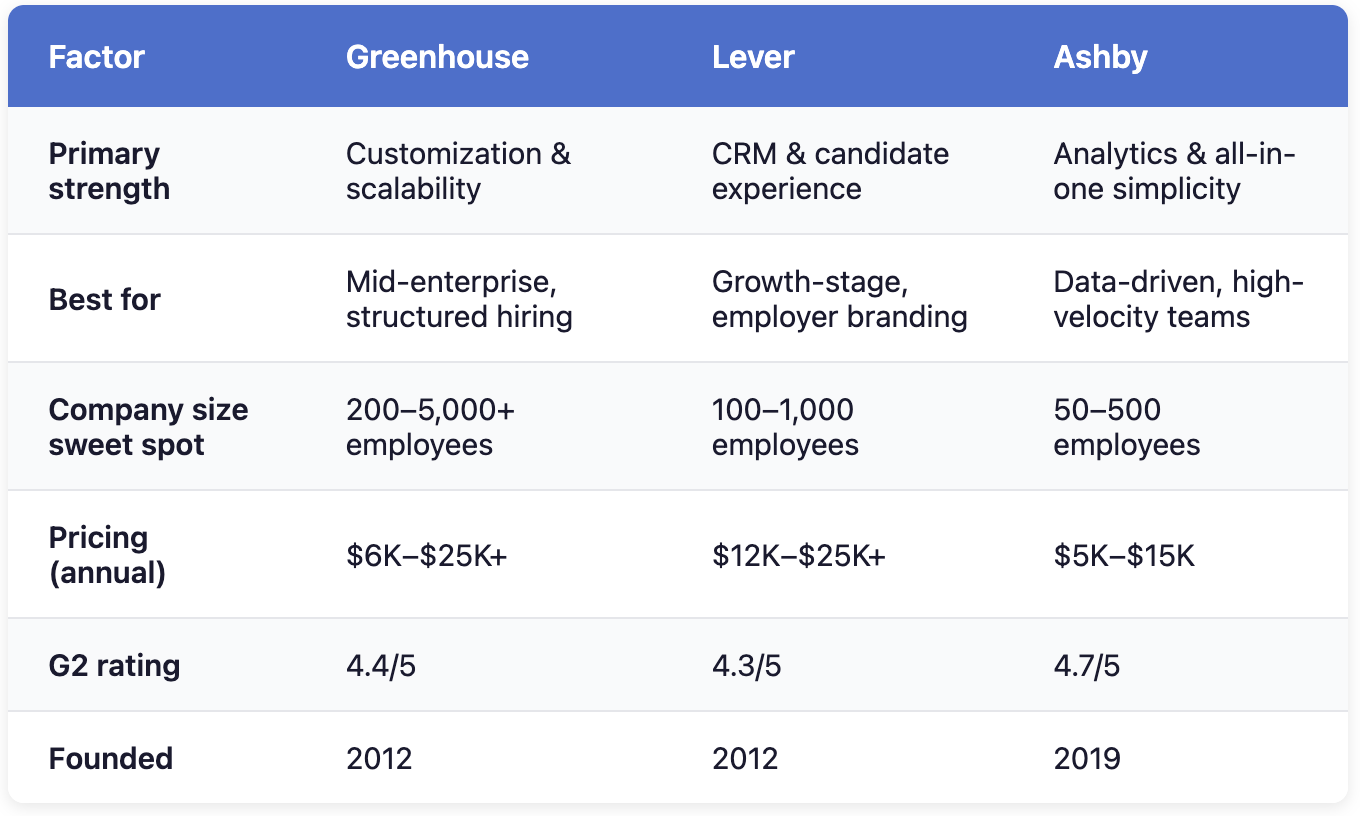
Greenhouse: The Customizable Enterprise Standard
Greenhouse has become the default choice for mid-to-large companies that need a scalable, highly configurable recruiting platform. If you're hiring across multiple departments, geographies, and job families with different workflows, Greenhouse handles the complexity.
What Makes Greenhouse Different
Greenhouse was built around the idea that every company's hiring process is unique. The platform provides extreme configurability—you can define custom stages, scorecards, interview plans, and approval workflows that match exactly how your organization recruits.
Core capabilities:
- Highly customizable hiring workflows and pipelines
- Structured interviewing with scorecards and feedback templates
- Advanced employee referral management
- Robust onboarding workflows (not just offer letters)
- DEI tools with bias-reduction features
- Extensive partner marketplace (400+ integrations)
- Job board distribution and career page management
- Comprehensive reporting and analytics
Where Greenhouse Excels
- Customization depth: Greenhouse lets you configure virtually every aspect of your hiring process. Custom fields, conditional workflows, role-based permissions, multi-stage approval chains—if you need it, Greenhouse can probably do it.
- Hiring manager adoption: Despite its depth, Greenhouse gets strong reviews from hiring managers. The interface has a low learning curve for reviewers and interviewers, and the built-in templates and automations guide users through processes.
- Integration ecosystem: Greenhouse's partner marketplace is the most extensive in the mid-market ATS space. Pre-built integrations with major HRIS platforms (Workday, BambooHR, Rippling, etc.), assessment tools (HackerRank, Codility), background check providers, and sourcing tools make it easy to build a connected recruiting tech stack.
- Structured hiring methodology: Greenhouse isn't just software—they've built an entire structured hiring philosophy into the platform. Scorecards, calibration tools, and interview training help companies make more objective, consistent hiring decisions.
- Referral and onboarding: Unlike many ATS platforms that stop at the offer letter, Greenhouse offers robust employee referral programs and new hire onboarding workflows that bridge recruiting and HR.
Where Greenhouse Falls Short
- Administrative burden: Greenhouse's power comes with complexity. Setting up the system properly requires significant admin effort, and ongoing maintenance of workflows, templates, and permissions isn't trivial. For lean recruiting teams, this overhead can be overwhelming.
- Customer support challenges: As Greenhouse has scaled, customer support quality has declined. Users report difficulty reaching live agents and slow response times—frustrating when you're in the middle of a hiring push.
- Premium pricing: Greenhouse is typically the most expensive option in the mid-market. For smaller companies or those with straightforward hiring needs, you're paying for configurability you may never use.
- Reporting learning curve: While Greenhouse offers comprehensive reporting, taking full advantage requires more technical skill than expected. Building custom reports can feel like a project rather than a task.
Ideal Greenhouse Customer
- Mid-to-large companies (200–5,000+ employees) with structured hiring processes
- Organizations hiring across multiple departments, locations, and job families
- Companies that need extensive workflow customization
- Teams with dedicated recruiting operations to manage the system
- Organizations prioritizing structured interviewing and bias reduction
For a detailed assessment, read our complete Greenhouse review.
Lever: The Candidate Experience Champion
Lever built its reputation on beautiful design and a candidate-centric approach. If you believe that recruiting is fundamentally a relationship business—and that candidate experience directly impacts hiring outcomes—Lever delivers.
What Makes Lever Different
Lever's core insight was that many ATS platforms treat candidates as transactions rather than relationships. Their natively-built CRM lets you nurture passive candidates over time, keeping your pipeline warm even when you don't have an immediate opening.
Core capabilities:
- Native CRM for candidate relationship management
- Clean, intuitive interface for recruiters and candidates
- Automated candidate nurturing and engagement
- Self-scheduling for candidates
- DEI dashboards and EEO tracking
- Pipeline management with drag-and-drop simplicity
- Integration marketplace with HRIS and recruiting tools
- Career page builder and employer branding tools
Where Lever Excels
- Candidate relationship management: Lever's native CRM is its biggest differentiator. You can track every touchpoint with a candidate across multiple roles and years, build nurture sequences for passive candidates, and maintain relationships that convert when timing is right.
- User interface: Lever consistently wins praise for its clean, intuitive design. Both recruiters and hiring managers find it easy to navigate, which drives adoption. One user noted: "We switched from Greenhouse to Lever and hiring managers actually started using the ATS instead of constantly asking recruiters to do things for them."
- Candidate experience: Lever has invested heavily in candidate-facing features: customizable career pages, mobile-optimized applications, candidate self-scheduling, automated status updates, and polished interview confirmation workflows. If employer branding matters, Lever delivers.
- Ease of implementation: Lever's straightforward design means faster implementations and shorter learning curves. You can get up and running quickly without extensive configuration.
- DEI tools: Lever offers purpose-built DEI dashboards that track diversity metrics through your funnel, support EEO reporting, and help reduce bias in interview processes.
Where Lever Falls Short
- Post-acquisition challenges: Lever was acquired by Employ (which also owns JazzHR and Jobvite), and the transition has created turbulence. Users report increased turnover in sales and support, and service quality has declined.
- API pricing: Lever charges customers for API access, making integrations more expensive than competitors. This can add significant cost if you're building a connected recruiting tech stack.
- Scalability limits: Lever works beautifully for companies hiring 20–100 people per year, but high-volume hiring (200+ annually) can expose limitations. The platform isn't as scalable as Greenhouse for complex, multi-geography operations.
- Limited onboarding: Lever's onboarding capabilities stop at digital offer letters. If you want recruiting-to-HR workflow continuity, you'll need separate tools.
- Premium pricing for features: Lever's base price is competitive, but advanced features (automation, advanced analytics, integrations) cost extra. That $12K base can quickly become $18K–$25K.
Ideal Lever Customer
- Growth-stage companies (100–1,000 employees) with strong employer brand
- Organizations in competitive talent markets where candidate nurturing matters
- Companies prioritizing candidate experience and employer branding
- Teams that want intuitive software without extensive configuration
- Companies hiring 20–150 people per year
For a detailed assessment, read our complete Lever review.
Ashby: The Analytics-First Disruptor
Ashby is the hot new player that's rapidly winning market share from both Greenhouse and Lever. Founded in 2019, Ashby was built from scratch with modern architecture, analytics at its core, and an all-in-one philosophy that eliminates the need for multiple recruiting point solutions.
What Makes Ashby Different
Ashby's founders looked at the ATS market and saw platforms that were either powerful but clunky (Greenhouse) or beautiful but limited (Lever). They built Ashby to deliver both—with analytics capabilities that neither competitor can match.
Core capabilities:
- All-in-one ATS, CRM, sourcing, and scheduling
- Industry-leading analytics and reporting
- High configurability with modern UX
- Transparent, seat-based pricing
- Built-in interview scheduling (no Calendly needed)
- Customizable dashboards and SQL-level querying
- Strong HRIS integrations (including deep Workday sync)
- Analytics sold standalone for companies with existing ATS
Where Ashby Excels
Analytics that actually work: This is Ashby's superpower, and it's not close. Analytics are built into every screen with customizable dashboards, cohort analysis, funnel tracking, and attribution reporting. You can answer questions like:
- Which sourcing channels produce candidates who reach final rounds at highest rates?
- How does time-to-hire vary by hiring manager?
- What's the ROI of our employee referral program by department?
Greenhouse and Lever have reporting, but Ashby's analytics are in a different league.
- All-in-one simplicity: Ashby combines ATS, CRM, sourcing, and scheduling into a single platform. No need to layer Calendly, Gem, or other point solutions on top—everything works together natively. This reduces cost, complexity, and context-switching.
- Scheduling automation: Ashby's interview scheduling is significantly more sophisticated than competitors. Automated scheduling, interviewer load balancing, and calendar optimization are built in—not bolted on.
- Transparent pricing: Ashby offers seat-based, month-to-month pricing that's refreshingly transparent. No black-box annual contracts or surprise renewal increases. For companies with variable hiring needs, this flexibility is valuable.
- Implementation speed: Customers consistently praise Ashby's fast implementations. Full setup in 3 weeks (including Workday integration) is common—compared to months for Greenhouse deployments.
- Customer support: Ashby gets strong reviews for responsive, knowledgeable support. As a younger company, they're still in the phase where customer success is a genuine priority.
Where Ashby Falls Short
- Still maturing: Ashby is the youngest platform in this comparison, and it shows in occasional bugs and missing features. The product is evolving rapidly, but enterprise-grade polish is still developing.
- Tech-company concentration: Ashby's customer base is heavily concentrated in tech companies, primarily in North America. If you're in a different industry or geography, the platform may lack specific features or integrations you need.
- Less brand recognition: Greenhouse and Lever are known quantities. Ashby requires more explanation to stakeholders who haven't heard of it. For risk-averse organizations, the "new player" status creates hesitation.
- DEI tools less developed: While Ashby offers EEO tracking and bias-reduction features, they're not as sophisticated as Greenhouse's structured hiring methodology or Lever's DEI dashboards.
Ideal Ashby Customer
- Fast-growing companies (50–500 employees) with data-driven recruiting culture
- Tech companies and startups comfortable with newer platforms
- Teams that want all-in-one functionality without point solution sprawl
- Organizations where recruiting analytics drive decision-making
- Companies with variable hiring needs who value flexible pricing
For a detailed assessment, read our complete Ashby review.
Head-to-Head Comparison
Core ATS Functionality
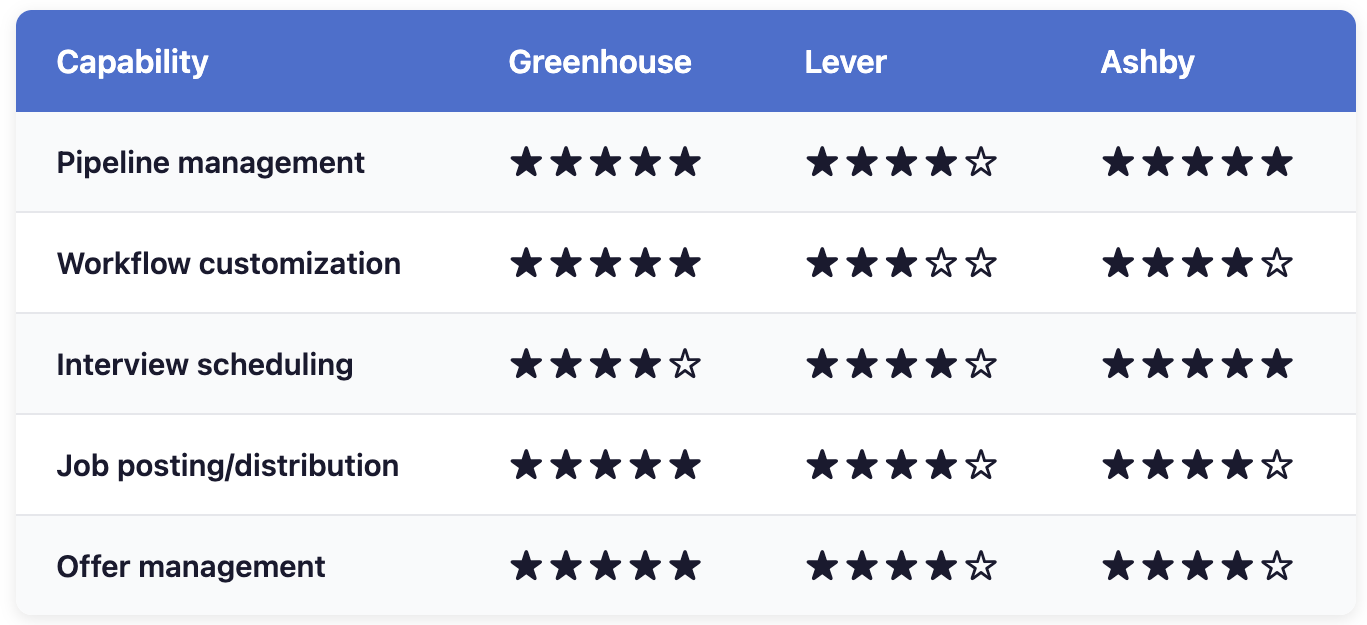
Verdict: Greenhouse offers the deepest customization. Ashby wins on scheduling automation. Lever provides the smoothest basic workflows.
CRM & Sourcing
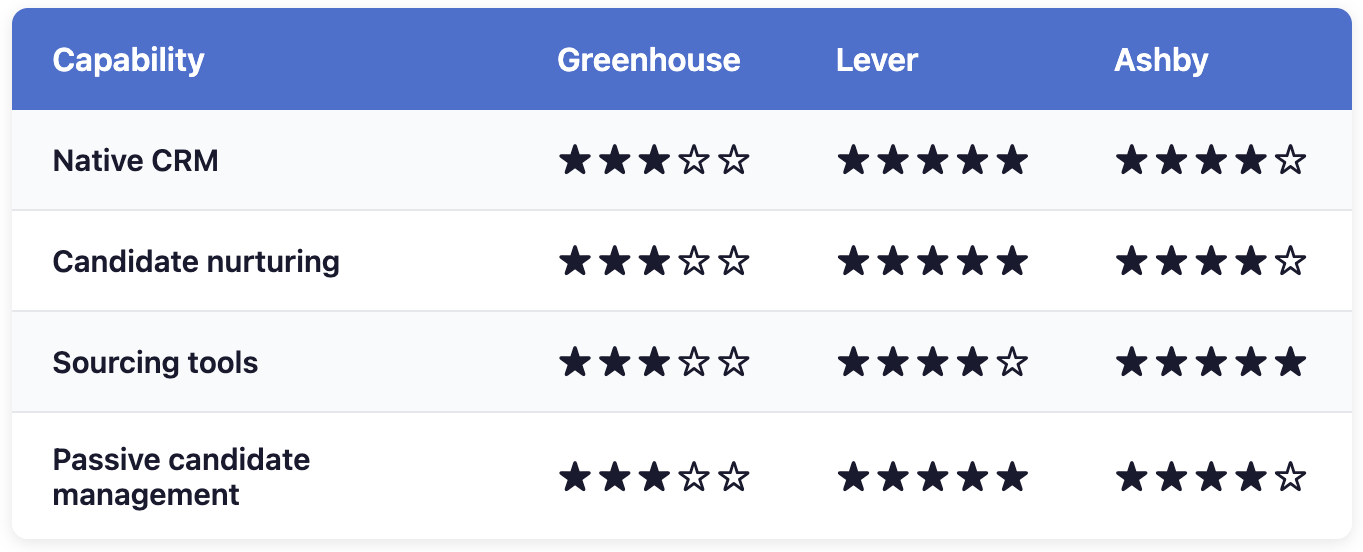
Verdict: Lever's native CRM is best-in-class for candidate relationship management. Ashby offers strong all-in-one sourcing. Greenhouse relies more on integration partners.
Analytics & Reporting
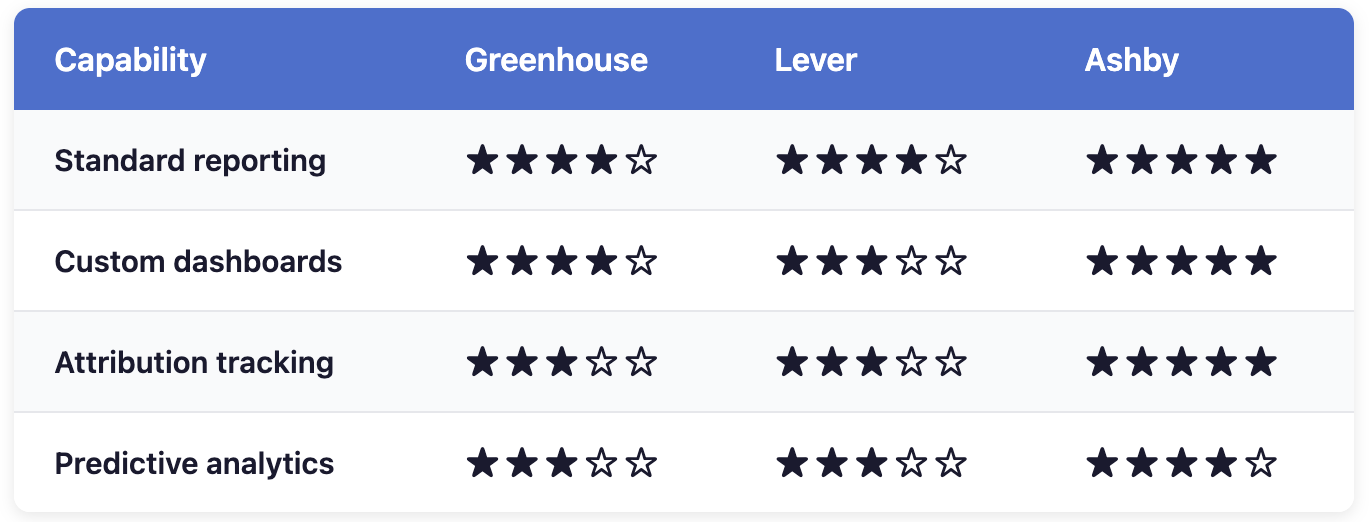
Verdict: Ashby dominates analytics. If data-driven recruiting decisions are your priority, Ashby is the clear choice.
User Experience
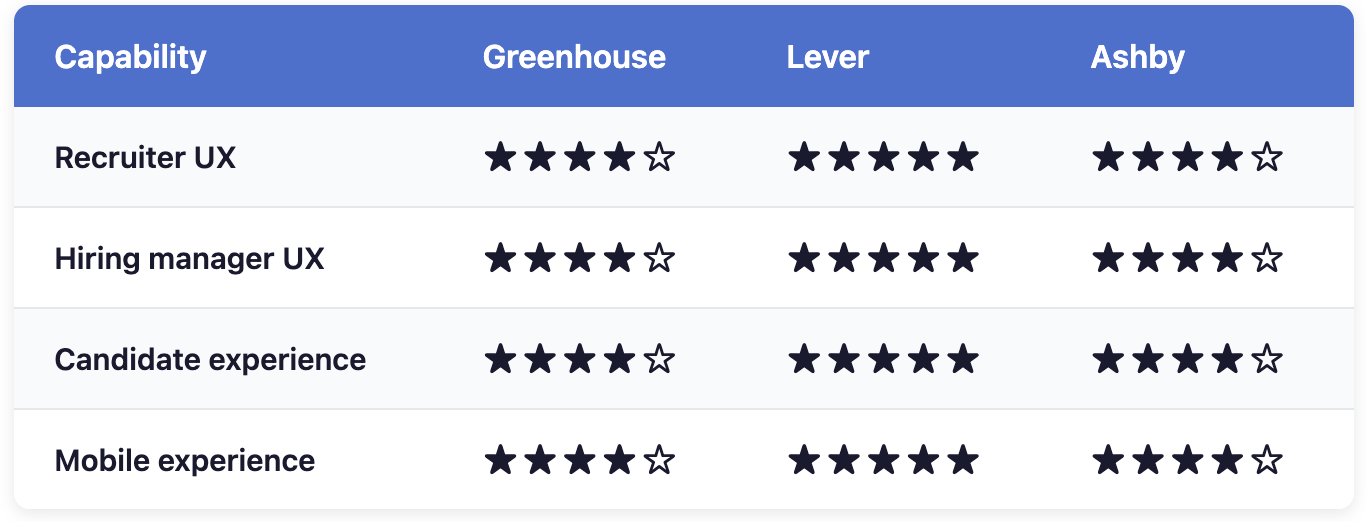
Verdict: Lever wins on pure user experience. The interface is cleaner and more intuitive, especially for hiring managers and candidates.
Integration Ecosystem
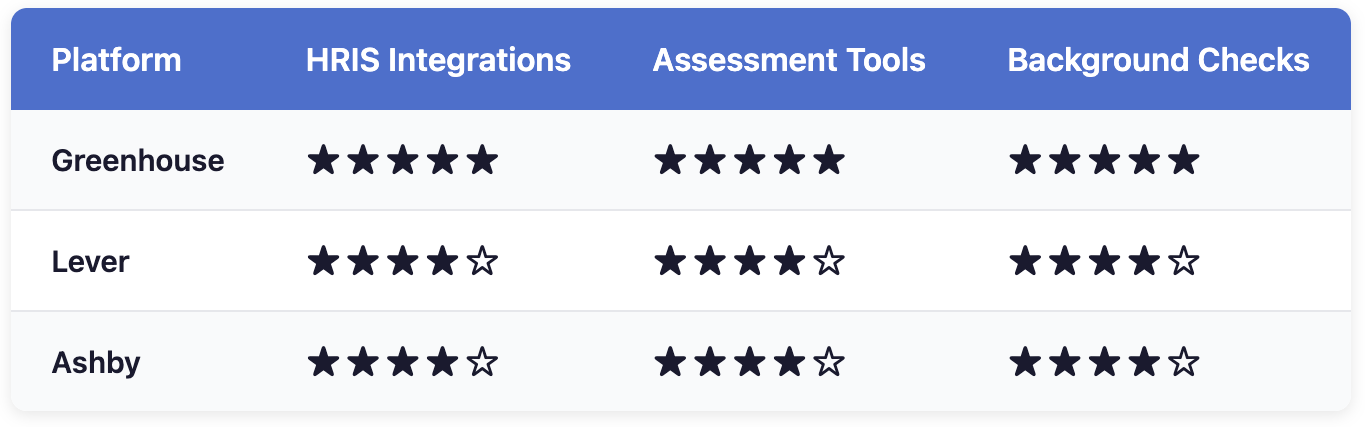
Verdict: Greenhouse's 400+ integration marketplace is the most extensive. Lever and Ashby offer solid integrations but with smaller ecosystems.
Pricing
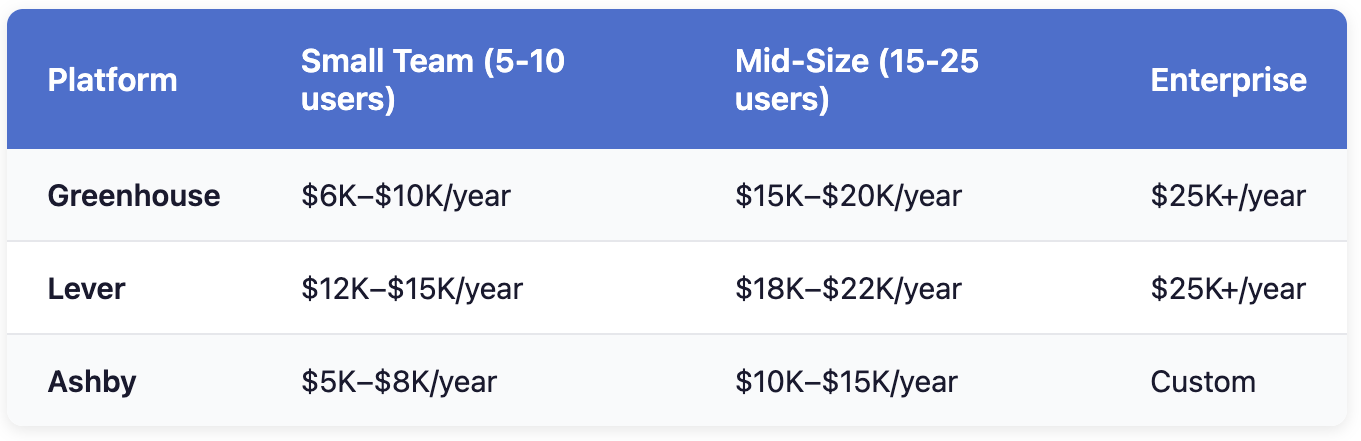
Verdict: Ashby offers the best value with transparent, flexible pricing. Greenhouse is expensive but justified for complex needs. Lever's base price is competitive, but add-ons increase costs quickly.
Decision Framework: Which ATS Fits You?
Choose Greenhouse If:
- You need maximum customization – Every hiring workflow is unique across departments
- You're scaling to enterprise – 200+ employees with complex, multi-geography hiring
- Structured interviewing is a priority – You want methodology, not just software
- You have dedicated recruiting operations – Someone can manage system complexity
- Integration ecosystem matters – You need connections to many specialized tools
Choose Lever If:
- Candidate experience is paramount – Employer brand drives your recruiting strategy
- You need native CRM – Nurturing passive candidates over time is core to your approach
- You want intuitive simplicity – Easy adoption without extensive training
- You're hiring 20–150 people/year – Mid-volume with relationship focus
- Design quality matters – Beautiful software improves team adoption
Choose Ashby If:
- Analytics drive your decisions – You want data on every aspect of recruiting performance
- You prefer all-in-one simplicity – Fewer point solutions, less complexity
- You're a fast-growing tech company – Ashby's sweet spot
- Flexible pricing matters – Month-to-month, seat-based billing
- You're comfortable with newer platforms – Willing to trade some maturity for innovation
The Hybrid Consideration
Some organizations layer point solutions on their ATS:
- Greenhouse + Gem – Adds sourcing CRM that Greenhouse lacks
- Lever + Calendly – Supplements scheduling when Lever's isn't enough
- Any ATS + Ashby Analytics – Ashby sells their analytics platform standalone
This adds cost and complexity but delivers best-in-class capabilities in specific areas.
What About Other Options?
The ATS market has additional players worth considering:
- Workable ($5-12K/year): Strong all-around option for small-to-mid companies. Good balance of features and price, AI-powered sourcing, recently launched lightweight HRIS. Less depth than Greenhouse, less polish than Lever.
- JazzHR ($3-8K/year): Budget-friendly option for small teams. Basic but functional. Now part of Employ (same parent as Lever), which may mean future integration or consolidation.
- iCIMS ($15-40K+/year): Enterprise-grade for high-volume hiring (1,000+ hires/year). More scalable than Greenhouse but more complex. Not for mid-market.
- BambooHR ATS: If you're already on BambooHR for HRIS, their native ATS is decent for basic needs. Not competitive with standalone ATS platforms for serious recruiting operations.
HRIS Integration Considerations
Your ATS needs to connect with your HRIS. Here's how these platforms integrate:
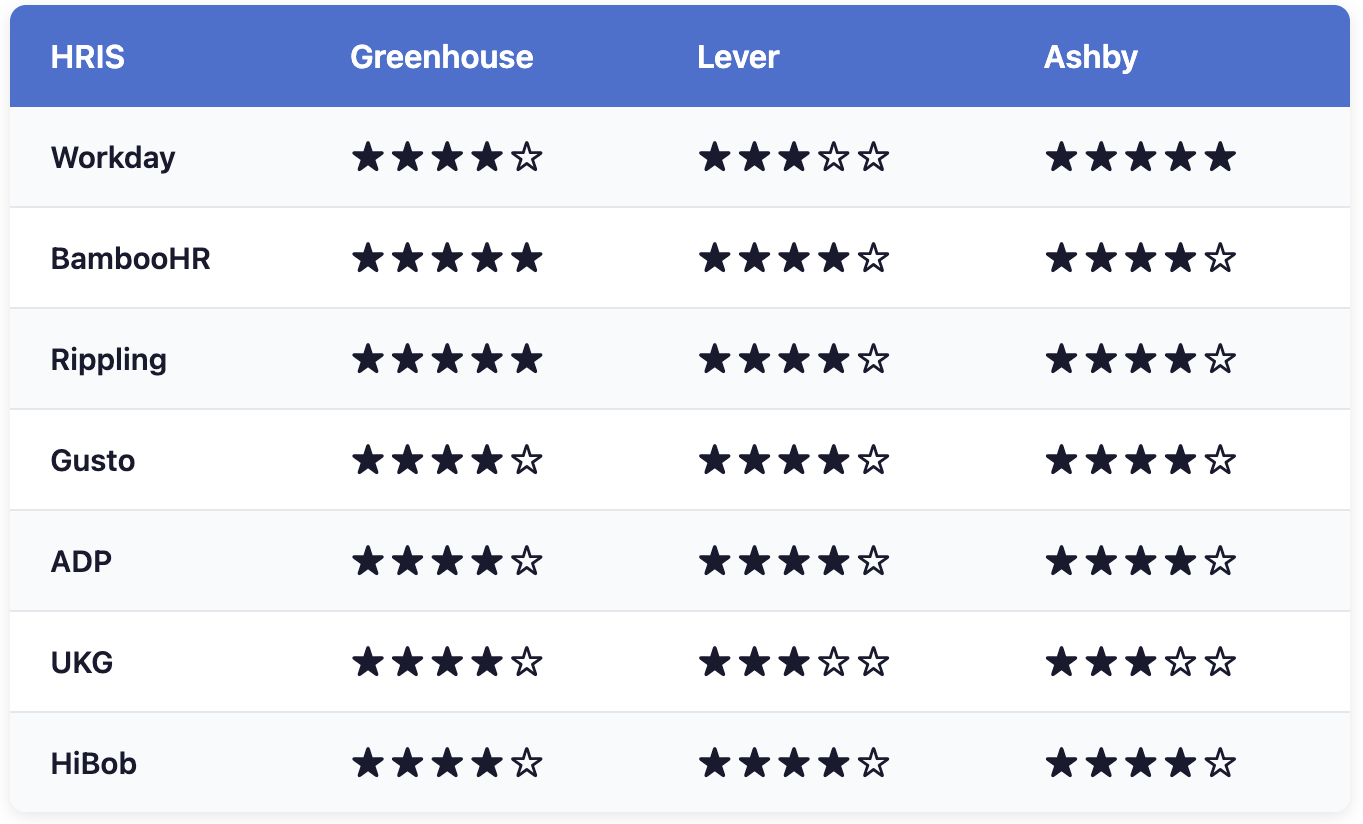
Note: Ashby's deep Workday integration is a standout—customers report completing the integration in 2-6 weeks without external consultants, compared to months with other ATS platforms.
Making Your Decision
The Greenhouse vs Lever vs Ashby decision depends on what matters most to your recruiting organization:
- If customization and scalability drive your decision: Greenhouse offers the deepest configurability and handles enterprise complexity that others can't match. You'll pay more and invest more in administration, but for large organizations with structured hiring processes, the investment pays off.
- If candidate experience and relationship management drive your decision: Lever's native CRM and beautiful design deliver exceptional candidate-facing experiences. For companies in competitive talent markets where employer brand matters, Lever helps you stand out.
- If analytics and modern simplicity drive your decision: Ashby represents the future of ATS—analytics at the core, all-in-one functionality, and flexible pricing. For data-driven teams willing to bet on a newer platform, Ashby offers the best combination of capability and value.
All three are significant upgrades from legacy ATS platforms. The differences aren't about quality—they're about fit. Choose based on your recruiting philosophy, team size, and what trade-offs you're willing to accept.
Need help deciding? OutSail advises companies on HR technology selection, including applicant tracking systems. We can help you evaluate options and find the right fit.


.png)
