OutSail vs Capterra: Moving From Software Lists to Strategic Matches
OutSail is the Capterra alternative for HR—offering HRIS selection expert help with curated vendor matches, structured demos, and contract guidance for confident decisions.

You've browsed the reviews, filtered the categories, and requested demos from six different vendors. Now what? Here's why HRIS selection expert help beats software directories—and how the business models behind each approach shape your results.
If you've ever searched for HR software, you've probably landed on Capterra.
It makes sense. Capterra aggregates thousands of software products, collects user reviews, and lets you filter by features, company size, and price range. For a quick gut check on whether a tool exists and what people think of it, review sites like Capterra serve a purpose.
But here's the question most HR leaders eventually ask: Why do I still feel stuck after spending hours on these sites?
The answer lies in something most people never consider: business models. How a company makes money shapes what it optimizes for. And when you look at how software review sites generate revenue versus how OutSail operates, the difference in outcomes becomes obvious.
The Business Model Problem Nobody Talks About
Capterra and similar review sites (G2, Software Advice, TrustRadius) make money in two primary ways:
- Pay-per-click advertising: Vendors pay when you click through to their website
- Pay-per-lead: Vendors pay when you request a demo or fill out a contact form
This creates an incentive structure worth examining. The platform succeeds when you click more links and book more demos. Ten demo requests are more profitable than three. The wider your search, the better their revenue.
There's nothing nefarious about this—it's just how the business works. But it means the platform has no financial incentive to help you narrow your options quickly or find the single best fit. In fact, the opposite is true.
OutSail's model works differently.
As an HR technology broker, OutSail receives a commission from whichever vendor you ultimately select. Not when you click. Not when you book a demo. When you complete a purchase.
This flips the incentive entirely. OutSail succeeds when you make a successful selection—ideally after evaluating just three or four perfectly aligned vendors rather than ten loosely relevant ones. Fewer demos with better matches means a higher likelihood you'll actually complete the purchase. That's good for you and good for OutSail.
The business model alignment isn't a marketing angle. It's the fundamental difference that shapes every other aspect of the experience.
Where Review Sites Stop (And Where Decisions Get Hard)
Here's the typical Capterra journey for an HR leader shopping for an HRIS:
- Search "HRIS software" or "payroll software"
- Apply some filters (company size, features needed)
- Read reviews, compare ratings
- Request demos from four to eight vendors who look promising
- ... Now what?
That fifth step is where review sites disappear. Their job is done once you've booked the meetings. But for you? The hard part is just beginning.
You now have six demos scheduled over the next three weeks with vendors who all claim to be perfect for your needs. Each demo is led by a skilled salesperson whose job is to highlight strengths and minimize weaknesses. You're furiously taking notes, trying to remember what Vendor B said about benefits integrations while Vendor D is showing you their time-tracking module.
After the demos, you're left comparing apples to oranges with no common framework. Your team has different opinions based on which features impressed them. The "best" choice often comes down to whoever gave the flashiest presentation or whose sales rep built the best rapport.
This is the reality of list-based software shopping. You get a starting point, but no finish line.
What HRIS Selection Expert Help Actually Looks Like
OutSail was built for everything that happens after the list—and increasingly, to help you skip the aimless list-browsing phase entirely.
Before Demos: Strategic Matching, Not Keyword Filtering
Review sites let you filter by category and features. OutSail does something different: outcome-based matching.
Instead of starting with "show me HRIS vendors with payroll," OutSail's process starts with your situation:
- What's broken about your current system?
- What does your team need to accomplish in the next one to three years?
- What's your realistic budget range?
- How fast do you need to implement?
- What existing systems need to integrate?
- What's your headcount today, and where will it be in three years?
With this context, OutSail's advisors—backed by a database of 220+ vendors and thousands of completed selections—deliver a curated shortlist of three to five vendors specifically matched to your requirements.
This isn't filtering. It's expertise applied to a specific situation. The difference shows up in the shortlist: fewer vendors, but dramatically better fit.
During Demos: Structure That Prevents Chaos
Remember the demo chaos problem? Six vendors, three weeks, no common framework, everyone remembers different things?
OutSail provides proprietary evaluation tools designed to solve exactly this:
Shared Scorecards: Your entire evaluation team scores each vendor against the same weighted criteria. Instead of subjective debates about who "felt" better, you have objective data showing where each vendor excels and where they fall short—mapped directly to your stated requirements.
Pre-Built Question Libraries: OutSail's platform includes challenging questions that go beyond vendor-prepared demos. These are designed to surface real capabilities, limitations, and gotchas that sales teams don't volunteer.
Centralized Workspace: Review vendor profiles, collaborate with your team, track your evaluation progress, and manage demo scheduling from one place. No more scattered notes across emails, docs, and memory.
The goal isn't just to survive the demo process—it's to make the demos actually useful for decision-making.
After Demos: The Part Review Sites Don't Touch
Here's where the gap between list-based shopping and expert guidance becomes a canyon.
Proposal Review: Vendors send proposals filled with line items, fees, and terms that most HR leaders see once every five to seven years. What's a fair implementation fee? Is that per-employee-per-month rate competitive? Should you push back on the contract length?
OutSail's advisors review your proposals against a database of thousands of HRIS contracts. They know what's negotiable, what's inflated, and what questions to ask. Clients routinely save 10–20% on their final contracts with this insight.
Negotiation Strategy: Beyond benchmarking, OutSail provides specific talking points for negotiations. This isn't generic advice—it's tailored to the specific vendor, the specific deal, and your specific leverage points.
Implementation Partner Network: Buying the software is only half the battle. A poor implementation can sink even the best HRIS choice. OutSail maintains relationships with implementation consultants across the vendor ecosystem, so when you need support beyond what the vendor provides, you're not starting from scratch.
None of this exists in the review site model. They're optimized to generate leads, not to ensure successful outcomes.
A Side-by-Side Comparison
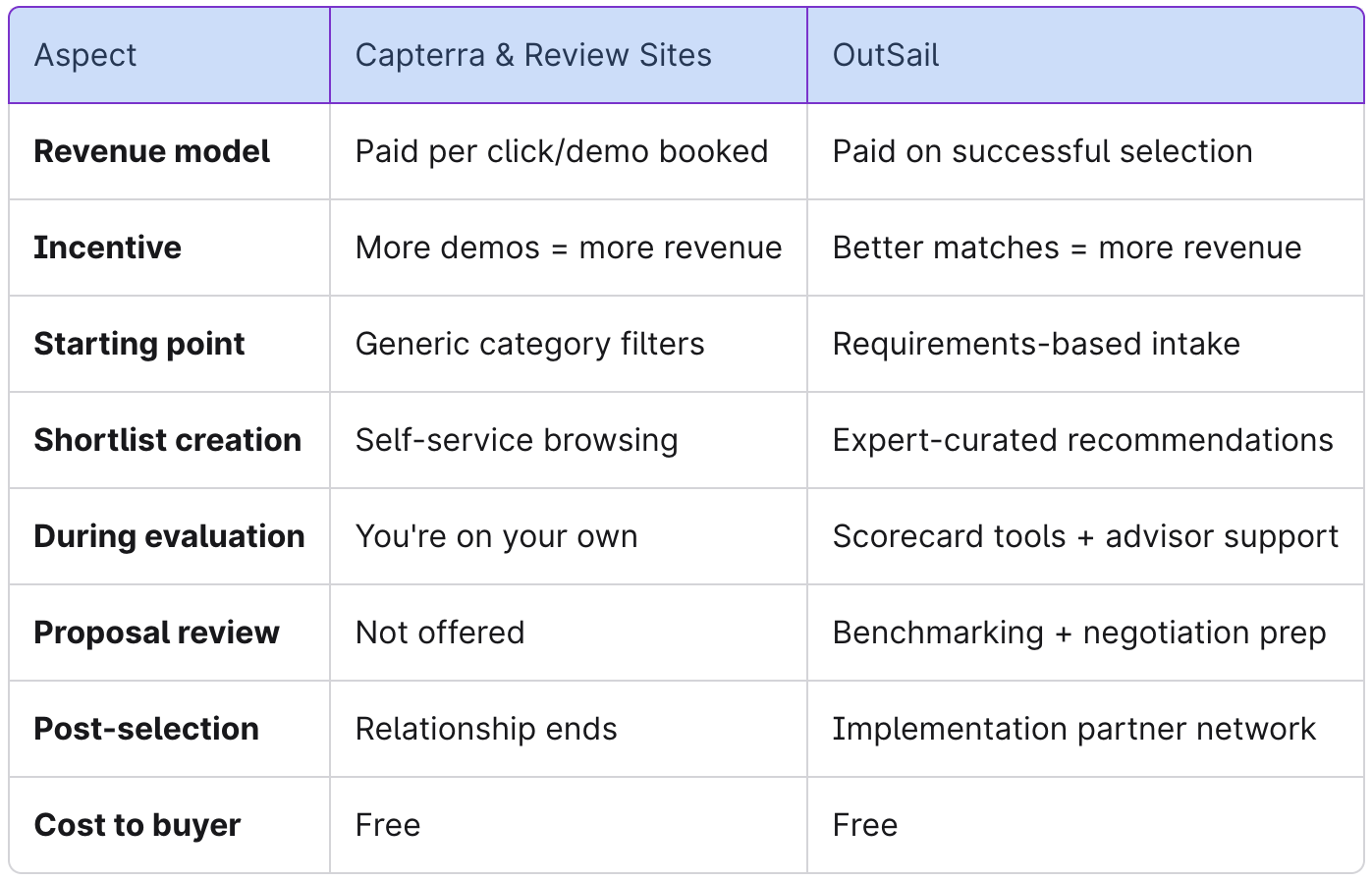
Both are free to use. But "free" means very different things when the underlying business models create different outcomes.
When Review Sites Still Make Sense
To be fair, Capterra and similar platforms aren't useless. They serve real purposes:
Early-stage awareness: If you genuinely don't know what categories of HR software exist, browsing a directory helps you get oriented.
Quick sanity checks: Wondering if a vendor you've heard of has a terrible reputation? A quick review scan can flag obvious red flags.
Commodity software purchases: For simple, low-stakes tools where the decision isn't that consequential, self-service browsing may be sufficient.
But for HRIS selection—a decision that affects every employee, costs tens of thousands of dollars (or more), and locks you in for three to five years—the review site approach falls short precisely when you need the most help.
The Real Question: What Are You Optimizing For?
If you're optimizing for activity—lots of demos, lots of options, lots of tabs open—review sites deliver.
If you're optimizing for outcomes—the right system, purchased at the right price, implemented successfully—you need something built for that goal.
OutSail exists because those two things aren't the same. Browsing a list of 50 HRIS vendors sorted by star ratings isn't vendor evaluation. It's noise disguised as information.
Real vendor evaluation means:
- Starting with your specific requirements, not generic filters
- Comparing three to four right-fit vendors, not eight semi-relevant ones
- Using structured tools to make demos actually comparable
- Having expert guidance when proposals arrive
- Negotiating with real market data, not guesswork
That's the difference between finding software and making a successful selection.
Moving From Lists to Strategic Matches
OutSail's platform was built to replace the chaos of list-based shopping with a structured, outcome-focused process.
You get a dedicated advisor who learns your situation. You receive a curated shortlist within days—not a list of everyone who paid for placement, but a tailored set of vendors matched to your requirements. You evaluate with shared scorecards and challenging questions. You negotiate with benchmarking data. You implement with partner support if needed.
And it costs you nothing, because the business model is aligned with your success.
That's not a better version of Capterra. It's a fundamentally different approach to HRIS selection.
Ready to move from software lists to strategic matches?
Learn More About the OutSail Platform →
OutSail is a free HR technology broker that partners with 220+ vendors to provide expert guidance throughout the HRIS selection process. From requirements gathering to contract negotiation, OutSail's tools and advisors are designed to help you make a confident, successful selection—not just book more demos.

.png)
