OutSail vs Big 4 Consulting Firms: Right-Sized HRIS Advisory for Growing Companies
OutSail outperforms Big 4 consulting firms for HRIS selection with right-sized expertise, faster timelines, real pricing data, and mid-market HR software advisory—at no cost.


When you're making a major technology decision, there's comfort in big names.
Deloitte. PwC. EY. KPMG. These firms have advised Fortune 500 companies for decades. They have thousands of consultants, global reach, and brand recognition that makes procurement committees feel safe.
So when mid-market companies face an HRIS decision, some instinctively look toward the Big 4. If they're good enough for enterprises, surely they can help a 500-person company pick HR software, right?
The logic is understandable. But it misses a fundamental truth about how Big 4 consulting actually works—and why their model is structurally misaligned with what growing companies need.
This isn't about whether Deloitte or PwC employs smart people. They do. It's about whether their business model, expertise, and service delivery make sense for a mid-market HRIS selection. In most cases, they don't.
Let's break down why—and what affordable HR tech consulting looks like when it's actually designed for companies like yours.
The Big 4 Business Model: Built for Enterprises, By Design
The Big 4 consulting firms didn't become billion-dollar businesses by serving 300-person companies. They built their models around enterprise clients with enterprise budgets.
This shapes everything about how they operate:
Minimum engagement sizes. Big 4 firms typically have minimum project thresholds of $100,000–$500,000+. A mid-market HRIS selection—which might reasonably cost $20,000–$40,000 through a boutique consultancy—simply doesn't meet their minimums. If they take the project at all, you're either paying enterprise rates for mid-market work or getting junior resources because the project doesn't justify senior attention.
Staffing models built for scale. Big 4 projects are staffed with pyramids: partners at the top, managers in the middle, and armies of analysts at the bottom. This model works for massive transformation programs. For a focused HRIS selection, you're paying for overhead that adds no value.
Enterprise-centric knowledge bases. When Big 4 consultants think about HRIS, they think about Workday, SAP SuccessFactors, and Oracle HCM—the platforms their enterprise clients use. Their knowledge of the mid-market landscape (Paylocity, Paycom, UKG Ready, Rippling, Namely, BambooHR, and dozens of others) is often thin because those vendors aren't relevant to their typical client base.
Long sales cycles and slow delivery. Big 4 firms move at enterprise pace. Proposals take weeks. Scoping takes weeks. Projects kick off months after initial conversations. For a growing company that needs to make an HRIS decision before open enrollment or a funding milestone, this timeline is a dealbreaker.
The Big 4 aren't trying to serve mid-market companies poorly. They're simply not trying to serve them at all. Their entire operation is optimized for a different client profile.
The Specialization Gap: HRIS Expertise Under 5,000 Employees
Here's a question most companies don't think to ask: How much does this consultant actually know about HRIS for companies our size?
For Big 4 firms advising on HR technology, the honest answer is often "not much."
Why Enterprise HRIS Knowledge Doesn't Transfer
The HRIS market for companies with 5,000+ employees looks completely different than the market for companies with 200–2,000 employees:
Different vendors dominate. Enterprise HRIS is a three-horse race: Workday, SAP SuccessFactors, and Oracle HCM. Mid-market HRIS has 30+ legitimate contenders, each with different strengths, sweet spots, and limitations. A consultant who knows Workday inside-out may have never evaluated Paycom, Rippling, or UKG Ready.
Different evaluation criteria matter. Enterprises evaluate HRIS on global scalability, complex org structures, and integration with massive ERP systems. Mid-market companies care about ease of implementation, responsive support, and whether the platform works well for their specific headcount range. The questions you should ask are fundamentally different.
Different pricing structures apply. Enterprise HRIS deals are negotiated with procurement teams over months, with pricing influenced by global volume and multi-year commitments. Mid-market deals move faster and follow different patterns. A consultant whose pricing benchmarks come from Workday enterprise deals has no relevant data for a Paylocity mid-market negotiation.
Different implementation realities exist. Enterprise HRIS implementations take 12–24 months with dedicated internal teams. Mid-market implementations should take 8–16 weeks and often rely more heavily on vendor-provided support. Consultants who only know enterprise timelines will scope projects (and budgets) inappropriately.
Big 4 consultants may be excellent at what they do—advising Fortune 500 companies on complex global HR transformations. But that expertise doesn't translate to helping a 400-person company choose between Paylocity, Paycor, and Namely.
The Depth Problem
Even within the mid-market, HRIS selection requires specialized knowledge that generalist consultants don't have:
- Which vendors perform best for manufacturing versus tech versus healthcare?
- Which platforms handle multi-state payroll complexity well?
- Which vendors have the best benefits administration for companies using a specific broker?
- How do different vendors compare on implementation support quality?
- What are the real-world limitations that don't show up in demos?
This knowledge comes from doing HRIS selections repeatedly, across hundreds of clients, with continuous feedback on what worked and what didn't. It doesn't come from occasionally helping an enterprise client add an HRIS module to their Workday deployment.
OutSail's approach: One hundred percent of OutSail's business is HR technology advisory, with particular depth in the mid-market. The team has completed 1,000+ selections, maintains active relationships with 220+ vendors, and continuously updates knowledge based on client outcomes. When you ask "how does Vendor X actually perform for companies like ours?", the answer comes from direct, recent experience—not extrapolation from enterprise engagements.
The Upsell Problem: When Selection Is Just the Foot in the Door
This is the part of Big 4 consulting that rarely gets discussed openly.
For Big 4 firms, HRIS selection projects aren't a core business. They're a wedge—a way to establish a client relationship that leads to larger, more profitable engagements.
The real money in Big 4 consulting comes from:
- Implementation services: Multi-million-dollar projects to deploy and configure the systems they helped you select
- Managed services: Ongoing outsourcing of HR operations and technology management
- Transformation programs: Large-scale change initiatives that extend over years
- Staff augmentation: Placing contractors in client organizations for extended periods
An HRIS selection project—even at $100,000+—is small potatoes compared to these revenue streams. Which means the selection engagement isn't really about finding you the best HRIS. It's about positioning for the follow-on work.
How This Bias Shows Up
The upsell incentive distorts HRIS selection in predictable ways:
Recommendations favor complexity. A Big 4 firm makes more money implementing Workday than implementing Rippling. Consciously or not, this creates pressure to recommend platforms that require more implementation support—even when a simpler solution would serve the client better.
"Transformation" framing inflates scope. What should be a straightforward HRIS selection becomes a "digital HR transformation initiative" with change management workstreams, process redesign phases, and organizational readiness assessments. Each addition increases the consulting bill without necessarily improving the outcome.
Vendor relationships create conflicts. Big 4 firms have partnership agreements with major enterprise HRIS vendors. These relationships include revenue sharing, co-marketing arrangements, and certification incentives. Recommending a vendor outside these partnerships means leaving money on the table.
Timeline extensions serve consultant revenue. A drawn-out selection process bills more hours. There's no incentive to help you decide quickly and move on.
None of this requires malicious intent. It's just how incentives work. When a firm's business model depends on expanding engagements, every interaction is filtered through that lens.
OutSail's approach: OutSail has no implementation services, no managed services contracts, and no consulting staff to place. The business model is simple: help you select the right vendor, and receive a commission from that vendor when you sign. There's no downstream revenue that would bias recommendations toward more complicated (or more expensive) platforms. The incentive is purely to find the best fit—because that's what leads to completed purchases.
The Timeline Reality: Enterprise Pace vs. Growing Company Needs
Time is often the most undervalued factor in an HRIS selection.
Growing companies face real deadlines: open enrollment windows, funding round milestones, compliance requirements, or simply the operational pain of running on spreadsheets and disconnected systems. Every week the selection drags on is another week of workarounds and frustration.
Big 4 consulting firms operate on a different clock:
Sales cycles measured in months. Initial conversations, capability presentations, formal proposals, legal review, contract negotiation—Big 4 business development moves at glacial pace. You might spend eight weeks just getting to a signed engagement letter.
Scoping and discovery phases. Before any actual vendor evaluation begins, expect weeks of requirements gathering, stakeholder interviews, and current-state documentation. This phase often produces impressive deliverables that don't actually accelerate your decision.
Deliberate, documented processes. Big 4 firms produce comprehensive analyses with extensive documentation. This thoroughness serves enterprise clients who need audit trails and board-ready materials. For a mid-market company, it's often overkill that extends timelines without improving outcomes.
Resource allocation delays. Big 4 firms juggle hundreds of engagements. Even after signing, you may wait weeks for the right team members to become available.
A Big 4 HRIS selection engagement commonly runs four to six months from initial contact to recommendation. For enterprises with 18-month planning horizons, that's acceptable. For a 600-person company that needs a new system before January 1st, it's impossible.
OutSail's approach: From first conversation to signed vendor contract, OutSail engagements typically run four to eight weeks. You receive a curated shortlist within days of completing requirements intake. Evaluation tools are ready immediately—no custom development required. Advisors are available responsively, not on a consultant's billing schedule. The process moves at the speed of your decision-making, not the speed of enterprise consulting bureaucracy.
Comparing the Models: What You Actually Get
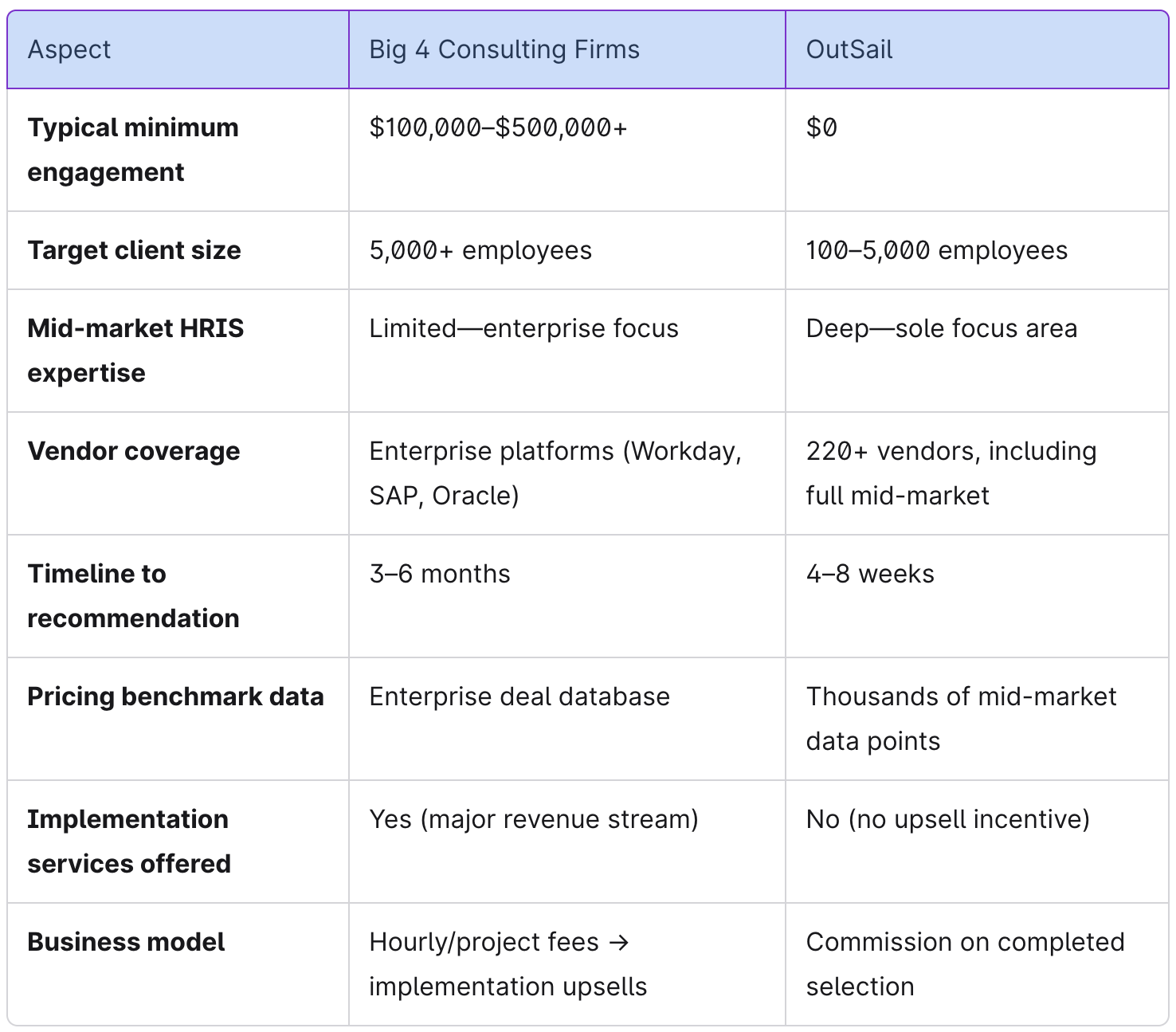
The pattern is clear: Big 4 firms are optimized for a client profile, project scope, and timeline that doesn't match mid-market HRIS selection. OutSail is purpose-built for exactly this use case.
When Big 4 Engagement Does Make Sense
To be fair, there are scenarios where Big 4 consulting is appropriate for HR technology decisions:
True enterprise scale. If you're a 10,000+ employee global organization selecting Workday, SAP SuccessFactors, or Oracle HCM, Big 4 firms have genuine expertise and the scale to support complex implementations across multiple countries and entities.
Massive transformation programs. If HRIS selection is one component of a broader HR transformation involving operating model redesign, shared services implementation, and global process standardization, the Big 4 model makes more sense.
Board-level requirements. Some organizations have governance requirements that mandate engagement with established consulting firms for major technology decisions. If your board expects a Big 4 name on the recommendation, that's a legitimate constraint.
Political cover. In large organizations, recommending a vendor carries career risk. "Deloitte recommended it" provides cover that "we used a free broker" might not offer in certain corporate cultures.
For a 400-person company choosing between Paylocity, Paycom, and UKG Ready? None of these scenarios apply. The Big 4 model is simply misaligned with the need.
What Right-Sized HRIS Advisory Looks Like
Mid-market companies don't need enterprise consulting. They need:
Specialized expertise in their market segment. Advisors who know the mid-market HRIS landscape deeply—not as a side specialty, but as their entire focus. Who know how Paycom differs from Paylocity in practice, not just on a feature checklist. Who can tell you which vendors work well for companies with your specific profile.
Speed that matches their reality. A process that delivers a curated shortlist in days, not months. Tools that are ready to use immediately. Advisors who respond on your timeline, not a billing schedule.
Pricing data that's actually relevant. Negotiation leverage based on thousands of mid-market deals, not enterprise contract benchmarks that don't apply to your situation.
Aligned incentives. An advisor whose success depends entirely on finding you the right solution—not on expanding the engagement or winning implementation work.
Affordability. Advisory that doesn't consume a material portion of your total HRIS budget before you've even selected a vendor.
This is what OutSail was built to provide.
The OutSail Experience for Mid-Market Companies
If you've only experienced enterprise consulting (or no external guidance at all), here's what working with OutSail looks like:
Phase 1: Requirements Intake (Days 1–3)
You complete a structured requirements intake—not a months-long discovery phase, but a focused survey that captures what you actually need: headcount, growth trajectory, must-have modules, integration requirements, budget range, and timeline constraints.
Phase 2: Curated Shortlist (Days 4–7)
Based on your requirements, you receive a detailed shortlist of three to five vendors specifically matched to your situation. Each recommendation includes:
- Pricing estimates based on thousands of mid-market data points
- Pros and cons as they relate to your specific requirements
- Real user feedback from companies similar to yours
- Key questions to ask during demos
No wading through 50 options. No guessing about which vendors serve your segment. Just actionable recommendations you can move on immediately.
Phase 3: Structured Evaluation (Weeks 2–4)
As you demo your shortlisted vendors, OutSail provides:
- Shared scorecards so your team evaluates every vendor against consistent criteria
- Question libraries designed to surface real capabilities and limitations
- Advisor availability to answer questions, interpret vendor responses, and keep the process on track
The demos you take are with right-fit vendors. The evaluation produces objective data, not just subjective impressions.
Phase 4: Proposal Review and Negotiation (Weeks 4–6)
When vendors submit proposals, your advisor benchmarks them against OutSail's database of thousands of HRIS contracts:
- Is the per-employee pricing competitive for your size and requirements?
- How do implementation fees compare to similar deals?
- What discounts have other companies secured with this vendor?
- Which contract terms should you push back on?
You negotiate with data, not hope. Clients routinely save 10–20% on their final contracts.
Phase 5: Selection and Beyond
Once you've made your decision, OutSail doesn't disappear. If you need implementation support beyond what the vendor provides, OutSail connects you with vetted partners—no markup, no upsell, just access to the right resources.
The entire process typically completes in four to eight weeks—not four to six months.
The Real Question: What Does Your Company Actually Need?
Big 4 firms built impressive businesses serving Fortune 500 enterprises. They have smart people, established methodologies, and brand names that inspire confidence in boardrooms.
But none of that matters if their model doesn't fit your situation.
Mid-market HRIS selection requires specialized expertise in a market segment the Big 4 largely ignore. It requires speed that enterprise consulting can't deliver. It requires pricing benchmarks from deals that Big 4 firms never see. And it requires incentives aligned with finding the right solution—not expanding the engagement.
OutSail exists because growing companies deserve expert guidance without enterprise price tags, enterprise timelines, or enterprise conflicts of interest.
That's not a criticism of the Big 4. It's an acknowledgment that different companies need different things—and that right-sized advisory delivers better outcomes than forcing a mid-market need into an enterprise-shaped solution.
Ready to see what HRIS advisory looks like when it's built for companies like yours? Meet Your Advisor
OutSail is a free HR technology broker that has helped over 1,000 mid-market companies—including DoorDash, Hudl, and Aurora—research, evaluate, and select the right HRIS. With deep expertise in the 100–5,000 employee segment and partnerships across 220+ vendors, OutSail provides the specialized guidance growing companies need without the enterprise consulting price tag.

.png)
