Mid-Market HRIS Buying Mistakes: 7 Errors Companies Make at 200–2,000 Employees
Choosing the best HRIS systems for mid-market companies? Avoid these 7 costly mistakes that derail selection at 200–2,000 employees and waste months of effort.

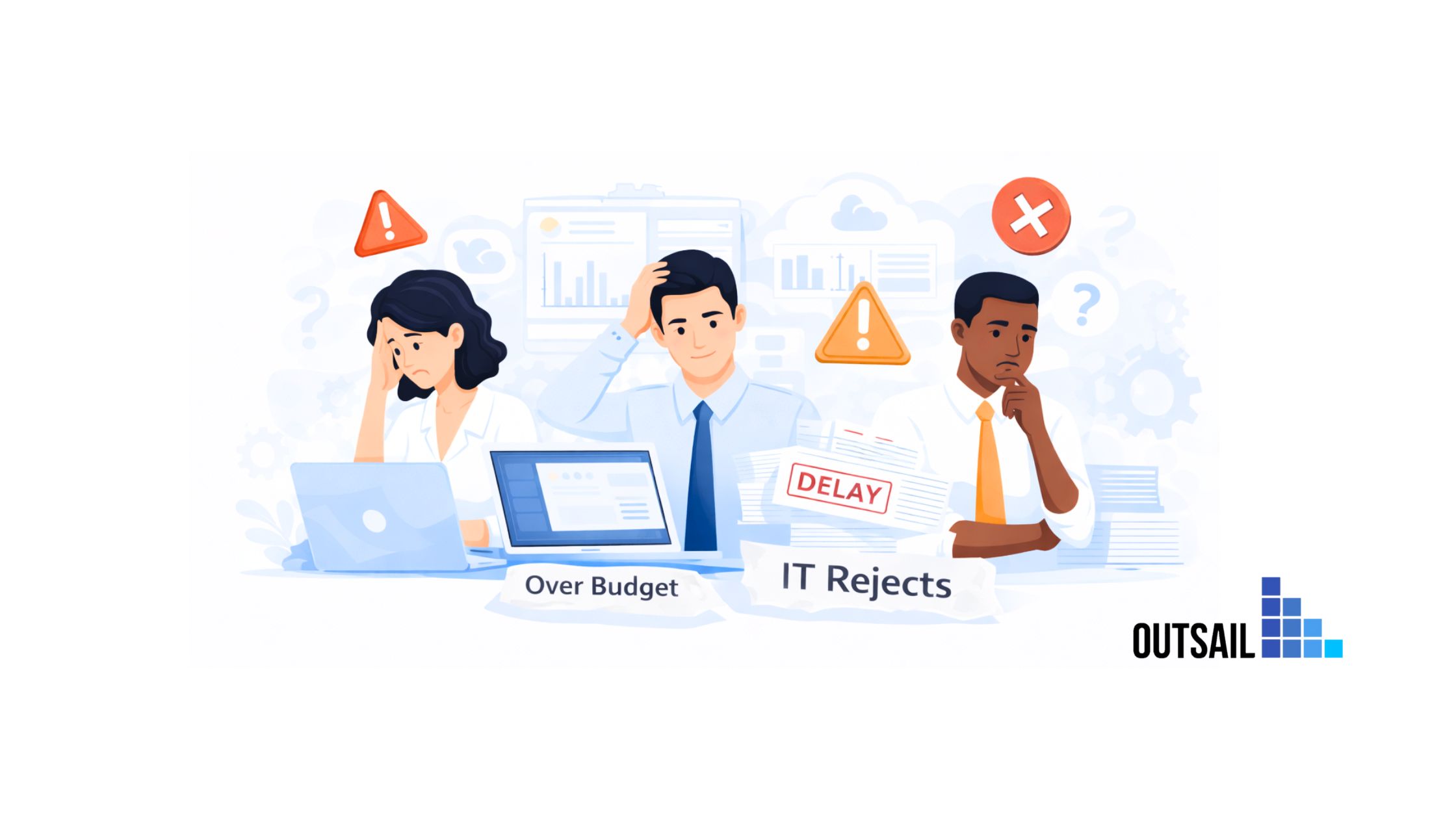
The mid-market HRIS buying process is uniquely painful. You're too big for small business software but too small for the white-glove enterprise treatment. Vendors see you as a volume play, implementations get templated, and mistakes get expensive fast.
After guiding hundreds of mid-sized companies through HRIS selection, we've watched the same errors derail projects over and over. Here are the seven mistakes that cost companies the most time, money, and sanity.
Mistake #1: Prioritizing Features Over Outcomes
The most common trap in HRIS selection is building a checklist of features and picking the vendor with the most checkmarks. It feels logical. It's also backwards.
What goes wrong:
A 400-person company decides they need an HRIS with advanced succession planning, AI-powered analytics, predictive turnover modeling, and automated career pathing. They select the platform with the most sophisticated talent management suite. Eighteen months later, they've never touched succession planning, the AI features require data they don't have, and they're frustrated that basic payroll takes too many clicks.
They bought features. They needed outcomes.
How to fix it:
Start with problems, not features. Before looking at any vendor, answer these questions:
- What's broken today that we need to fix?
- What takes too much time that we need to automate?
- What can't we do today that we need to enable?
- What compliance risks are we carrying that we need to eliminate?
Then translate those problems into measurable outcomes:
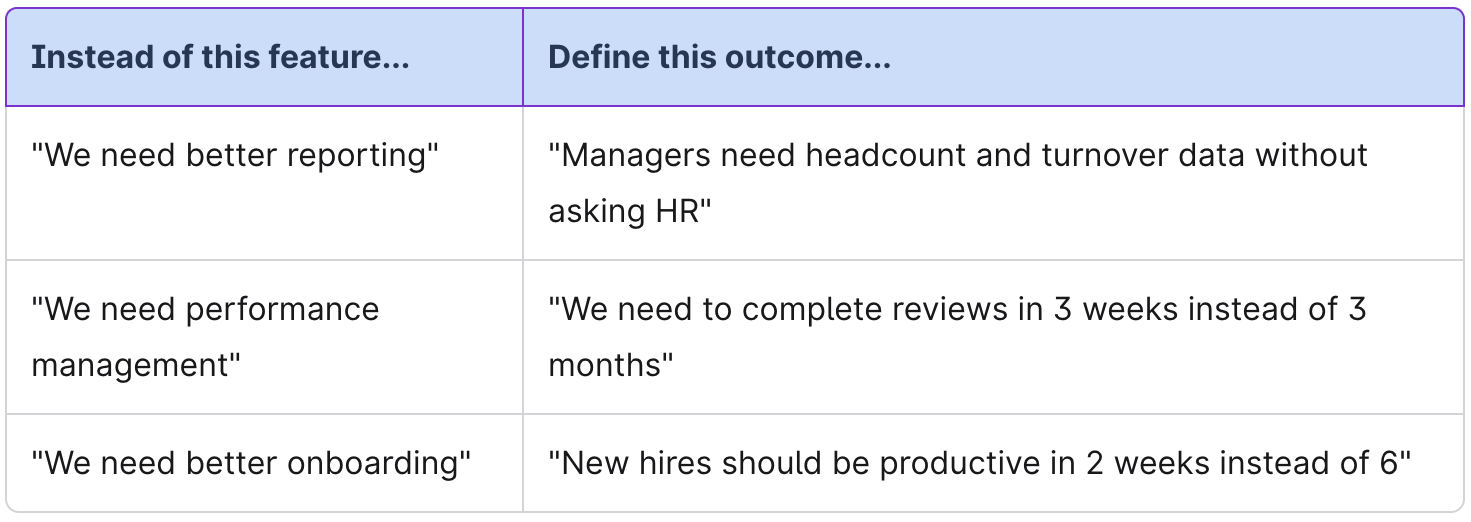
When you evaluate platforms against outcomes, you'll make better decisions—and you'll have clear success metrics for your implementation.
See our guide to defining HRIS requirements
Mistake #2: Not Building Internal Consensus Early
HRIS projects die in committee. We've seen companies spend six months evaluating vendors only to have the CFO kill the project because "we didn't budget for this" or have IT reject the finalist because "it doesn't meet our security requirements."
What goes wrong:
HR leads the selection process in isolation. They find the perfect platform, negotiate pricing, and bring it to leadership for approval. Then:
- Finance questions the ROI and asks for a three-year cost analysis nobody prepared
- IT flags security concerns that weren't addressed during evaluation
- Operations wants to know why their scheduling needs weren't considered
- The CEO asks why this is a priority when they're trying to cut costs
The project stalls. Momentum dies. Six months of work goes nowhere.
How to fix it:
Build your buying coalition before you talk to a single vendor:
Identify stakeholders early:
- Executive sponsor (usually CHRO, CFO, or COO)
- Budget owner (whoever controls the money)
- IT/Security (they'll have requirements you need to know upfront)
- Key department heads (Operations, Finance, Sales—whoever will use the system)
- End users (managers and employees who interact with HR systems daily)
Align on the "why" before the "what":
- Why are we doing this now?
- What happens if we don't?
- What does success look like?
- What's our realistic budget range?
- What's our timeline, and what's driving it?
Create a decision framework:
- Who has input vs. who has veto power?
- What criteria matter most to each stakeholder?
- How will we make the final decision?
Getting this alignment upfront takes 2-4 weeks. Skipping it risks losing 6-12 months.
Mistake #3: Misunderstanding Your Buying Window
Every company has internal rhythms that affect when purchases can happen. Ignore these rhythms, and your perfect vendor selection crashes into budget cycles, board meetings, or executive bandwidth.
What goes wrong:
An HR leader starts evaluating HRIS vendors in September, excited to have a new system in place for the new year. They run a thorough process, select a finalist in November, and bring it to the CFO for approval.
The CFO says: "This is great, but our fiscal year ends in December. The budget for next year was locked in October. We can't add a $200K expense now. Let's revisit this in Q2."
Four months of work. Zero progress.
How to fix it:
Map your internal buying windows before you start:
Budget cycles:
- When does your fiscal year start?
- When are budgets finalized?
- Is there discretionary spending authority, and what's the threshold?
- Are there capital vs. operating expense implications?
Executive availability:
- When are board meetings that consume leadership attention?
- When are strategic planning cycles?
- When are executives traveling or distracted by other priorities?
Business cycles:
- When is your busy season?
- When do you have bandwidth for implementation?
- Are there compliance deadlines driving timing (open enrollment, year-end)?
Work backwards from your target go-live:
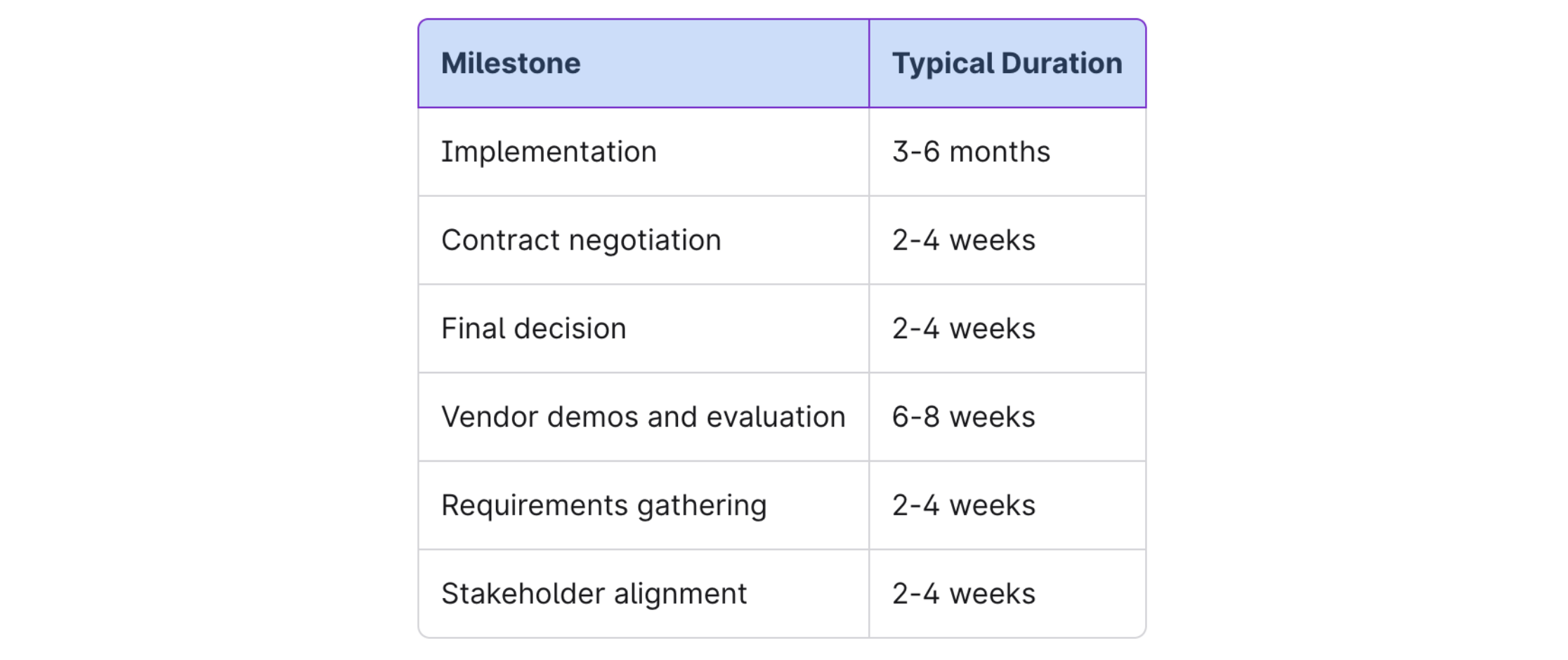
If you want to go live by January 1, you needed to start in April. If you're starting in September, you're looking at a spring go-live at best.
Mistake #4: Meeting with Too Many Vendors
More options should mean better decisions, right? In HRIS selection, the opposite is often true. Meeting with too many vendors creates confusion, delays, and decision fatigue.
What goes wrong:
A company decides to be "thorough" and invites eight vendors to demo. Each demo takes 90 minutes plus prep and follow-up. The evaluation team sits through 12+ hours of demos over six weeks. By vendor five, they can't remember what vendor two showed them. Features blur together. Everyone has a different favorite. The team argues about criteria that should have been settled before demos started.
Three months later, they're still debating. Leadership loses patience. The project gets shelved.
How to fix it:
Limit your shortlist to 3-4 vendors. This is enough to see market options without creating chaos. If you can't narrow to 3-4, your requirements aren't clear enough.
Create tiers:
- Tier 1: 3-4 vendors who get full demos
- Tier 2: 2-3 vendors you'll consider if Tier 1 doesn't work out
- Eliminated: Everyone else (with documented reasons)
Use discovery calls to narrow, not demos: Before investing 90 minutes in a demo, do a 30-minute discovery call:
- "Here's our situation. Here are our must-haves. Can you support this?"
- "Here's our budget range. Are we in your wheelhouse?"
- "Here's our timeline. Can you implement by then?"
Half of vendors will disqualify themselves. Now you're down to a manageable shortlist.
Compare top mid-market HRIS vendors
Mistake #5: Showing Up to Demos Unprepared
Vendors are professional demo-givers. They know how to make their software look incredible. Without preparation, you'll see what they want to show you—not what you need to evaluate.
What goes wrong:
The evaluation team shows up to demos with vague instructions: "Show us everything." The vendor runs their standard dog-and-pony show, highlighting their best features and glossing over weaknesses. Everyone nods along. At the end, someone asks, "So what did you think?" and gets a range of impressions based on whatever stuck in each person's memory.
Different team members focused on different things. Nobody asked about the workflows that matter most. Critical requirements got skipped. The team can't compare vendors because they saw different things in each demo.
How to fix it:
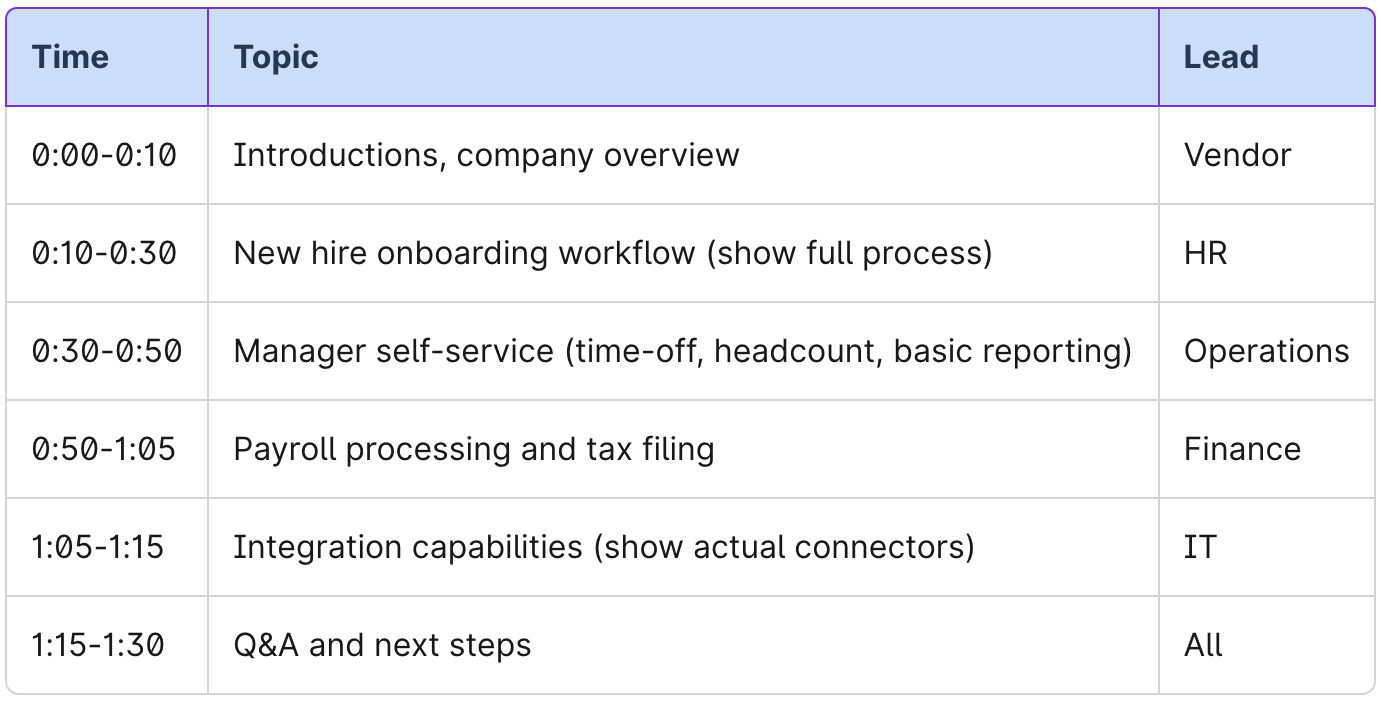
Create a demo agenda and send it to vendors in advance:
Your agenda should include:
- Specific scenarios you want to see (not features—scenarios)
- Questions you need answered
- Time allocated for each section
- Who from your team is attending and their role
Example demo agenda:
Build a scorecard before the first demo:
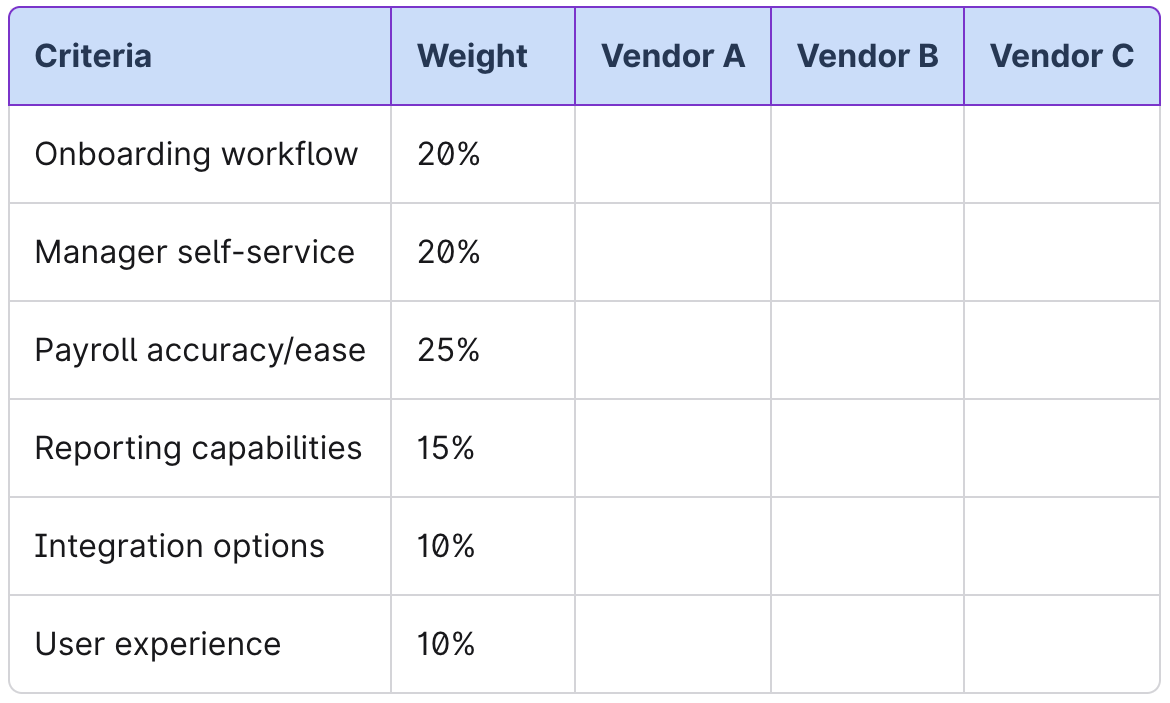
Score immediately after each demo while impressions are fresh. Compare scores, not memories.
Assign roles:
- Facilitator: Keeps demo on agenda, manages time
- Note-taker: Documents key points, captures follow-up questions
- Evaluators: Score against criteria, ask clarifying questions
Mistake #6: Not Negotiating
HRIS pricing is not fixed. The number on the proposal is a starting point, not a final offer. Companies that don't negotiate leave 15-30% on the table.
What goes wrong:
A company receives proposals from three finalists. They compare the numbers, pick the lowest price, and sign. They never asked for discounts, never pushed back on implementation fees, and never negotiated contract terms.
Later, they learn a similar company got 25% off the same platform. They're locked into a three-year contract with no price protection. Implementation fees that seemed standard were actually negotiable.
How to fix it:
Everything is negotiable:
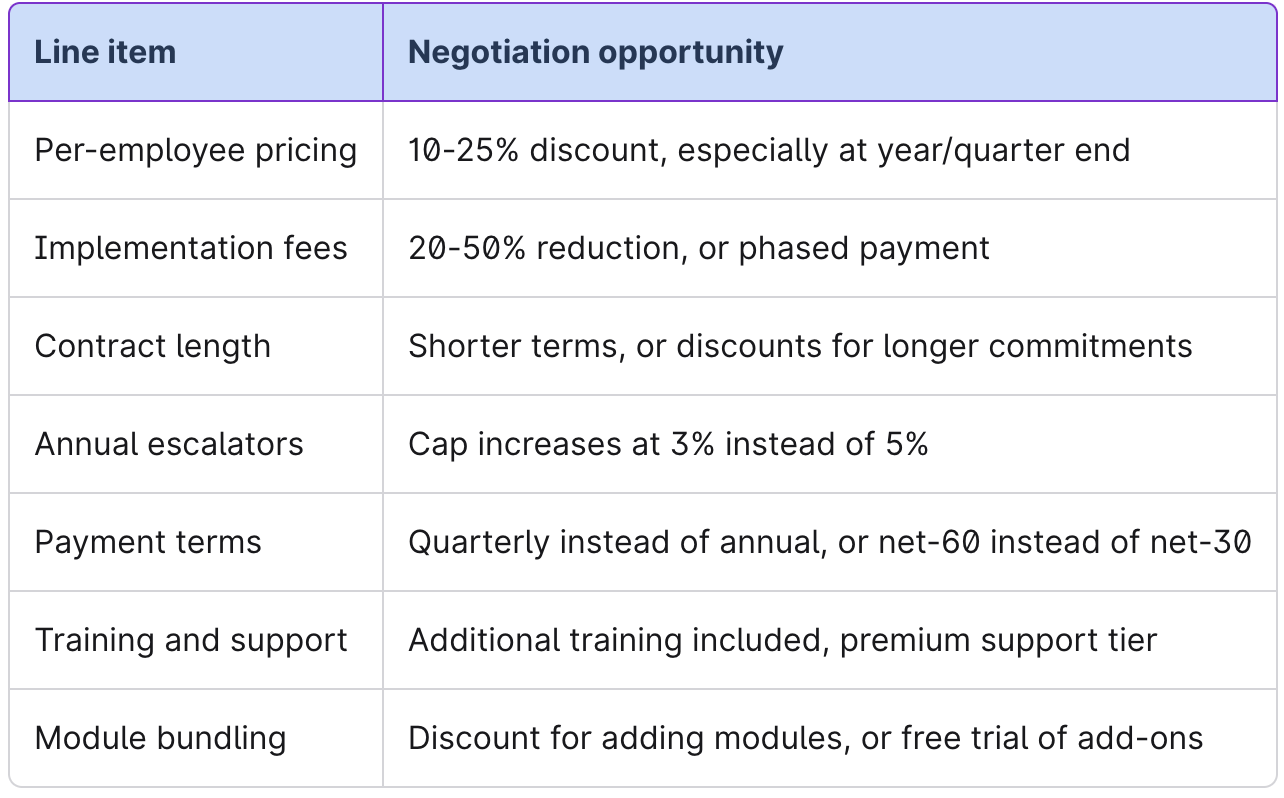
Leverage your position:
- Timing: Vendors discount heavily at quarter-end and year-end to hit targets
- Competition: Let vendors know they're competing (but don't bluff)
- Volume: Growing companies can negotiate based on projected headcount
- Reference: Some vendors discount for case studies or references
- Multi-year: Longer commitments often unlock better pricing
Get everything in writing: Verbal promises mean nothing. If a vendor commits to pricing, implementation support, or feature delivery, it goes in the contract or it doesn't count.
See our HRIS pricing negotiation guide
Mistake #7: Thinking the Job Is Done at Selection
Selecting a vendor feels like crossing the finish line. It's actually the starting gun. Implementation is where HRIS projects succeed or fail—and most companies underestimate what it takes.
What goes wrong:
After months of evaluation, the team celebrates selecting their new HRIS. They hand the project to a junior HR coordinator with instructions to "work with the vendor on implementation." Leadership moves on to other priorities.
Six months later, the implementation is behind schedule. Data migration is a mess. Managers weren't trained and are frustrated. Employees are confused. The vendor blames the company for not providing resources. The company blames the vendor for overpromising.
The system goes live anyway, half-configured. Two years later, they're evaluating replacements.
How to fix it:
Staff the implementation properly:
Implementation requires dedicated resources. At minimum:
- Project manager: Someone who owns the timeline and decisions (ideally not the same person running day-to-day HR)
- Subject matter experts: People who know your current processes and data
- Technical resource: Someone to handle integrations, data, and security
- Executive sponsor: Leadership who can remove obstacles and make decisions
For a 200-2,000 employee company, expect implementation to consume 20-40% of your project lead's time for 3-6 months.
Treat implementation as a project, not a task:
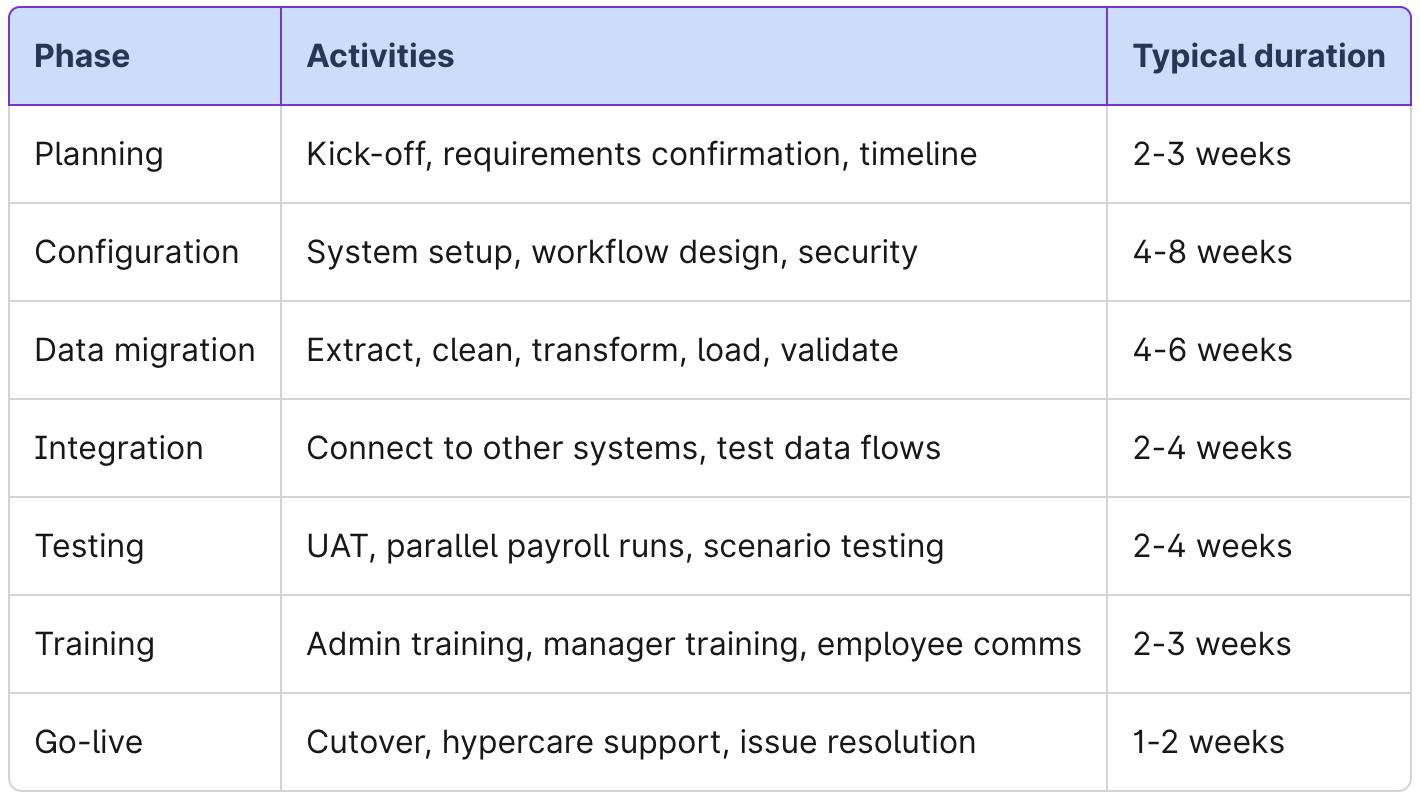
Budget for the hidden costs:
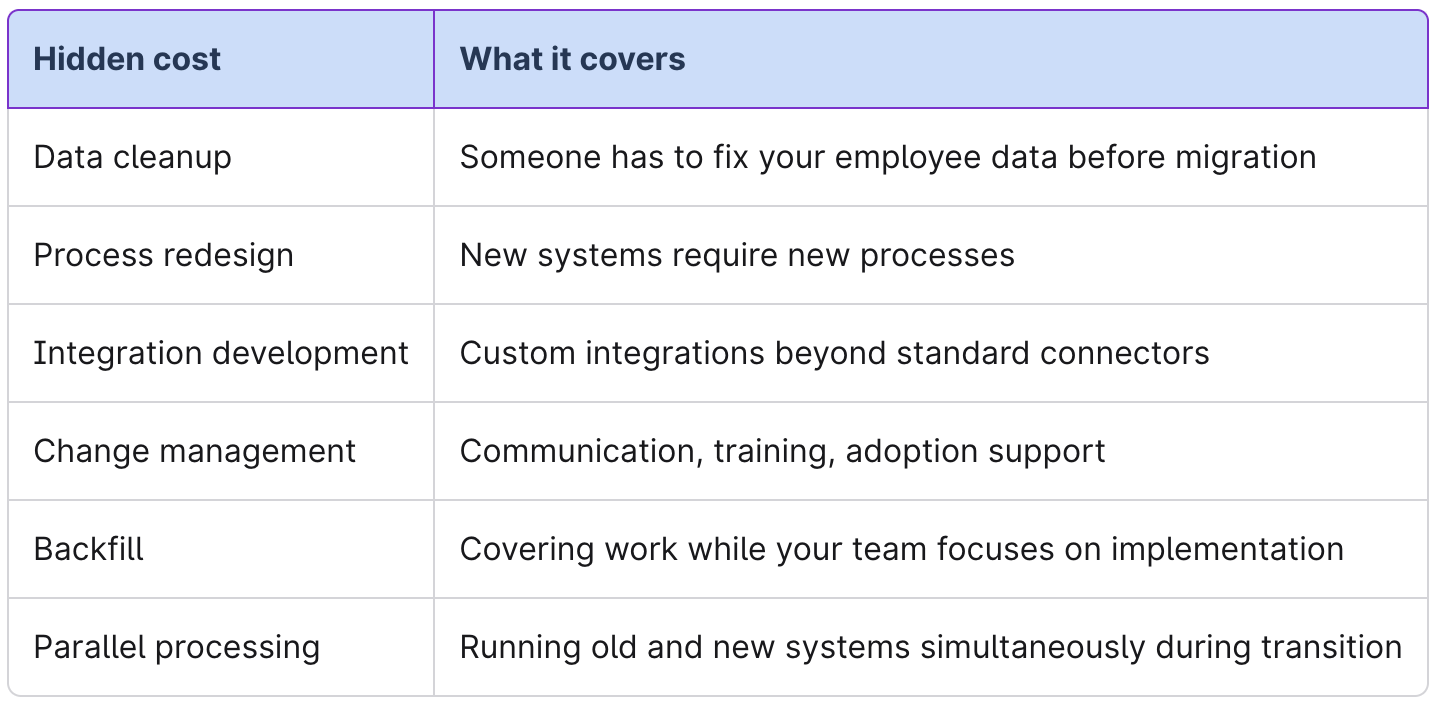
A $150K HRIS can easily require $50-100K in implementation investment beyond vendor fees.
Read our HRIS implementation guide
The Mid-Market HRIS Buying Checklist
Before you start your next HRIS evaluation, make sure you can check these boxes:
Preparation:
- [ ] Defined problems to solve (not just features to buy)
- [ ] Documented measurable outcomes for success
- [ ] Identified all stakeholders and their requirements
- [ ] Confirmed budget range and approval process
- [ ] Mapped internal buying windows and timeline constraints
Evaluation:
- [ ] Narrowed to 3-4 finalist vendors
- [ ] Created demo agenda with specific scenarios
- [ ] Built scorecard with weighted criteria
- [ ] Assigned evaluation team roles
Selection:
- [ ] Compared vendors on outcomes, not just features
- [ ] Checked references from similar companies
- [ ] Negotiated pricing and contract terms
- [ ] Got all commitments in writing
Implementation:
- [ ] Assigned dedicated project resources
- [ ] Built realistic implementation timeline
- [ ] Budgeted for hidden costs
- [ ] Planned training and change management
Why Mid-Market HRIS Selection Is Worth Getting Right
The difference between a successful HRIS implementation and a failed one compounds over years. A well-selected, well-implemented system saves hours every week, reduces errors, improves employee experience, and scales with your growth.
A poor selection creates ongoing frustration, workarounds, and eventually another expensive evaluation process.
The seven mistakes above are preventable. They require discipline, not expertise. Take the time to avoid them, and you'll join the minority of mid-market companies that actually get HRIS selection right.
Need Help With Your HRIS Evaluation?
OutSail has guided hundreds of mid-market companies through HRIS selection. We help you avoid these mistakes, run an efficient process, and select a platform that actually fits your needs.
Ready to start? Schedule a consultation


.png)
