Dayforce 2026: What's New in Ceridian's Flagship Platform
Ceridian is now Dayforce. See what's new in 2026: AI Workspace, 200+ country payroll, Thoma Bravo acquisition, and why Dayforce HCM dominates workforce management.

If you've searched for "Ceridian" lately, you've probably noticed something: the company now goes by Dayforce. The rebrand happened in February 2024, but the confusion lingers. Ceridian Dayforce, Dayforce HCM, Ceridian—they're all the same platform.
What's not the same? The pace of change. In the past 18 months, Dayforce has made aggressive bets on AI, expanded global payroll to 200+ countries, and been taken private by Thoma Bravo in a $12.3 billion deal. For organizations evaluating Dayforce—or already running it—here's what you need to know in 2026.
The Big News: Thoma Bravo Takes Dayforce Private
On February 4, 2026, private equity firm Thoma Bravo completed its acquisition of Dayforce for approximately $12.3 billion. Shareholders received $70 per share in cash, and Dayforce stock was delisted from the NYSE and Toronto Stock Exchange.
What this means for customers:
CEO David Ossip called it "a pivotal moment for Dayforce," positioning the company to "accelerate growth, customer value, and AI leadership" under private ownership. Thoma Bravo has a track record of acquiring enterprise software companies and investing heavily in product development.
For current and prospective customers, the key questions are:
- Will investment increase? Private equity often injects capital into product development. Dayforce's AI roadmap could accelerate.
- Will pricing change? PE firms also focus on profitability. Watch for potential price increases or packaging changes.
- Will service be affected? Some PE-backed software companies reduce support costs. Time will tell how Thoma Bravo approaches this.
The honest answer: it's too early to know. The acquisition just closed, and Dayforce's trajectory under private ownership will become clearer over the next 12-24 months.
For a full assessment of Dayforce's capabilities, see our complete Dayforce review.
Dayforce's Bold AI Bet: What's Actually Shipping
While every HCM vendor is talking about AI, Dayforce is betting bigger than most. They've built a 500+ person AI division and are rolling out capabilities designed to do more than chat—they're built to take action.
AI Workspace: The 2026 Flagship Feature
Announced at Dayforce Discover in October 2025, Dayforce AI Workspace represents the next evolution of their AI experience. Unlike traditional AI assistants that answer questions, AI Workspace is a collaborative environment where HR teams and AI work side-by-side on workforce challenges.
What AI Workspace enables:
- Compliance monitoring – Proactive alerts on regulatory changes with AI-enhanced impact analysis
- Employee action plans – Turns engagement survey data into actionable 30/60/90-day plans
- Performance coaching – AI-enabled role play and coaching support for managers
- HR analysis and reporting – Build dashboards and board-ready presentations collaboratively
- Employee milestones – Dynamic workspaces guiding employees through onboarding, role changes, and career moments
The key differentiator: AI Workspace runs on Dayforce's single data model, meaning AI has full context across HR, payroll, time, and talent—not just fragments from disconnected systems.
AI Workspace is available to new Dayforce customers starting in 2026.
AI Agents: Beyond Chat, Into Action
Dayforce AI Agents go beyond answering questions—they execute tasks. Current agents include:
- Pay Clarity agent – Handles payroll inquiries, identifies anomalies, provides real-time employee support
- People Analytics agents – Surfaces role-based insights across HR, pay, time, and talent data
- Content authoring agents – Generates compliant job descriptions, policy documents, and communications
- Time off and scheduling agents – Automates routine workforce management requests
The philosophy, as Chief Strategy Officer Joe Korngiebel put it: "We designed them to help organizations manage compliance, reduce friction, and propel their workforce forward. This is AI built for outcomes, not optics."
Strategic Workforce Planning
Dayforce also launched Strategic Workforce Planning, an AI-powered tool that helps HR leaders model future workforce scenarios using live organizational data. Think: skill inventories, labor costs, capacity constraints, and absenteeism patterns—all in one place.
HR leaders can simulate hiring freezes, seasonal fluctuations, or strategic pivots and visualize outcomes before committing resources. This builds on Dayforce's acquisition of Agentnoon, replacing spreadsheet-based planning with a unified, AI-assisted approach.
For a deeper dive into Dayforce's AI strategy, read our analysis: Dayforce's Bold AI Bet: Why Trust, Not Hype, Is Their Competitive Advantage.
Why Dayforce's AI Approach Is Different
Every vendor claims AI capabilities. Here's what sets Dayforce apart:
Governance First, Features Second
At Dayforce, every AI feature passes through a formal governance process before release. Chief AI Officer David Lloyd shared an example: a third-party call summarization tool was rejected in "20 seconds" because it couldn't confirm GDPR consent compliance.
"We never train our models on customer data without explicit contractual permission," Lloyd emphasized. "That's just non-negotiable."
AI by Choice
Dayforce makes every AI capability opt-in. Organizations control whether and where AI is enabled—down to specific states, provinces, or countries. This flexibility matters as AI regulations vary by jurisdiction and organizational comfort levels differ.
Single Data Model Advantage
Unlike vendors who've grown through acquisition and rely on integrations between separate systems, Dayforce has fully absorbed every product into a single, consolidated data model. This gives their AI something most competitors lack: clean, unified data across the entire HCM lifecycle.
As CEO David Ossip noted: "Foundational models require well-formed, comprehensive data—and Dayforce is unique in delivering this across the entire HCM lifecycle."
This architectural advantage explains why Dayforce can deploy AI capabilities that actually work—the "garbage in, garbage out" problem that plagues fragmented platforms simply doesn't exist.
Global Payroll: 200+ Countries and Counting
Dayforce has quietly built one of the most extensive global payroll networks in the industry, now covering 200+ countries and territories. This expansion came through strategic acquisitions:
- Excelity Global Solutions (2020) – Asian HCM capabilities
- Ascender HCM (2021) – Australia and APAC payroll
- ADAM Human Capital Management (2021) – Latin America, Brazil, and Caribbean markets (33 countries)
What this means in practice:
- Native payroll processing in major markets
- Unified user experience across countries
- Consolidated reporting for multinational organizations
- Local compliance expertise with global oversight
For companies operating across borders, Dayforce offers something rare: a single platform that handles both robust HCM functionality and global payroll without requiring a separate provider for most countries.
The hybrid approach option:
For countries where Dayforce doesn't process payroll natively, they've built partnerships and integrations with global payroll providers. This allows organizations to use Dayforce as their HCM system of record while connecting to specialized payroll where needed.
Workforce Management: Still the Crown Jewel
Dayforce's workforce management (WFM) capabilities remain best-in-class, particularly for organizations with:
- Hourly workforces – Retail, hospitality, healthcare, manufacturing
- Complex scheduling – Multiple locations, shift differentials, variable demand
- Union environments – Collective bargaining rules, seniority-based assignments
- Compliance-heavy industries – Predictive scheduling laws, meal/break requirements, overtime rules
What Makes Dayforce WFM Different
- Real-time, continuous calculations: Unlike platforms that batch-process payroll overnight, Dayforce calculates continuously. When a manager approves a timecard, the payroll impact is immediately visible. Employees can see accurate earnings at any time—not estimates.
- Dayforce Wallet (Earned Wage Access): Dayforce Wallet remains industry-leading, allowing employees to access earned wages before payday without payroll disruption. For industries with high turnover and hourly workforces, this feature has become a retention tool.
- AI-powered scheduling: Dayforce's scheduling algorithms balance business coverage needs with employee preferences, reducing conflicts and improving satisfaction. The system learns from historical patterns to predict demand and optimize labor costs.
Ideal Use Cases for Dayforce WFM
Dayforce continues to dominate in scenarios where workforce management complexity is high:
- Multi-location retail – Managing schedules across hundreds of stores with varying labor laws
- Healthcare systems – Credential tracking, shift differentials, fatigue rules, on-call scheduling
- Manufacturing – Union rules, piece-rate calculations, multiple pay rates per employee
- Hospitality – Tip pooling, tip credits, seasonal workforce fluctuations
If your organization has straightforward scheduling needs, Dayforce's depth may be more than you need. But if workforce management is your primary pain point, few platforms compete at this level.
Who Should Consider Dayforce in 2026?
Dayforce is a strong fit for:
- Enterprise organizations (1,000+ employees): The platform's cost and implementation complexity justify themselves at scale. You have the budget and resources to leverage the full feature set.
- Global operations: If you operate in multiple countries and need unified HCM with global payroll, Dayforce's 200+ country coverage reduces the need for separate providers.
- Complex workforce management needs: Healthcare, retail, manufacturing, and hospitality organizations with hourly workforces, compliance requirements, and scheduling complexity.
- Organizations prioritizing AI: If you want to be an early adopter of AI-powered HR capabilities with enterprise-grade governance, Dayforce's approach is among the most mature.
Dayforce may not be the best fit for:
- Small businesses (under 250 employees): The cost and implementation effort don't match simpler needs.
- Organizations with limited IT/HR resources: Dayforce implementations require dedicated expertise. If you're running lean, the learning curve may be too steep.
- Simple, single-country payroll: If your payroll is straightforward and domestic, Dayforce's global capabilities and WFM depth may be overkill.
Dayforce Pricing in 2026
Dayforce doesn't publish list pricing, but based on market data, expect:
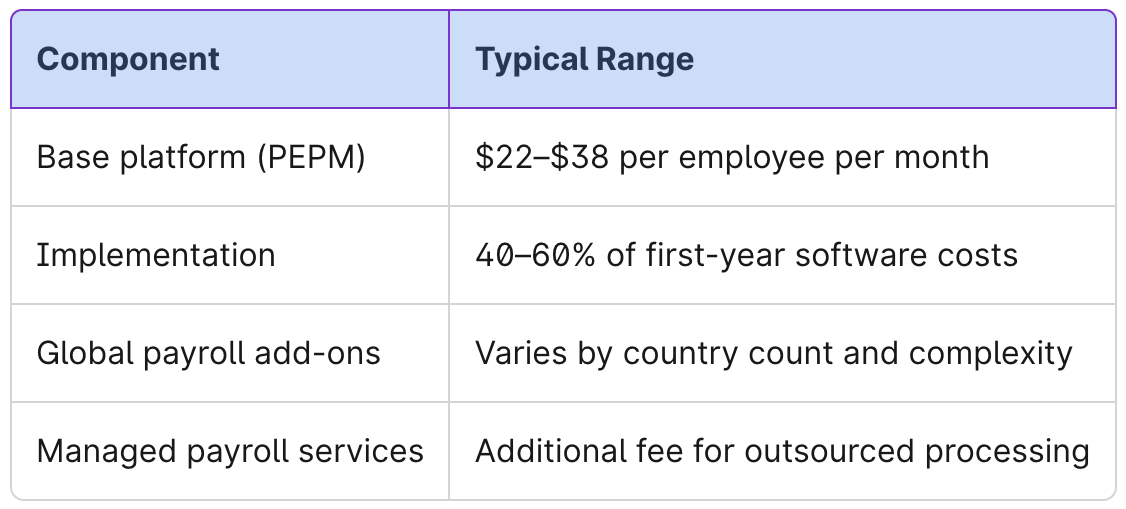
Pricing varies significantly based on:
- Number of employees
- Modules selected (HR, payroll, WFM, talent, benefits)
- Countries of operation
- Contract length
- Service tier
The Bottom Line: Dayforce in 2026
Dayforce enters 2026 with momentum: aggressive AI investment, expanded global capabilities, and the resources of private equity backing. The Thoma Bravo acquisition adds uncertainty about long-term direction, but also potential for accelerated product development.
Strengths to watch:
- AI Workspace and AI Agents represent genuine innovation, not just chatbot rebranding
- Global payroll coverage (200+ countries) reduces multi-vendor complexity
- Workforce management remains best-in-class for complex, compliance-heavy environments
- Single data model gives AI capabilities an architectural advantage
Concerns to monitor:
- Private equity ownership could mean pricing pressure or service changes
- Implementation timelines remain long (6+ months for complex deployments)
- The platform's depth creates a steeper learning curve than simpler alternatives
For organizations with the scale and complexity to leverage Dayforce's capabilities, it remains one of the most powerful HCM platforms available. For everyone else, simpler options may deliver better ROI.
Ready to Evaluate Dayforce?
OutSail has helped hundreds of companies evaluate Dayforce against alternatives. We can help you determine whether Dayforce fits your needs—and if so, how to negotiate the best deal. Schedule a consultation.
.png)
