Rippling vs Deel vs Remote: Which Global HR Platform Is Right for You?
Rippling vs Deel vs Remote compared. This global HR platform comparison breaks down EOR, payroll, and HRIS differences in a clear international HR software comparison.

The Rise of Global-First HR Platforms
The way companies build teams has fundamentally changed. Remote work, distributed teams, and international hiring have shifted from pandemic necessity to strategic advantage. But with this shift comes a new challenge: managing a global workforce across different countries, currencies, and compliance requirements. Three platforms have emerged as leaders in this space: Rippling, Deel, and Remote. Each promises to simplify global hiring, but they approach the problem from different angles.
Rippling brings the strongest full-suite HRIS capabilities, though their Employer of Record (EOR) and global payroll offerings are still maturing. Deel dominates in EOR and global payroll services and continues to strengthen their HRIS functionality, though gaps remain. Remote excels at EOR and global payroll while focusing on embedding their tools seamlessly with other HRIS platforms rather than building a wide-ranging HR suite. This guide will help you determine which platform aligns with your organization's specific needs.
Not Sure Which Global Platform Fits Your Needs?
Choosing between Rippling, Deel, and Remote can be overwhelming. OutSail's HRIS Marketplace lets you compare these platforms side-by-side based on your specific requirements—completely free.
→ Compare Global HR Platforms Now
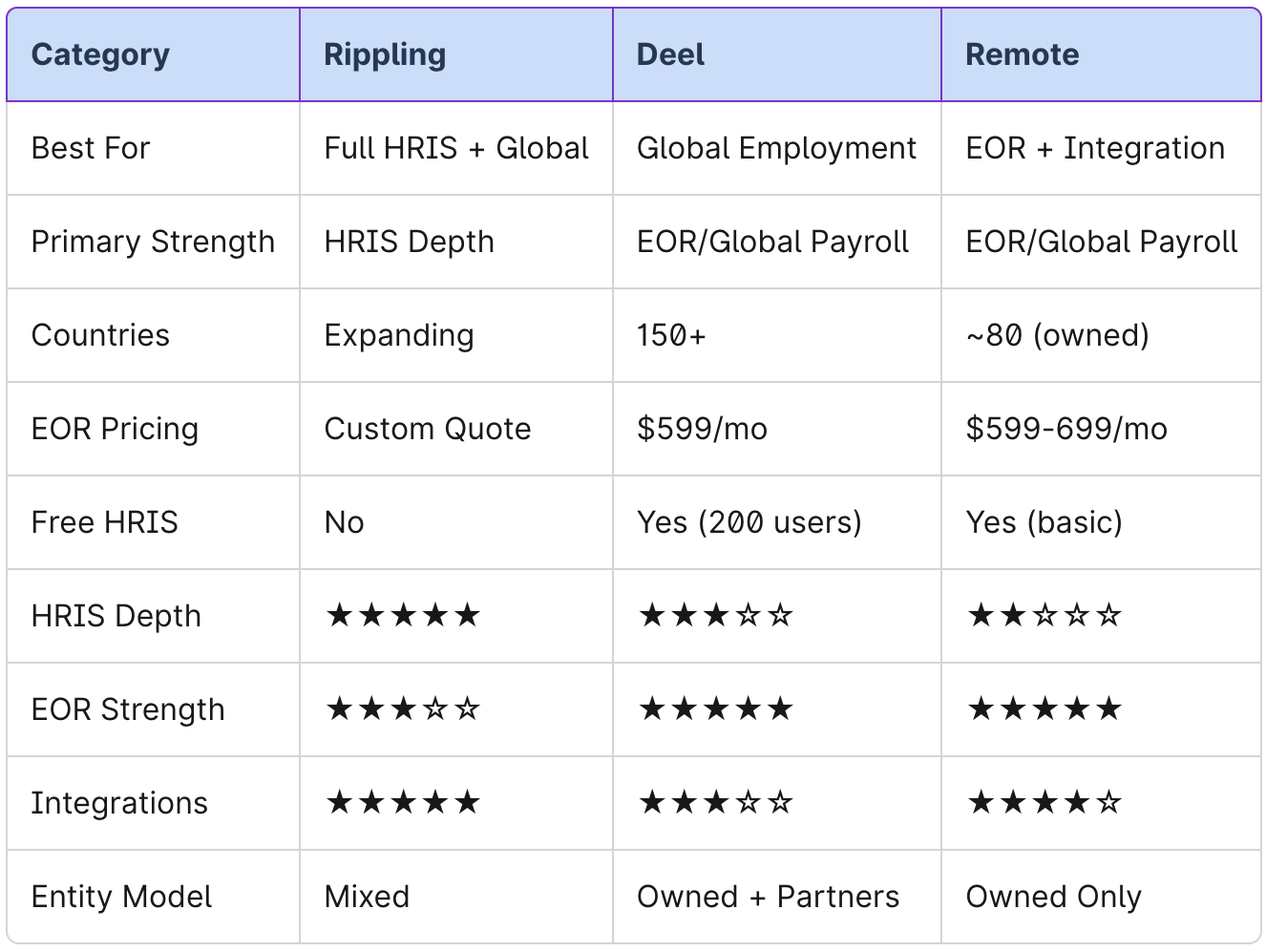
Quick Comparison: Rippling vs Deel vs Remote at a Glance
Rippling: The Full-Suite HRIS Leader
Founded in 2016 by Parker Conrad (former Zenefits CEO), Rippling has grown into one of the most valuable private companies in HR tech with a valuation exceeding $13 billion. Rippling's philosophy centers on being a unified platform for HR, IT, and Finance—not just another point solution. They've built a system where employee data flows seamlessly across every business function, from onboarding to device management to payroll.
Where Rippling Shines
Comprehensive HRIS Functionality
Rippling offers the deepest HRIS capabilities among these three vendors. Their platform covers the full employee lifecycle: recruiting, onboarding, payroll, benefits administration, time and attendance, performance management, and learning management. For companies that need a true all-in-one HR system (not just global employment), Rippling delivers functionality that Deel and Remote simply don't match.
Unmatched Integration and Automation
Rippling's integration marketplace is industry-leading, connecting with hundreds of third-party applications including Greenhouse, Lever, Carta, Pave, and many more. But integrations are just the beginning. Rippling's dynamic workflow builder allows you to create automated actions triggered by data from any connected system. When an employee is promoted in your performance tool, Rippling can automatically adjust their access permissions, update their compensation, and notify relevant stakeholders—without manual intervention.
IT and Device Management
Unlike Deel and Remote, Rippling extends beyond HR into IT management. The platform can order laptops, configure software access, manage single sign-on, and handle device security—all from the same system that runs your payroll. For companies where HR and IT collaboration is common (especially tech companies), this unified approach eliminates the friction of separate systems.
Modern User Experience
Rippling's interface reflects its Silicon Valley roots: clean, intuitive, and designed for the modern workforce. Employee self-service is a strength, with a mobile-first approach that mirrors the consumer apps people use daily. Onboarding flows are particularly impressive, guiding new hires through paperwork, benefits enrollment, and IT setup in a streamlined experience.
Where Rippling Falls Short
- Lighter Global Payroll and EOR: While Rippling has expanded into global employment, their EOR and international payroll capabilities aren't as mature as Deel's or Remote's. Rippling partners with third parties for EOR in many countries rather than owning entities directly, which can impact consistency.
- Country Coverage Gaps: Rippling's global reach is expanding but doesn't yet match Deel's 150+ countries or Remote's owned-entity approach. For companies hiring in less common markets, this may present limitations.
- Start-up Growing Pains: Despite rapid growth, some customers report that newer modules (like performance management) aren't as polished as the core platform. Implementation and support experiences can vary.
- Pricing Transparency: Rippling doesn't publicly disclose EOR pricing, requiring direct contact for quotes. This makes upfront comparison challenging.
Best Fit for Rippling
Rippling is ideal for companies that need a comprehensive HRIS with global capabilities as a secondary benefit. If you're primarily a US-based company looking to occasionally hire internationally while maintaining a robust domestic HR tech stack, Rippling offers the best of both worlds. Tech companies that value integration depth and IT management within HR will find Rippling particularly compelling.
Deel: The Global Employment Powerhouse
Founded in 2018, Deel has experienced explosive growth, reaching over $1 billion in annual recurring revenue and operating in 150+ countries. Deel started as a contractor management platform and evolved into a comprehensive global employment solution. Their acquisition of Safeguard Global's payroll division in 2024 further cemented their position as a leader in international payroll and compliance.
Where Deel Shines
Employer of Record Excellence
Deel's EOR service is among the most comprehensive in the industry. They now own entities in over 100 countries (up from relying more heavily on partners previously), allowing them to legally employ workers on your behalf without you setting up local subsidiaries. This means you can hire a developer in Portugal, a designer in Japan, and a sales rep in Brazil—all within days, not months.
Global Payroll at Scale
For companies with their own international entities, Deel's global payroll service handles the intricacies of multi-country payroll processing, tax compliance, and local regulations. Their platform processes payroll in local currencies, manages statutory deductions, and ensures compliance with each country's labor laws. The Safeguard Global acquisition expanded their payroll infrastructure substantially.
Contractor Management Mastery
As Deel's original strength, contractor management remains best-in-class. The platform handles locally compliant contracts, tax documentation (W-8BEN, W-9, etc.), and payments in 150+ currencies. Their 'Deel Shield' feature provides protection against worker misclassification—a growing concern as governments crack down on gig economy arrangements.
Free HRIS for Small Teams
Deel now offers a free HRIS for teams up to 200 employees, covering basic functionality like employee data management, time-off tracking, workflows, and analytics. While lighter than Rippling's full suite, this free tier makes Deel attractive for startups and small businesses building their first global team.
Compliance Infrastructure
Deel's compliance framework spans 90+ countries with AI-powered monitoring and a built-in knowledge library covering local labor laws. Their network includes partnerships with over 150 accounting and legal firms globally, providing in-country advisory services when needed. For companies nervous about international compliance risks, Deel offers peace of mind.
Where Deel Falls Short
- HRIS Depth Still Developing: While Deel has added HRIS capabilities (Deel HR, Deel Engage), they don't yet match the functionality of dedicated HRIS platforms like Rippling, BambooHR, or HiBob. Performance management, recruiting, and talent management modules are lighter.
- Premium Pricing: Deel's EOR service runs $599/month per employee—on the higher end of the market. Contractor management at $49/month is competitive but not the cheapest option available.
- Recent Reputation Challenges: The widely-publicized Rippling lawsuit alleging corporate espionage has raised questions about Deel's corporate practices. While the legal situation remains unresolved, some buyers report hesitation.
- Integration Ecosystem: While Deel integrates with popular tools like QuickBooks, Xero, and major HRIS platforms, their integration depth doesn't match Rippling's automation capabilities.
Best Fit for Deel
Deel is ideal for companies where global employment is the primary need rather than comprehensive HR functionality. Startups hiring their first international employees, remote-first companies building distributed teams across many countries, and organizations with substantial contractor workforces will find Deel's specialization valuable. If you already have a domestic HRIS and need a global employment layer on top, Deel fits well.
Remote: The Integration-First Global Platform
Founded in 2019 by former GitLab leaders, Remote has quickly established itself as a leading EOR provider with a distinctive approach: they only operate in countries where they fully own their legal entities. This strategy provides maximum control over service quality and compliance but limits their country coverage compared to competitors who use third-party partners.
Where Remote Shines
Owned-Entity Model
Remote's commitment to owning all their international entities (rather than partnering with third parties) differentiates them in the market. This direct model means consistent service quality across countries, no middleman markups, and full accountability for compliance. For companies prioritizing control and consistency over maximum country coverage, this approach resonates.
Competitive and Transparent Pricing
Remote offers some of the most competitive pricing in the EOR market, with rates starting around $599/month per employee (comparable to Deel) and contractor management at $29/month. Their pricing model is transparent and flat-rate, avoiding the percentage-of-salary pricing that some competitors use. No hidden fees, platform charges, or setup costs for most services.
HRIS Partnership Strategy
Rather than building a wide-ranging HRIS to compete with platforms like Rippling, Remote focuses on embedding their global employment tools into existing HRIS platforms. Their partnership with Gusto ('Gusto Global, powered by Remote') exemplifies this approach—Gusto customers can hire internationally through Remote without leaving their familiar platform. This strategy appeals to companies that already have an HRIS they love.
Intellectual Property Protection
Remote's 'IP Guard' feature provides specialized intellectual property protection across all jurisdictions. Employment contracts include IP clauses tailored to each country's legal framework—a particular concern for tech companies, creative agencies, and any business where employee-created IP is valuable.
Self-Service Implementation
Remote's platform is designed for quick, self-service implementation. Companies can onboard international employees in days rather than weeks, with streamlined workflows that guide users through country-specific requirements. This speed-to-hire advantage matters for fast-moving companies competing for global talent.
Where Remote Falls Short
- Limited Country Coverage: Operating in approximately 80 countries (compared to Deel's 150+), Remote's owned-entity model means they can't serve every market. If you need to hire in countries outside their coverage, you'll need an alternative solution.
- Narrower HRIS Functionality: Remote's free HRIS covers basics (employee records, time-off, expenses, org charts), but lacks the depth of Rippling or even Deel's Engage module. Performance management, recruiting, and advanced analytics require other tools.
- Email-Only Support: Customer support is primarily available via email, which can be frustrating for urgent issues. While their support team is knowledgeable, the lack of phone or live chat options is a drawback for some users.
- Less Brand Recognition: As a newer entrant compared to Deel's rapid rise, Remote has lower brand awareness. This can matter when stakeholders question vendor selection.
Best Fit for Remote
Remote is ideal for companies that want specialized EOR/global payroll services to complement an existing HRIS rather than replace it. Organizations that value the owned-entity model's consistency, prioritize IP protection, or already use Gusto for US HR will find Remote a natural fit. Companies hiring in Remote's covered countries who want straightforward, transparent pricing will appreciate their approach.
Head-to-Head: Key Decision Factors
Rippling vs Deel: Full Suite vs Global Specialist
The Rippling vs Deel comparison often comes down to what problem you're primarily solving. Rippling excels when you need a comprehensive HRIS that happens to support global employment. Deel wins when global employment is your primary challenge and HRIS is secondary. Rippling's integration depth and IT management capabilities have no equivalent in Deel's platform, but Deel's EOR infrastructure and country coverage exceed Rippling's global offerings.
Deel vs Remote: Global Giants Face Off
Deel vs Remote is a closer comparison since both focus on global employment. Deel offers broader country coverage (150+ vs ~80), a more developed HRIS layer, and stronger brand recognition. Remote counters with their owned-entity model (consistency over coverage), transparent pricing, and partnership approach that integrates with existing HR systems. Choose Deel for maximum geographic flexibility; choose Remote for consistency and integration with your current HRIS.
Rippling vs Remote: Different Philosophies
Rippling vs Remote represents fundamentally different approaches to the market. Rippling wants to be your single system for everything HR, IT, and increasingly Finance. Remote wants to be the best global employment layer that works alongside whatever other systems you choose. Neither approach is wrong—it depends on whether you prefer consolidated platforms or best-of-breed solutions. Rippling suits companies wanting to reduce vendor count; Remote suits those who already have systems they love.
Pricing Comparison: What to Expect
Global HR platform pricing varies based on services used, employee count, and country mix. Here are typical ranges:
Rippling
- Core HRIS: $8-15 per employee per month (PEPM)
- US Payroll: Additional $6-8 PEPM
- EOR/Global Services: Custom pricing (contact required)
Deel
- HRIS: Free for up to 200 employees (basic features)
- Contractor Management: $49/month per contractor
- Global Payroll: Starting at $29 PEPM
- EOR: $599/month per employee
Remote
- HRIS: Free (basic features)
- Contractor Management: $29/month per contractor
- Global Payroll: $29 PEPM
- EOR: $599-699/month per employee
Note: EOR pricing can vary by country due to local employment costs, benefits requirements, and regulatory burden. Always request country-specific quotes.
Making Your Decision: A Framework
Rather than declaring a single winner, consider which vendor aligns with your specific situation:
Choose Rippling if you need:
- A comprehensive HRIS covering the full employee lifecycle
- Deep integrations with third-party tools and workflow automation
- Combined HR and IT management in one platform
- Global hiring as a secondary capability to robust US HR
Choose Deel if you need:
- Maximum country coverage for EOR services (150+ countries)
- Strong contractor management for a global freelance workforce
- A free HRIS to get started with basic HR functionality
- Established global payroll infrastructure at scale
Choose Remote if you need:
- Consistent service quality through owned entities (no third parties)
- Strong IP protection for tech companies and creative businesses
- Integration with an existing HRIS (like Gusto) rather than replacement
- Transparent, competitive pricing with no hidden fees
Frequently Asked Questions
What is an Employer of Record (EOR)?
An Employer of Record is a third-party organization that legally employs workers on your behalf in countries where you don't have a legal entity. The EOR handles payroll, taxes, benefits, and compliance while you manage the employee's day-to-day work. This allows companies to hire internationally without setting up foreign subsidiaries—a process that typically takes months and costs tens of thousands of dollars per country.
Which platform is best for startups?
For early-stage startups hiring their first international team members, Deel or Remote typically offer the fastest path. Deel's free HRIS tier is attractive for small teams, while Remote's transparent pricing and self-service implementation suit resource-constrained organizations. Rippling becomes more compelling once you need comprehensive HR functionality beyond just global employment.
Can I use multiple platforms together?
Yes, and many companies do. A common setup uses Rippling or BambooHR as the core HRIS for US employees while using Deel or Remote specifically for international workers. Remote's partnership approach (like Gusto Global) is explicitly designed for this use case. The trade-off is managing multiple systems versus having a single source of truth.
How long does it take to hire through an EOR?
Most EOR providers can onboard employees within 1-3 weeks, depending on the country. Some straightforward markets (UK, Canada, Germany) can be as fast as 3-5 business days. Countries with more demanding documentation requirements or slower government processes may take longer. All three platforms offer faster time-to-hire than setting up your own foreign entity, which typically takes 3-6 months.
What happens if I want to convert an EOR employee to my own entity?
All three platforms support transitioning employees from EOR to your own legal entity when you're ready to establish local presence. This typically involves terminating the EOR employment relationship (following local laws) and rehiring the employee directly. The platforms can help coordinate this transition to minimize disruption to the employee.
Conclusion
The Rippling vs Deel vs Remote decision ultimately reflects your organization's priorities. Rippling delivers the most powerful full-suite HRIS with emerging global capabilities. Deel offers market-leading EOR and global payroll with improving HRIS features. Remote provides focused EOR excellence designed to complement your existing systems.
None of these platforms is universally 'best'—each serves different use cases exceptionally well. The right choice depends on whether you're solving for comprehensive HR functionality, maximum global coverage, or seamless integration with existing tools. Take time to evaluate demos, understand pricing for your specific country mix, and consider how your global hiring needs might evolve over the next few years.
Ready to Find Your Perfect Global HR Platform?
Stop spending hours researching vendors. OutSail's HRIS Marketplace lets you compare Rippling, Deel, Remote, and 50+ other HR platforms based on your specific requirements. Get matched with the right vendors, access verified pricing, and work with an advisor who's guided over 1,000 companies through this decision—all completely free.
What You Get with OutSail:
- Side-by-side vendor comparisons — See how platforms stack up on your priorities
- Verified pricing data — Know what you should expect to pay
- Expert guidance — Work with advisors who've seen 500+ HR software purchases annually
- Completely free — No cost, no catch, no preferred vendors

.png)
