How Much Does UKG Cost in 2026? UKG Ready vs UKG Pro Pricing Explained
UKG pricing for 2026: UKG Ready costs $25–33 PEPM for mid-market, UKG Pro runs $32–41 PEPM for enterprise. Full module breakdowns, implementation fees, competitor comparisons, and negotiation tips.

UKG (Ultimate Kronos Group) is one of the largest HR technology companies in the world, born from the 2020 merger of Ultimate Software and Kronos. The combined entity serves tens of thousands of organizations globally, with particular strength in workforce management, payroll, and industries with large hourly or shift-based workforces.
But UKG's pricing is opaque by design. The company doesn't publish rates, every quote is custom, and the two platforms — Ready and Pro — serve different markets at different price points. For buyers trying to budget before engaging with sales, this creates a frustrating information gap.
This guide fills that gap with the pricing benchmarks, module-level breakdowns, and negotiation context you need to evaluate a UKG quote accurately — whether you're looking at Ready, Pro, or trying to decide which platform fits your organization.
UKG's Pricing Model: How It Works
UKG charges on a flat per-employee-per-month (PEPM) basis for both Ready and Pro. This is one of UKG's strengths — the model is based on actual headcounts and is all-inclusive for the modules you've selected. You won't see per-paycheck charges, per-transaction fees, or surprise line items that inflate your monthly invoice.
Here's how the model is structured:
- Base HR module is typically required. Companies are generally expected to take UKG's core HR module as a foundation. Beyond that, the platform is modular — you choose which capabilities you need (payroll, time and attendance, scheduling, benefits administration, talent management, analytics) and each module contributes to your total PEPM rate.
- A la carte beyond the base. Unlike some vendors that force you into bundled packages, UKG lets you build a configuration that matches your priorities. Want core HR, payroll, and workforce management without talent modules? You can do that. Need the full suite including recruiting, performance, learning, and succession? You can add those individually.
- Volume-based pricing. Larger organizations negotiate lower per-employee rates. A 3,000-employee company on UKG Pro will pay a meaningfully lower PEPM than a 500-employee company on the same platform — sometimes 20–30% less per employee.
- Subscription billing. UKG charges on a quarterly or annual subscription basis, depending on contract terms. This makes cost forecasting straightforward once you've locked in your PEPM rate.
UKG Ready Pricing in 2026
UKG Ready is UKG's mid-market platform, designed for companies with approximately 200–2,000 employees. It combines core HR, payroll, time and attendance, scheduling, and talent management in a unified, cloud-based system built on a single database architecture.
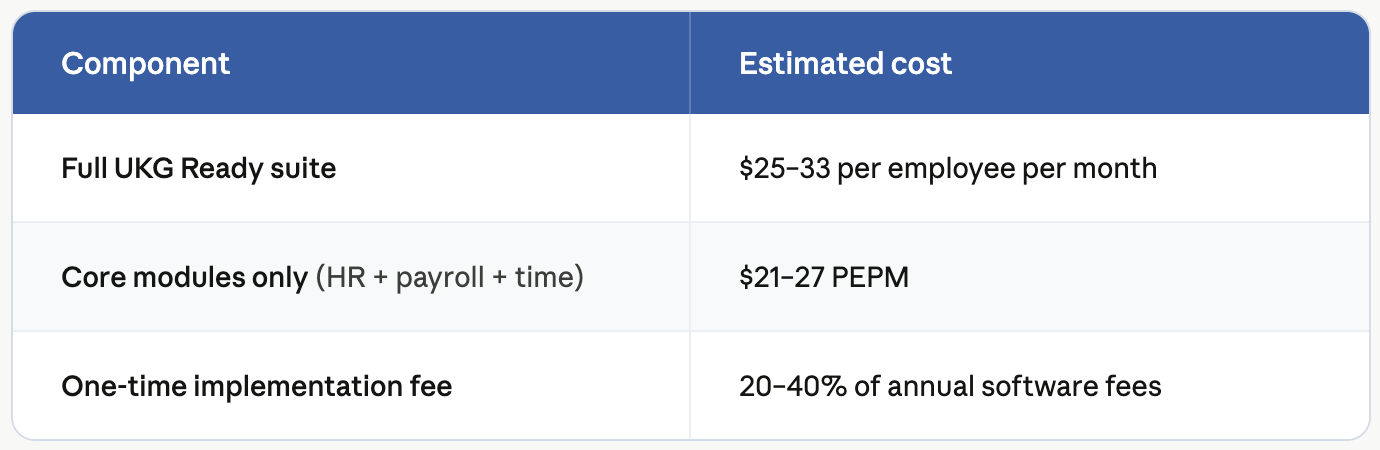
Example: 300-employee company on full UKG Ready suite
At $25–33 PEPM, annual software costs would run approximately $90,000–$118,800. Implementation fees at 20–40% of annual software would add roughly $18,000–$47,500 in year one. Total first-year investment: approximately $108,000–$166,000.
Example: 800-employee company on full UKG Ready suite
At the same PEPM range (likely toward the lower end for this headcount), annual software costs would be approximately $240,000–$316,800. Implementation fees would scale accordingly — expect $48,000–$127,000 depending on scope and whether you use UKG's team or a third-party implementation partner.
What's Included in UKG Ready
UKG Ready covers the core modules most mid-market companies need:
- Core HR — Employee records, compliance dashboards, document management, org charts
- Payroll — US, Canada, UK, and New Zealand payroll processing; tax filing and compliance
- Time & Attendance — Time tracking, clock-in/out (including biometric and geofencing options), overtime management, and labor cost allocation
- Scheduling — Shift scheduling, labor forecasting, schedule optimization
- Recruiting — Applicant tracking, job posting, candidate management
- Onboarding — New hire workflows, document collection, orientation management
- Benefits Administration — Enrollment, carrier connections, ACA compliance
- Performance Management — Reviews, goal tracking, feedback
- Compensation Management — Merit cycles, salary planning, promotion-based increases
- Learning Management — Training courses, compliance tracking
UKG Ready also supports global capabilities through UKG One View, enabling payroll processing in 160+ countries and supporting 20+ languages.
UKG Pro Pricing in 2026
UKG Pro is UKG's enterprise-grade HCM platform, designed for larger organizations with 750–25,000+ employees. It offers deeper configurability, more advanced analytics, and the most powerful workforce management tools in the industry — inherited from Kronos's decades of specialization in labor management and scheduling.
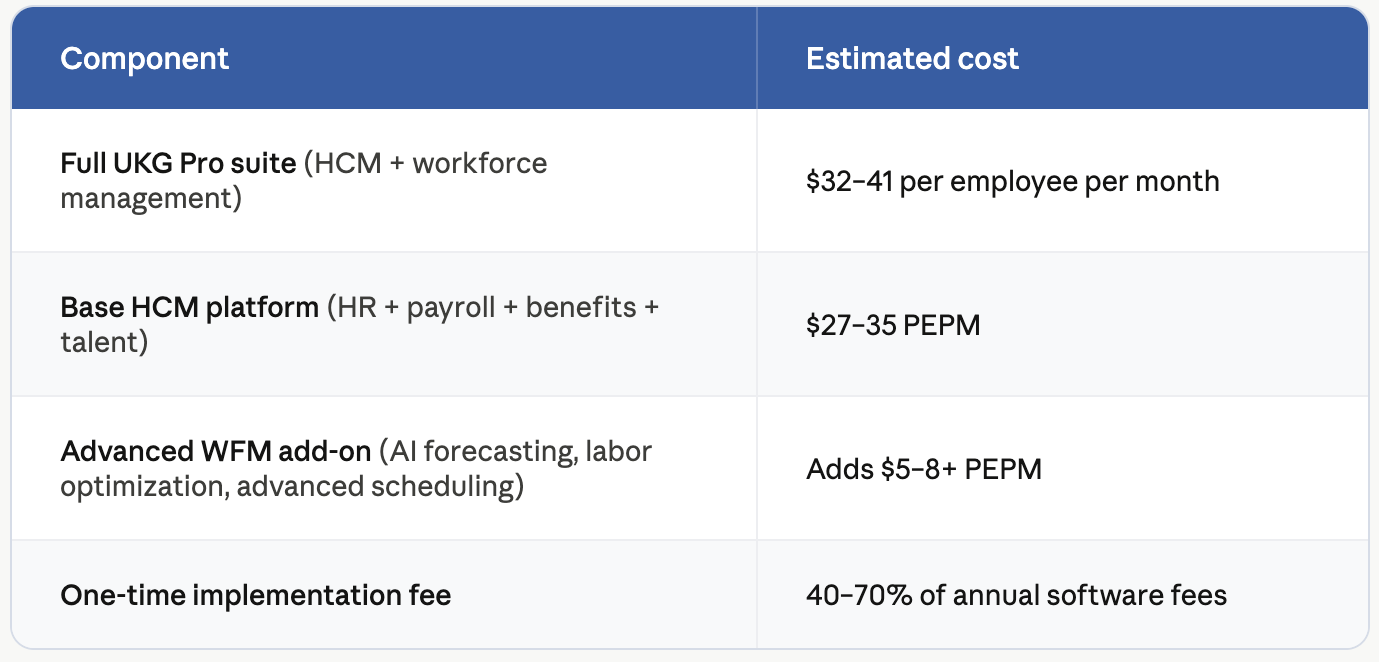
Example: 1,000-employee company on full UKG Pro suite
At $32–41 PEPM, annual software costs would run approximately $384,000–$492,000. Implementation fees at 40–70% would add $153,000–$344,000. Total first-year investment: approximately $537,000–$836,000.
Example: 3,000-employee company on UKG Pro with WFM
Larger deployments negotiate lower PEPM rates. At $30–36 PEPM (reflecting volume pricing), annual software costs would be approximately $1,080,000–$1,296,000. Implementation fees for a deployment of this scale can range from $300,000–$750,000+, especially when complex integrations, global payroll, and custom configurations are involved.
What's Included in UKG Pro (Beyond Ready)
UKG Pro includes everything in Ready plus:
- Advanced workforce management — AI-powered labor demand forecasting, schedule optimization, fatigue management, and compliance automation
- Succession management — Talent pools, career pathing, nine-box grids
- Compensation management — More advanced comp planning tools with modeling capabilities
- UKG Pro Workforce Management — The industry's most powerful WFM solution, with deep configurability for complex scheduling, labor law compliance, and labor cost optimization
- People analytics — AI-backed reporting, predictive analytics, and Employee Voice sentiment analysis
- Global payroll — Through UKG's acquisition of Immedis, Pro supports payroll in 160+ countries
- Community features — UKG Talk (employee resource groups, peer connection, mentorship)
- UKG Wallet — Earned wage access for employees
UKG Ready vs UKG Pro: Pricing Side-by-Side
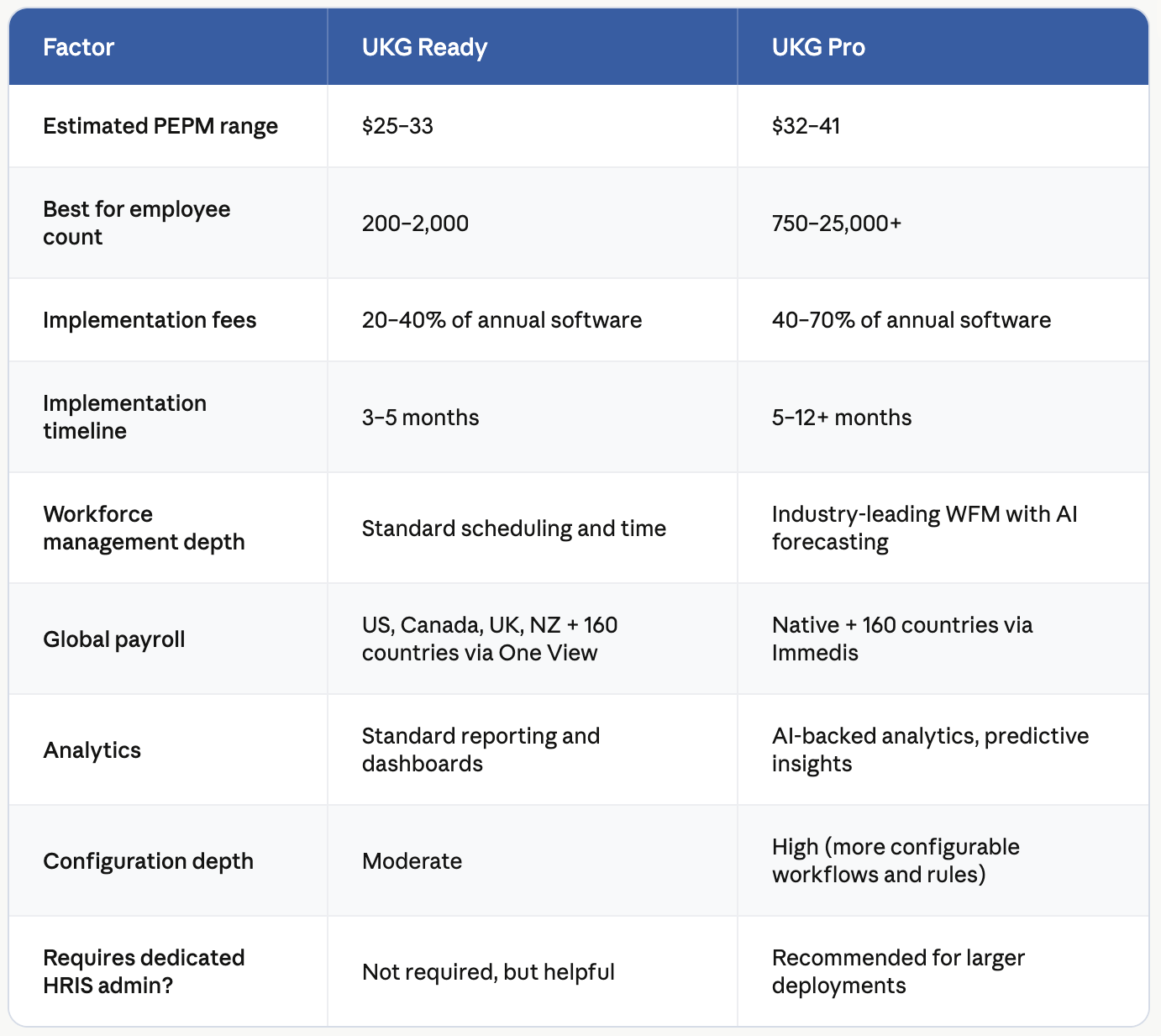
The key distinction: UKG Ready is a unified mid-market platform that balances breadth with ease of use. UKG Pro is a configurable enterprise platform that offers deeper functionality at a higher price point and longer implementation timeline. For a full feature-by-feature breakdown, see our UKG Ready vs UKG Pro comparison.
Where Additional Costs Can Show Up
UKG does a strong job of keeping its quoting process transparent. The flat PEPM model, all-inclusive module pricing, and headcount-based billing mean that what's in the quote is close to what you'll actually pay. That said, there are areas where total costs can extend beyond the base subscription:
Implementation Fees
This is the biggest variable in any UKG deal. UKG implementations are often partner-driven, meaning third-party system integrators (not just UKG's internal team) handle configuration, data migration, integration setup, and training. Partner rates vary widely:
- UKG Ready: $20,000–$100,000+ depending on company size and scope
- UKG Pro: $50,000–$500,000+ for full-suite enterprise deployments
For complex global deployments with multiple integrations and custom configurations, implementation consulting alone can exceed the first year of software fees. Always get a detailed implementation scope and timeline before signing — and consider engaging independent implementation support. For more on what to expect, see our implementation timelines guide.
Third-Party Implementation Partners
Many UKG deployments are managed by certified implementation partners rather than UKG's internal team. These partners bring specialized expertise (especially for industry-specific configurations), but their rates are separate from UKG's software fees. Budget for this independently and get multiple partner quotes.
Advanced Modules and Add-Ons
While UKG's base pricing is a la carte, some advanced capabilities — particularly around AI-powered analytics, advanced WFM features, and specialized compliance tools — may carry premium pricing above the standard PEPM range. Ask for a fully itemized module list with individual costs during the quoting process.
Annual Renewal Increases
Like most enterprise software vendors, UKG applies annual price increases at contract renewal. If your initial contract doesn't cap these increases, you could see 5–10% annual jumps. Negotiate a renewal cap (3–5% is standard) into your initial agreement.
Custom Integrations
UKG offers a Boomi-powered integration hub for Pro and pre-built integrations for Ready, but complex custom integrations with ERP systems, financial platforms, or specialized industry tools may require additional professional services and ongoing maintenance costs.
How UKG's Pricing Compares to Competitors
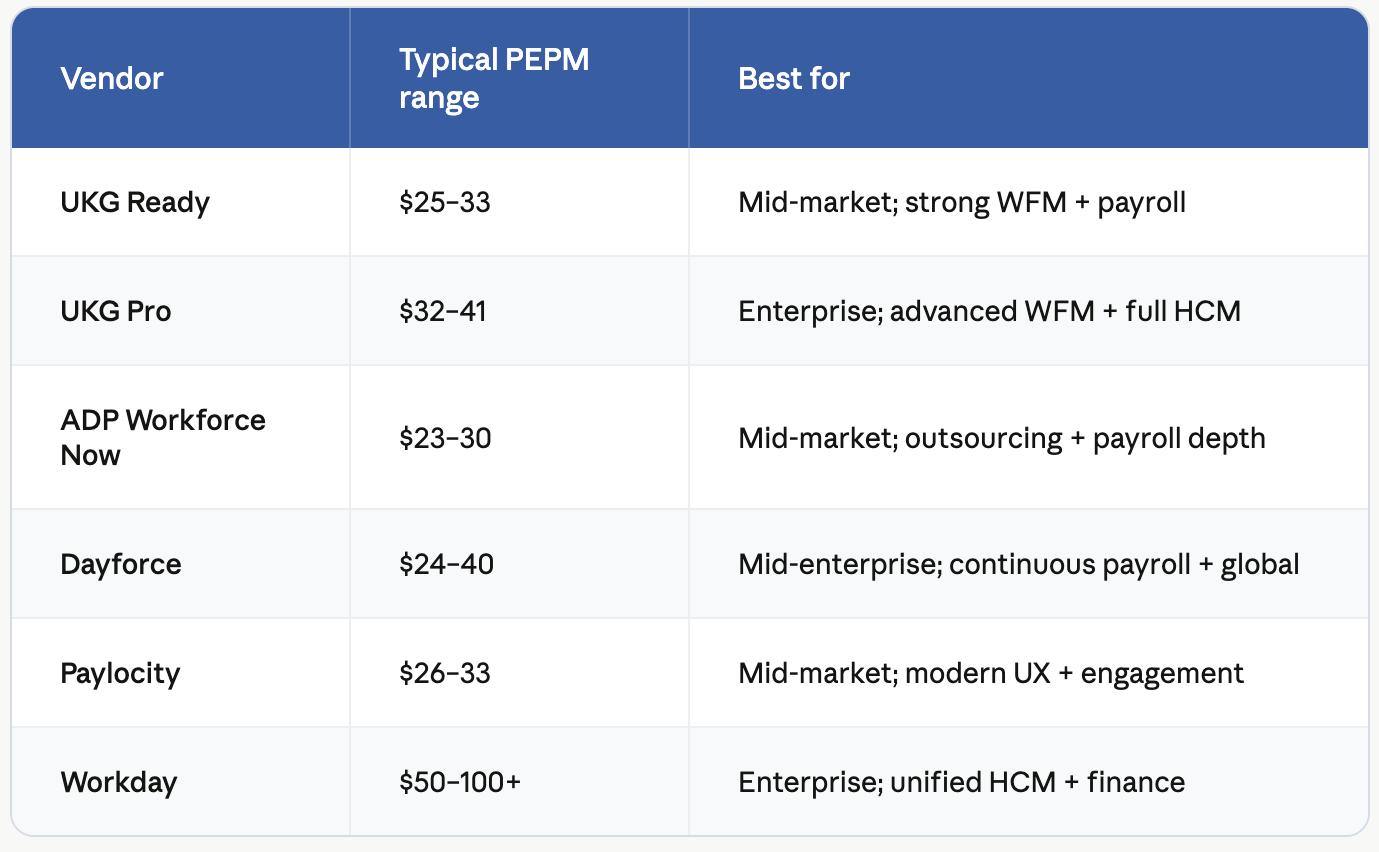
UKG Ready sits at the higher end of mid-market pricing but delivers workforce management depth that most competitors in this range can't match. For companies where scheduling, time tracking, and labor cost management are top priorities, the premium over ADP or Paylocity is often justified.
UKG Pro is priced below Workday but above Dayforce and ADP for most configurations. The value proposition centers on workforce management — if your organization has large hourly or shift-based populations, UKG Pro's WFM capabilities are among the best in the market at any price point.
For a full side-by-side with enterprise competitors, see our comparison of Workday vs UKG vs Dayforce vs ADP.
Negotiation Tips for UKG Buyers
Get Competing Quotes
UKG's pricing becomes more flexible when there's a competitive proposal from Dayforce, ADP, or Paylocity on the table. Even if UKG is your preferred vendor, having benchmark quotes from alternatives gives you leverage on PEPM rates and implementation fees.
Negotiate Implementation Separately
Don't assume the implementation fee is fixed. This is often the most negotiable part of a UKG deal. Some buyers reduce it by 30–50% by committing to a longer contract term or by bringing in a third-party implementation partner with lower rates.
Time Your Purchase
UKG's fiscal year runs calendar-year. Q4 (October–December) is when sales teams are pushing hardest to close annual targets. End-of-quarter timing (March, June, September, December) also creates urgency that benefits buyers.
Cap Renewal Increases
Make sure your contract specifies a maximum annual price increase — 3–5% is the standard range. Without a cap, you're exposed to unpredictable increases at each renewal cycle. This is one of the most commonly overlooked contract provisions and one of the most impactful over a multi-year agreement.
Commit to Multi-Year Terms Strategically
A 3-year commitment often unlocks better PEPM rates, but make sure the contract includes reasonable termination provisions (especially important given how quickly the HCM market evolves). For guidance on contract terms, see our HRIS contract negotiation guide.
Audit Your Module Selection
UKG's a la carte model means you can over-buy. Before signing, confirm that every module in your quote is something your team will actually implement and use within the first 12 months. It's better to start lean and add modules later than to pay for capabilities that sit dormant.
Frequently Asked Questions
How much does UKG Ready cost per employee?
Most mid-market companies pay between $25 and $33 per employee per month for the full UKG Ready suite. Core-only configurations (HR, payroll, and time) can run $21–27 PEPM. Implementation fees add 20–40% of your first-year software costs.
How much does UKG Pro cost per employee?
UKG Pro typically ranges from $32 to $41 per employee per month for the full HCM and workforce management suite. The base HCM platform without advanced WFM starts at $27–35 PEPM. Implementation fees are higher than Ready — expect 40–70% of annual software costs.
Does UKG have hidden fees?
UKG's pricing model is more transparent than many competitors. The flat PEPM structure is all-inclusive for selected modules, and there are no per-paycheck or per-transaction charges. The main areas where costs extend beyond the base quote are implementation (which can be substantial, especially for Pro), third-party implementation partner fees, annual renewal increases, and custom integration work.
Should I choose UKG Ready or UKG Pro?
It depends on your size and workforce management needs. UKG Ready is best for companies with 200–2,000 employees that want a unified mid-market platform with solid payroll and scheduling. UKG Pro is designed for organizations with 750–25,000+ employees that need enterprise-grade WFM, advanced analytics, and deeper configurability.
How long does a UKG implementation take?
UKG Ready implementations typically take 3–5 months. UKG Pro implementations range from 5–12+ months depending on scope, global payroll requirements, and integration work. Larger, more complex deployments can extend beyond 12 months, especially when advanced WFM configurations are involved.
Is UKG worth the premium over mid-market competitors?
If your organization has a large hourly or shift-based workforce where scheduling, labor cost management, and compliance tracking are top priorities, UKG's workforce management tools justify the premium. For companies with primarily salaried workforces and straightforward scheduling needs, more affordable mid-market platforms like Paylocity or ADP Workforce Now may deliver comparable value at a lower price point.
The Bottom Line on UKG Pricing
UKG earns points for a pricing model that's straightforward and predictable. The flat PEPM structure, all-inclusive module pricing, and headcount-based billing mean fewer invoice surprises than you'll find with many competitors. The a la carte approach also gives you control — you buy the modules you need and skip the ones you don't.
The key cost variable is implementation. UKG deployments — especially Pro — are among the more involved in the HCM space, and implementation fees can represent a substantial portion of your first-year investment. Budget carefully, get multiple implementation partner quotes, and build in contingency for timeline extensions.
UKG Ready at $25–33 PEPM is competitively priced for the depth of workforce management it delivers in the mid-market. UKG Pro at $32–41 PEPM is a premium offering, but for organizations with complex WFM needs, the investment in UKG's industry-leading scheduling and labor tools often pays for itself through reduced overtime, improved compliance, and better labor cost visibility.
If you're evaluating UKG alongside other platforms, OutSail can help. Our advisory team reviews hundreds of HRIS proposals each year and can tell you whether your quote is competitive — for free.
.png)
